
Chef Juliette
John Dory (St. Pierre)
John Dory has the delicacy of sole and the firmness of turbot. A light flouring, a quick butter sauté, and nut-brown beurre noisette show exactly why looks never mattered.
A cooking platform built around craft, culture, and the stories behind what we eat.
Created by Chef Juliette
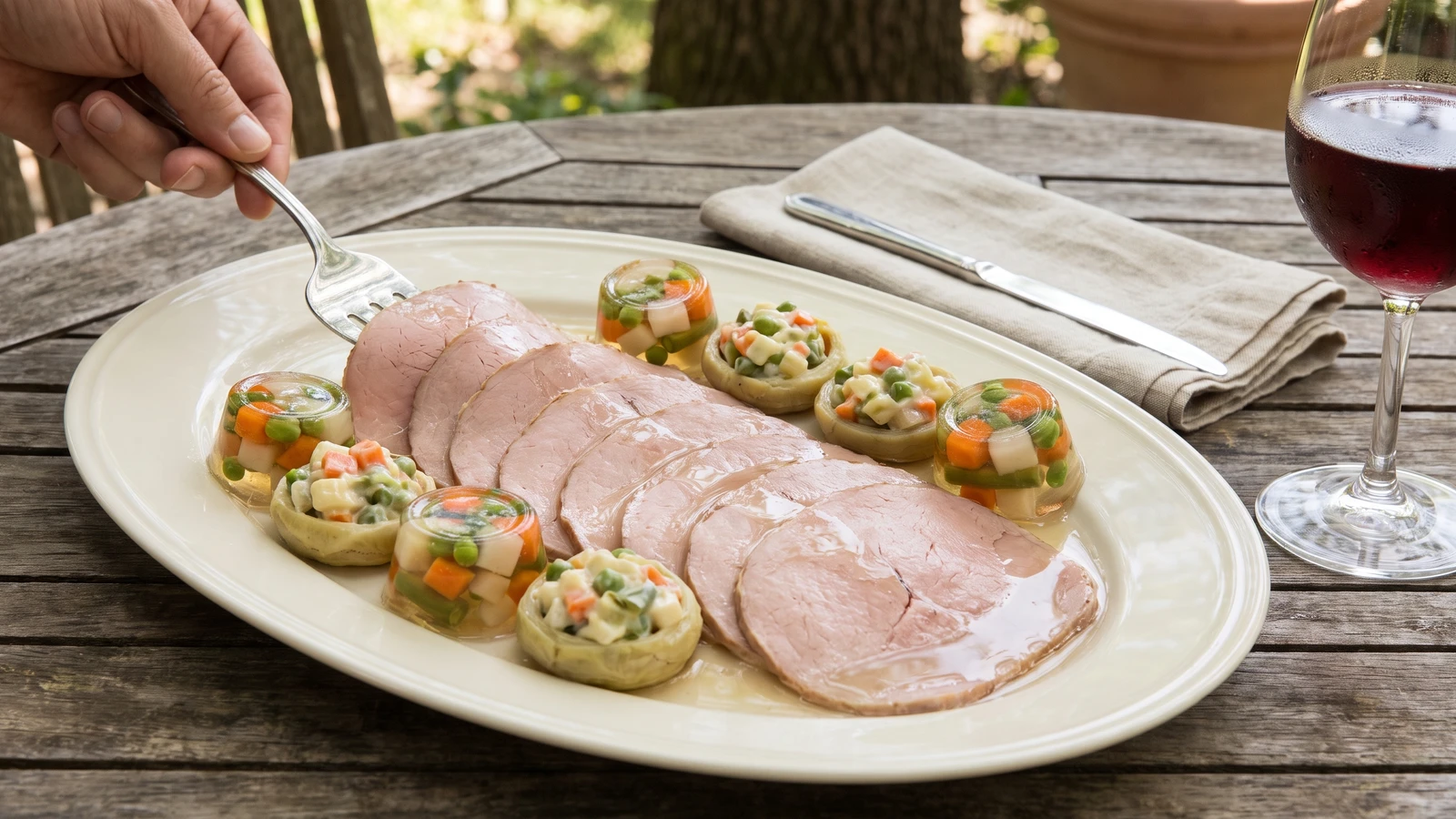
Based on No. 1205, Longes, Carrés et Noix de Veau Froids, from Le Guide Culinaire (1907) by Auguste Escoffier
Cold veal, cooked just rosy, glazed with crystal-clear aspic, and set among jewel-like macédoine, mayonnaise-bound artichokes, and jelly cubes: the French buffet translated for four.
Longes, Carrés et Noix de Veau Froids (cold veal loins, racks, and cushions) teaches the central rule of the cold table: cook the meat for the temperature at which it will be eaten. Cold mutes seasoning and exposes every dry fibre, so the veal must leave the oven while still succulent, then cool completely before a drop of aspic touches it.
The original entry assumed several full joints, a saucier on staff, a stockpot never off the fire, and a garde-manger ready with clarified aspic and ornamental salads. The salamander, for once, stayed idle. At home, choose one loin, boned carré, or noix for four people; clarify a modest quantity of good stock, set it with gelatin, and let the refrigerator handle the waiting. Multiple joints and brigade portions are scaffolding and can go. The juicy veal, transparent coating, macédoine, and border of clear jelly cubes are the dish and must stay.
For clean home service, the cold roast is sliced before glazing instead of being carved through a whole aspic shell at a buffet. That is the practical change, and nothing essential is lost. The step that decides the finish is simple: both veal and platter must be thoroughly cold, while the aspic must be liquid but thickened enough to cling.
Longes, carrés et noix de veau froids belong to the Parisian service froid, the grand cold-table repertoire that turned roasted joints into composed buffet dishes. The names preserve the butcher's distinctions between the loin, the ribbed carré, and the compact noix cut from the leg, although all received the same treatment once cold. Aspic was more than ornament: it protected the cut meat, carried seasoning at a temperature that dulls flavour, and displayed the clarity of the kitchen's stock in every cube.
Quantity
1 roast: 2 pounds (900 g) boneless, or 2½ pounds (1.1 kg) bone-in
trimmed and tied into an even shape
Quantity
3¼ teaspoons (16 ml / 20 g)
divided
Quantity
¾ teaspoon (4 ml / 1.5 g)
divided
Quantity
2 tablespoons (30 ml / 28 g)
Quantity
1 tablespoon (15 ml / 14 g)
Quantity
2 (about 100 g)
halved
Quantity
4 sprigs
Quantity
4 cups (960 ml / 960 g)
Quantity
2
Quantity
3 tablespoons (45 ml / 28 g)
Quantity
1 tablespoon (15 ml / 15 g)
Quantity
⅔ cup (160 ml / 100 g)
cut into 5 mm dice
Quantity
⅔ cup (160 ml / 100 g)
cut into 5 mm dice
Quantity
¾ cup (180 ml / 100 g)
cut into 5 mm pieces
Quantity
½ cup (120 ml / 75 g)
Quantity
4 (about 8 ounces / 225 g drained)
rinsed and dried
Quantity
1
Quantity
1 teaspoon (5 ml / 5 g)
Quantity
1 tablespoon (15 ml / 15 g)
Quantity
½ cup (120 ml / 110 g)
| Ingredient | Quantity |
|---|---|
| boneless center-cut veal loin, noix, or bone-in best-end carrétrimmed and tied into an even shape | 1 roast: 2 pounds (900 g) boneless, or 2½ pounds (1.1 kg) bone-in |
| fine sea saltdivided | 3¼ teaspoons (16 ml / 20 g) |
| finely ground white pepperdivided | ¾ teaspoon (4 ml / 1.5 g) |
| unsalted butter | 2 tablespoons (30 ml / 28 g) |
| neutral oil | 1 tablespoon (15 ml / 14 g) |
| large shallotshalved | 2 (about 100 g) |
| fresh thyme | 4 sprigs |
| very clear, fully defatted veal or chicken stock | 4 cups (960 ml / 960 g) |
| pasteurized egg whites | 2 |
| unflavoured powdered gelatin | 3 tablespoons (45 ml / 28 g) |
| white wine vinegar | 1 tablespoon (15 ml / 15 g) |
| carrotcut into 5 mm dice | ⅔ cup (160 ml / 100 g) |
| turnipcut into 5 mm dice | ⅔ cup (160 ml / 100 g) |
| green beanscut into 5 mm pieces | ¾ cup (180 ml / 100 g) |
| frozen petits pois | ½ cup (120 ml / 75 g) |
| cooked or jarred artichoke bottomsrinsed and dried | 4 (about 8 ounces / 225 g drained) |
| pasteurized egg yolk | 1 |
| Dijon mustard | 1 teaspoon (5 ml / 5 g) |
| fresh lemon juice | 1 tablespoon (15 ml / 15 g) |
| grapeseed or sunflower oil | ½ cup (120 ml / 110 g) |
Pat the veal dry and tie it at 4 cm intervals if the butcher has not already done so. Season it evenly with 1½ teaspoons (9 g) of the salt and ½ teaspoon (1 g) of the white pepper. Leave it uncovered in the refrigerator for at least 1 hour, then take it out while the oven heats to 375°F (190°C). An evenly shaped roast cooks evenly; any thin flap should be tucked underneath before tying.
Heat the butter and neutral oil in an ovenproof skillet over medium-high heat. When the butter foams, brown the veal on every side for 6 to 8 minutes, turning only when each surface is properly golden. Add the shallots and thyme, then transfer the skillet to the oven. Roast until the centre reaches 140°F (60°C), about 20 to 30 minutes for a boneless roast or 30 to 40 minutes for a bone-in carré. Begin checking early. The temperature should rise to 145°F (63°C) during the rest; waiting for that number in the oven gives cold veal that eats dry.
Move the veal to a clean rack and rest it for 20 minutes. Save the roasting juices for another sauce, but do not add them to the aspic because they will cloud it. Once the roast is no longer hot, refrigerate it uncovered for 1 hour, then cover loosely and chill for at least 3 more hours. Do not wrap warm veal tightly; trapped moisture softens the browned surface and encourages the aspic to slide.
Reserve ¾ cup (180 ml) of the cold stock for blooming the gelatin. Whisk the egg whites lightly into the remaining cold stock in a saucepan, then heat slowly while stirring the bottom until soft curds begin to rise. Stop stirring as soon as a raft forms. Make a small opening in the raft and hold the stock at the barest simmer for 15 minutes, ladling a little liquid through the opening now and then. Strain through a fine sieve lined with damp cheesecloth without pressing. Pressing squeezes every captured impurity back into the stock. If the liquid is not perfectly bright, pass it through fresh damp cloth once more.
Sprinkle the gelatin evenly over the reserved cold stock and leave it for 10 minutes to swell. Warm the clarified stock without boiling, then whisk in the bloomed gelatin until completely dissolved. Add the white wine vinegar, ½ teaspoon (3 g) of salt, and a pinch of white pepper. Set a spoonful in the freezer for 5 minutes and taste it cold. It should be savoury and gently sharp, because cold dulls seasoning. Adjust now. Pour 1½ cups (360 ml) into a shallow dish to make the jelly cubes and chill until firm, about 2 hours. Reserve the rest for the macédoine, mayonnaise, and glaze; if it sets before use, melt it gently over warm water.
Bring a saucepan of water to a boil with ¾ teaspoon (4.5 g) of salt. Add the diced carrot and turnip and cook for 3 minutes, then add the green beans for 2 minutes and the petits pois for the final minute. The Macédoine should be tender but still distinct, not cooked into one soft mixture. Drain immediately, cool in ice water, then drain again and spread the vegetables on a towel until thoroughly dry. Water left on them weakens and clouds the jelly.
Reserve ¾ cup (about 120 g) of the cooked vegetables for the small salads. Rinse four 4-ounce ramekins with cold water and shake them dry. Mix the remaining vegetables with ¾ cup (180 ml) of liquid aspic, divide among the ramekins, and chill until firm, about 90 minutes. If the vegetables float, chill the mixture for 10 minutes until the aspic begins to thicken, stir once, and return it to the molds. Ça se rattrape.
Whisk the egg yolk with the Dijon mustard, lemon juice, ¼ teaspoon (1.5 g) of salt, and a pinch of white pepper. Add the oil drop by drop until the emulsion catches, then pour it in a thin steady thread while whisking until the mayonnaise is firm and glossy. If it breaks, put 1 teaspoon of cold water in a clean bowl and whisk the broken mayonnaise into it a spoonful at a time. When smooth, whisk in 3 tablespoons (45 ml) of cooled but still liquid aspic. This mayonnaise collée, mayonnaise lightly set with clear jelly, is the home-sized form of the entry's cleared mayonnaise.
Fold the reserved Macédoine into enough mayonnaise collée to bind the vegetables without burying their colours. Spoon the small salads into the dried artichoke bottoms and shape neat rounded tops. Chill for at least 45 minutes so the mayonnaise collée gains enough body to hold on the platter.
Remove the strings from the thoroughly chilled veal and cut it across the grain into slices about 8 mm thick. Arrange them in an overlapping fan on a cold oval platter and blot away any surface moisture. Cool about ½ cup (120 ml) of melted aspic over ice until it has the consistency of light syrup, then brush a thin coat over the veal. Chill for 5 minutes and repeat twice. If the aspic runs straight onto the platter, it is too warm; chill it until slightly thickened and begin again. If it sets in the bowl, warm it gently. The coat should be transparent and glossy, never heavy or rubbery.
Dip each Macédoine mold in warm water for 2 seconds, loosen the edge with a fingertip, and turn it onto the platter beside the veal. Arrange the filled artichoke bottoms between the molds. Cut the firm aspic from the shallow dish into clear 1.5 cm cubes and border the entire platter generously, as the source requires. Keep the finished dish cold, then let it stand for 10 minutes before serving so the veal loses its refrigerator chill without softening the jelly. One cook, one stove, one splendid cold table. À table!
1 serving (about 580g)
Culinary guides, cultural storytelling, and the editorial depth that makes cooking meaningful.
Discover Culinary ExplorerChef Juliette
John Dory has the delicacy of sole and the firmness of turbot. A light flouring, a quick butter sauté, and nut-brown beurre noisette show exactly why looks never mattered.

Chef Juliette
Fresh haddock proves its delicacy in the meunière pan: a fine flour crust, moist pearly flakes, and beurre noisette sharpened with lemon and parsley, ready from one skillet in half an hour.
Chef Juliette
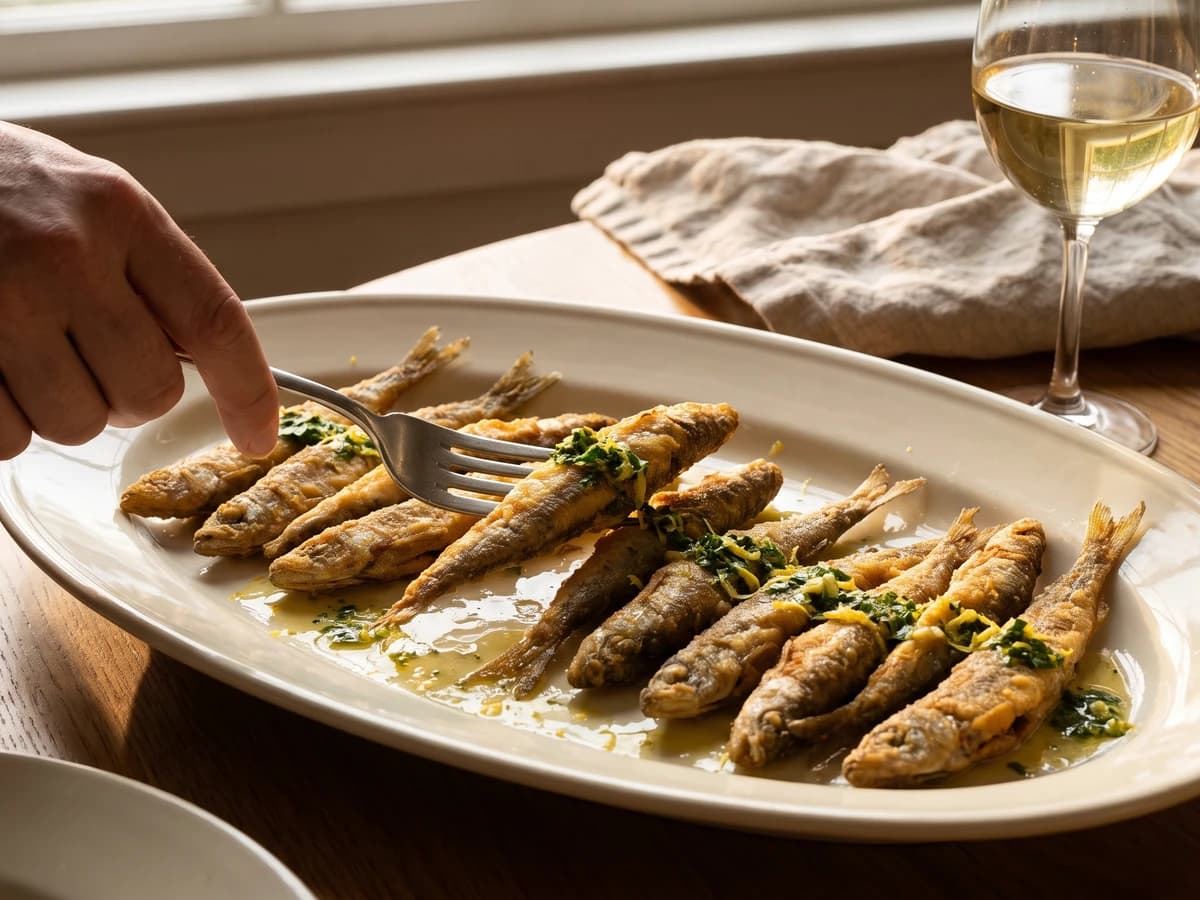
Éperlans à l’Anglaise turns small fish into a lesson in disciplined coating: boned smelts under a close, crisp crumb, pan-fried in clarified butter and finished with bright, half-melted maître d’hôtel butter.

Chef Juliette
Tiny smelts, shallot, mushrooms, white wine, gratin sauce, and fine bread raspings meet a fierce oven, where the fish must turn tender in the same breath the buttered crust bronzes.