
Chef Juliette
John Dory (St. Pierre)
John Dory has the delicacy of sole and the firmness of turbot. A light flouring, a quick butter sauté, and nut-brown beurre noisette show exactly why looks never mattered.
A cooking platform built around craft, culture, and the stories behind what we eat.

Created by Chef Juliette
Based on No. 1201, Noix de Veau en Surprise à la Pithiviers, from Le Guide Culinaire (1907) by Auguste Escoffier
Noix de veau becomes its own serving case, holding whole stuffed quail, minced mushroom, truffle, and glossy demi-glace, then revealing the tender veal sliced around it at the table.
Noix de Veau en Surprise à la Pithiviers aux Cailles (braised cushion of veal hiding whole stuffed quail) teaches architectural cooking: the roast is both meat and serving case. The one true thing to know before touching a pan is that the veal must finish tender enough to slice yet firm enough to survive hollowing. Leave sound walls and the surprise reaches the table intact.
The original kitchen assumed a saucier on staff, a stockpot never off the fire, prepared game essence, fifteen larks, and enough hands to braise, hollow, slice, stuff, sauce, and hold everything warm at once. For one cook, one stove, one evening, four whole quail replace the larks and are named honestly in the title. Prepared veal demi-glace supplies the classical foundation, while the fond left by browning the quail gives it the game scent. A salamander contributes nothing here; a covered braise and a properly hot oven are the honest home tools.
Separate game-essence production and brigade-scale holding are scaffolding and can go. Browning and braising the noix, keeping the birds whole and unboned, frying raw minced mushroom and truffle with them, binding the garnish with demi-glace, sealing the cap with farce mousseline, and surrounding the case with its own sliced meat must stay. The hollowing decides the dish, so cut slowly and keep the walls generous.
The name points to Pithiviers in the Loiret, where enclosed pies and pâtés of small birds, particularly larks, belonged to the local table long before the town's almond pastry became the better-known namesake. In this grand-kitchen interpretation, the enclosure is not pastry but a braised noix de veau hollowed into a case for game, mushrooms, truffle, and demi-glace. The canon permits quail or thrush in place of larks but insists that the title name the bird, which is why this version is aux cailles.
Quantity
1 roast, about 3 lb (1.35 kg)
tied into a neat oval
Quantity
2½ teaspoons (12.5 ml / 15 g)
divided
Quantity
¾ teaspoon (3.75 ml / 1.5 g)
divided
Quantity
6 tablespoons (90 ml / 85 g)
divided
Quantity
1 cup (240 ml / 150 g)
diced
Quantity
¾ cup (180 ml / 100 g)
diced
Quantity
½ cup (120 ml / 120 g)
Quantity
2½ cups (600 ml / 600 g)
Quantity
1
Quantity
⅓ cup (80 ml / 60 g)
finely diced
Quantity
1 tablespoon (15 ml / 15 g)
Quantity
2 tablespoons (30 ml / 30 g)
Quantity
4 quail, about 4½ oz (130 g) each
left unboned
Quantity
½ cup (120 ml / 60 g)
finely minced
Quantity
3 tablespoons (45 ml / 23 g)
finely minced
Quantity
1 cup (240 ml / 250 g)
at spoon-coating consistency
| Ingredient | Quantity |
|---|---|
| boneless veal noix or compact top-round roasttied into a neat oval | 1 roast, about 3 lb (1.35 kg) |
| fine saltdivided | 2½ teaspoons (12.5 ml / 15 g) |
| ground white pepperdivided | ¾ teaspoon (3.75 ml / 1.5 g) |
| unsalted butterdivided | 6 tablespoons (90 ml / 85 g) |
| yellow oniondiced | 1 cup (240 ml / 150 g) |
| carrotdiced | ¾ cup (180 ml / 100 g) |
| dry white wine | ½ cup (120 ml / 120 g) |
| unsalted veal stock | 2½ cups (600 ml / 600 g) |
| bouquet garni of parsley stems, thyme, and bay | 1 |
| very cold chicken breastfinely diced | ⅓ cup (80 ml / 60 g) |
| lightly beaten egg white | 1 tablespoon (15 ml / 15 g) |
| very cold heavy cream | 2 tablespoons (30 ml / 30 g) |
| whole oven-ready quailleft unboned | 4 quail, about 4½ oz (130 g) each |
| raw button mushroomsfinely minced | ½ cup (120 ml / 60 g) |
| raw black trufflefinely minced | 3 tablespoons (45 ml / 23 g) |
| prepared veal demi-glace, or half-glazeat spoon-coating consistency | 1 cup (240 ml / 250 g) |
Chill a mini-processor bowl and blade for 10 minutes. Process the cold chicken with a small pinch each of the measured salt and white pepper until it becomes smooth and tacky. Add the egg white, then pour in the cold cream gradually while the machine runs. This is farce mousseline, a smooth poultry forcemeat, and temperature is its discipline. If it turns shiny, loose, or greasy, stop and chill the bowl for 10 minutes before pulsing again. Ça se rattrape. Refrigerate the farce immediately.
Heat the oven to 325°F (165°C). Pat the veal dry, then season it with about two-thirds of the remaining salt and pepper. Melt half the butter in a snug heavy casserole over medium-high heat and brown the veal deeply on every side, allowing 10 to 12 minutes. Lift it out, add the onion and carrot, and cook until their edges take colour. Pour in the wine and scrape up the fond, then reduce by half. Return the veal, add the stock and bouquet garni, cover, and braise for 75 to 95 minutes, turning once, until the centre reaches 145°F (63°C). Keep the liquid at a quiet tremble. A hard boil tightens the meat and weakens the case.
Rest the veal for 15 minutes. Strain the braising liquid into a saucepan, skim away excess fat, and boil it down to 1 cup (240 ml). Cut a neat oval cap about ¾ inch (2 cm) thick from the top of the veal. With a narrow knife and spoon, remove the centre while leaving walls at least ⅝ inch (1.5 cm) thick and a base about ¾ inch (2 cm) thick. Slice the removed meat thinly across the grain and cover it with ½ cup (120 ml) of the hot reduced jus. If the knife nicks a wall, press a thin scrap of veal over the cut from inside with a dab of cold farce mousseline. Ça se rattrape.
Raise the oven to 375°F (190°C). Season the quail lightly inside and out with the remaining salt and pepper. Put one rounded teaspoon of cold farce mousseline, about the size of a hazelnut, into each bird without packing the cavity tight. Reserve the remaining farce for sealing. Melt the remaining butter in a wide skillet and brown the whole, unboned quail on every side over medium heat. After 6 minutes, add the raw minced mushrooms and truffle around them. Continue turning and basting until the birds are evenly bronzed and the thickest part of a thigh reaches about 155°F (68°C), another 4 to 6 minutes.
Lift the quail onto a warm plate. Add the demi-glace and ¼ cup (60 ml) of the reduced veal jus to the skillet, scraping every browned trace of quail into the sauce. Simmer gently until the mushroom and truffle garnish coheres in a glossy sauce that coats the back of a spoon. Return the quail and roll them through it. If butter separates around the edges, remove the pan from the heat and whisk in a tablespoon of cool veal jus. Ça se rattrape. The demi-glace must bind the garnish, not drown it.
Set the hollowed veal case in a shallow buttered baking dish. Spoon a little mushroom-truffle sauce into the bottom, arrange the four quail snugly inside, and pack the remaining garnish around them. Stir the reserved farce mousseline with 1 to 2 teaspoons of warm jus until nearly fluid but still able to cling. Paint a continuous line of it around the cut rim and replace the veal cap. If the cap will not sit flat, remove a spoonful of garnish rather than forcing it; pressure splits the walls.
Bake the filled case for 10 to 14 minutes. The original brief finish suited tiny larks; the named quail need enough time for both the stuffing in a bird and the forcemeat seam to reach 165°F (74°C). If the cap colours too quickly, lay a piece of parchment loosely over it. If the seam opens, brace the cap with short wooden picks and finish cooking before spooning any escaped sauce back into the case.
Warm an oval serving platter. Arrange the sliced veal in overlapping folds around its edge and moisten the slices with their hot jus. Set the filled case in the centre, remove any wooden picks, and glaze its surface lightly with the final spoonfuls of reduced jus. Carry it to the table with the cap in place, then lift the cap before serving one quail and several veal slices to each guest. À table!
1 serving (about 520g)
Culinary guides, cultural storytelling, and the editorial depth that makes cooking meaningful.
Discover Culinary ExplorerChef Juliette
John Dory has the delicacy of sole and the firmness of turbot. A light flouring, a quick butter sauté, and nut-brown beurre noisette show exactly why looks never mattered.

Chef Juliette
Fresh haddock proves its delicacy in the meunière pan: a fine flour crust, moist pearly flakes, and beurre noisette sharpened with lemon and parsley, ready from one skillet in half an hour.
Chef Juliette
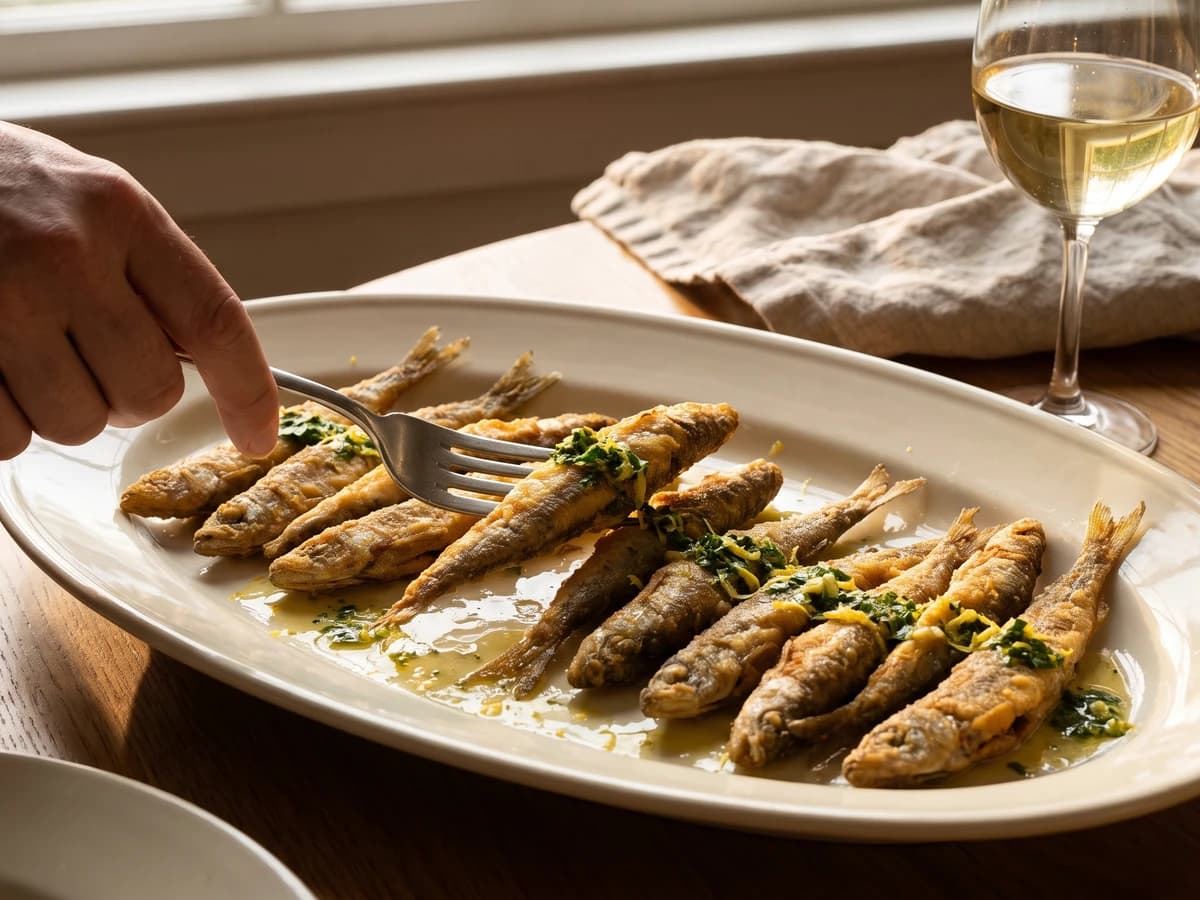
Éperlans à l’Anglaise turns small fish into a lesson in disciplined coating: boned smelts under a close, crisp crumb, pan-fried in clarified butter and finished with bright, half-melted maître d’hôtel butter.

Chef Juliette
Tiny smelts, shallot, mushrooms, white wine, gratin sauce, and fine bread raspings meet a fierce oven, where the fish must turn tender in the same breath the buttered crust bronzes.