
Chef Juliette
John Dory (St. Pierre)
John Dory has the delicacy of sole and the firmness of turbot. A light flouring, a quick butter sauté, and nut-brown beurre noisette show exactly why looks never mattered.
A cooking platform built around craft, culture, and the stories behind what we eat.

Created by Chef Juliette
Based on No. 1197, Cushion of Veal (Relevés), from Le Guide Culinaire (1907) by Auguste Escoffier
A veal relevé scaled for four: the fat-capped haunch joint takes two stock glazes, a careful oven braise, and a brief broiler lacquer, yielding rosy slices and an incomparable gravy.
Noix de veau braisée (braised cushion of veal) teaches braisage des viandes blanches, white-meat braising: build a gelatinous coat before the main cooking, then stop the instant the young meat is done. This is not a stew cooked to surrender. It is a roast-braise, lacquered outside, pale and juicy within, with a gravy drawn from the joint itself.
The brigade formula assumed an enormous haunch muscle served as a relevé, a saucier reducing ladles from stock never off the fire, hands available for constant basting, and a salamander to set the final glaze. For four, use a 3-pound boneless inside leg in a snug Dutch oven, keep prepared brown veal stock warm on a back burner, baste it yourself, and finish beneath the broiler. If that stock doesn't set when cold, plain gelatin restores the body the method depends upon without introducing another flavor. The larding needle and brigade-size presentation are scaffolding and go; the two preliminary stock reductions, regular basting, and precise doneness are the dish and stay. One cook, one stove, one evening.
This is the logic of Braising of White Meats (No. 248), scaled without changing its sequence. Do not chase spoon-tender veal. The source tests with a deep needle and clear juices; an instant-read thermometer gives the home cook a surer answer. Guard the final quarter-hour, because the moment between succulent and dry is the one step that decides the whole relevé.
Noix de veau belongs to the national grand-kitchen canon rather than a single French region; the cut is the great inner muscle of the calf's haunch, prized for its fine grain and covering of white fat. As a relevé, it appeared as the substantial joint of a formal meal, then passed naturally to the bourgeois Sunday table in a smaller form. Braisage des viandes blanches is often mistaken for long stewing, but the method is a stock-glazed, roast-length cooking whose gravy matters as much as the meat.
Quantity
1 joint, about 3 lb (1.35 kg)
trimmed and tied as directed
Quantity
about 1/4 cup (60 ml / 55 g)
diced
Quantity
3 tablespoons (45 ml / 42 g)
divided
Quantity
1 1/2 teaspoons (7.5 ml / 9 g)
Quantity
1/2 teaspoon (2.5 ml / 1 g)
Quantity
1 cup (240 ml / 140 g)
thickly sliced
Quantity
1 1/2 cups (360 ml / 225 g)
thickly sliced
Quantity
1
Quantity
2 teaspoons (10 ml / 6 g)
use only if the cold stock does not gel
| Ingredient | Quantity |
|---|---|
| boneless cushion of veal, inside leg or top round, with its white fat covering attachedtrimmed and tied as directed | 1 joint, about 3 lb (1.35 kg) |
| white veal fat trimmed from the jointdiced | about 1/4 cup (60 ml / 55 g) |
| unsalted butterdivided | 3 tablespoons (45 ml / 42 g) |
| fine sea salt | 1 1/2 teaspoons (7.5 ml / 9 g) |
| finely ground white pepper | 1/2 teaspoon (2.5 ml / 1 g) |
| carrotthickly sliced | 1 cup (240 ml / 140 g) |
| yellow onionthickly sliced | 1 1/2 cups (360 ml / 225 g) |
| bouquet garni of parsley stems, thyme, and bay | 1 |
| rich brown veal stockkept hot | 5 cups (1.2 L / 1.2 kg), for Braising of White Meats (No. 248) |
| unflavored powdered gelatin (optional)use only if the cold stock does not gel | 2 teaspoons (10 ml / 6 g) |
Trim away silverskin and ragged edges without stripping the thin white fat covering from the veal. Reserve and dice any loose fat. If the joint is uneven, fold its narrow end underneath, then tie it crosswise at 1 1/2-inch intervals so it cooks as one compact muscle. Do not lard it. The retained fat and regular basting protect the meat without piercing its lean flesh. Dry the joint thoroughly, season it with the salt and white pepper, and leave it for 30 minutes while the stock warms.
Warm the rich brown veal stock for Braising of White Meats (No. 248) in a small saucepan and keep it just below a simmer. Cold stock that sets softly is gelatinous enough. If yours remains liquid, sprinkle the gelatin over 1/2 cup of the cold stock, leave it for 5 minutes, then whisk it into the remaining stock as it warms. Gelatin is what lets each reduction cling to the joint and defend its juices in the oven.
Heat the diced veal fat over medium-low heat in a snug 5- to 6-quart Dutch oven until it renders and its pieces turn pale gold. Add 2 tablespoons of the butter. When the foam subsides, brown the veal on every side for 8 to 10 minutes, just until its surface firms and takes an even golden color. This is lighter than the hard searing used for a brown braise. If the butter darkens too quickly, lift the pot from the heat for a minute and lower the flame; bitter butter has no place in this gravy. Transfer the veal to a plate.
Put the carrots, onions, and bouquet garni into the rendered fat and turn them once. Set the veal over this aromatic bed, fat side up, then pour 1 cup of hot stock around it. Set the lid slightly ajar and hold the pot at a moderate simmer, basting twice, until the stock reduces to a glossy film around the aromatics, about 10 to 15 minutes. Add another 1 cup of stock and repeat. These two reductions are the essential foundation of Braising of White Meats (No. 248), not brigade ceremony. Never let the pot become dry: if the glaze begins to catch, add the next ladle immediately and scrape gently. If a patch turns black or smells acrid, transfer the meat and aromatics to a clean pot and leave the burnt film behind.
Heat the oven to 325°F (165°C). Add 2 1/2 cups of hot stock, or enough to reach halfway up the veal, keeping the remaining 1/2 cup in reserve. Bring the liquid to a gentle tremble on the stove, then place the pot uncovered in the oven. Baste the fat-covered top every 15 minutes so the gelatinous liquor builds a shining coat. Begin checking the center after 60 minutes; a compact 3-pound joint usually needs 75 to 95 minutes. Remove it when the center reaches 140 to 142°F (60 to 61°C), then confirm during its rest that it reaches 145°F (63°C) and holds there for at least 3 minutes. If it stalls below that point, return it to the oven briefly. If the liquor falls below 1 inch before the veal is ready, add the reserved hot stock. Do not cook for softness. Exact doneness is the whole principle.
Transfer the veal to a warm plate and tent it loosely for 20 minutes. Strain the braising liquor into a saucepan without crushing the aromatics, then let it stand for 2 minutes and skim off the surface fat. Save that veal fat for roasting potatoes. Boil the liquor steadily until about 1 1/4 cups remain and it coats the back of a spoon with a glossy film. Take it off the heat and whisk in the remaining tablespoon of cold butter. If the gravy becomes greasy, skim it and whisk in a spoonful of cold stock away from the heat. If it tightens too far, loosen it with stock; if it remains thin, reduce it longer. Ça se rattrape.
Heat the broiler and place the rested joint on a broiler-safe platter. Return any resting juices to the gravy. Brush the veal with a thin coat of gravy and set it about 8 inches beneath the broiler for 30 to 60 seconds, just until the surface gleams. Brush and glaze once more, watching without distraction because the concentrated stock can burn quickly. Remove the strings and carve the noix across the grain into 1/2-inch slices. Spoon a little gravy around the slices, leaving their lacquered surfaces visible, and pass the rest at the table. À table!
1 serving (about 275g)
Culinary guides, cultural storytelling, and the editorial depth that makes cooking meaningful.
Discover Culinary ExplorerChef Juliette
John Dory has the delicacy of sole and the firmness of turbot. A light flouring, a quick butter sauté, and nut-brown beurre noisette show exactly why looks never mattered.

Chef Juliette
Fresh haddock proves its delicacy in the meunière pan: a fine flour crust, moist pearly flakes, and beurre noisette sharpened with lemon and parsley, ready from one skillet in half an hour.
Chef Juliette
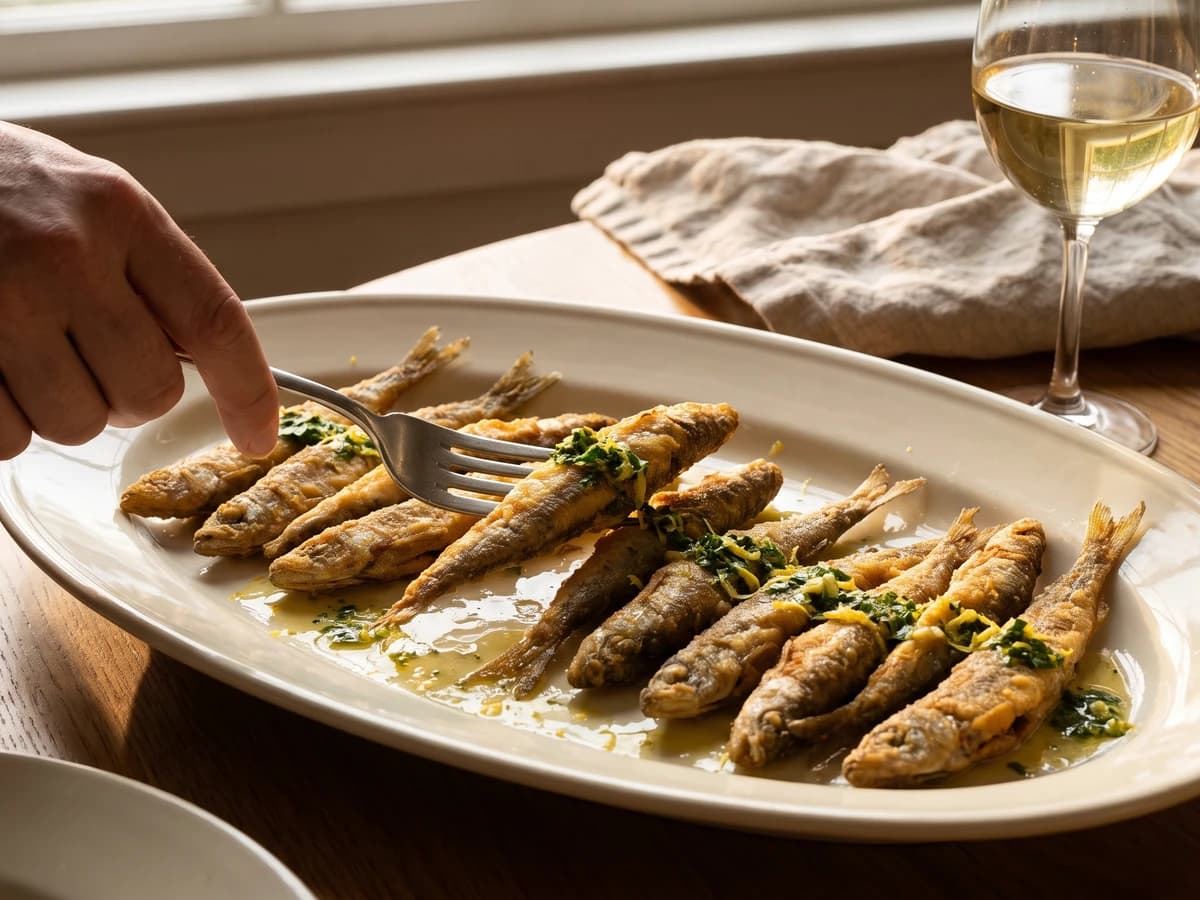
Éperlans à l’Anglaise turns small fish into a lesson in disciplined coating: boned smelts under a close, crisp crumb, pan-fried in clarified butter and finished with bright, half-melted maître d’hôtel butter.

Chef Juliette
Tiny smelts, shallot, mushrooms, white wine, gratin sauce, and fine bread raspings meet a fierce oven, where the fish must turn tender in the same breath the buttered crust bronzes.