
Chef Juliette
John Dory (St. Pierre)
John Dory has the delicacy of sole and the firmness of turbot. A light flouring, a quick butter sauté, and nut-brown beurre noisette show exactly why looks never mattered.
A cooking platform built around craft, culture, and the stories behind what we eat.
Created by Chef Juliette
Based on No. 1187, Selle de Veau Prince Orloff, from Le Guide Culinaire (1907) by Auguste Escoffier
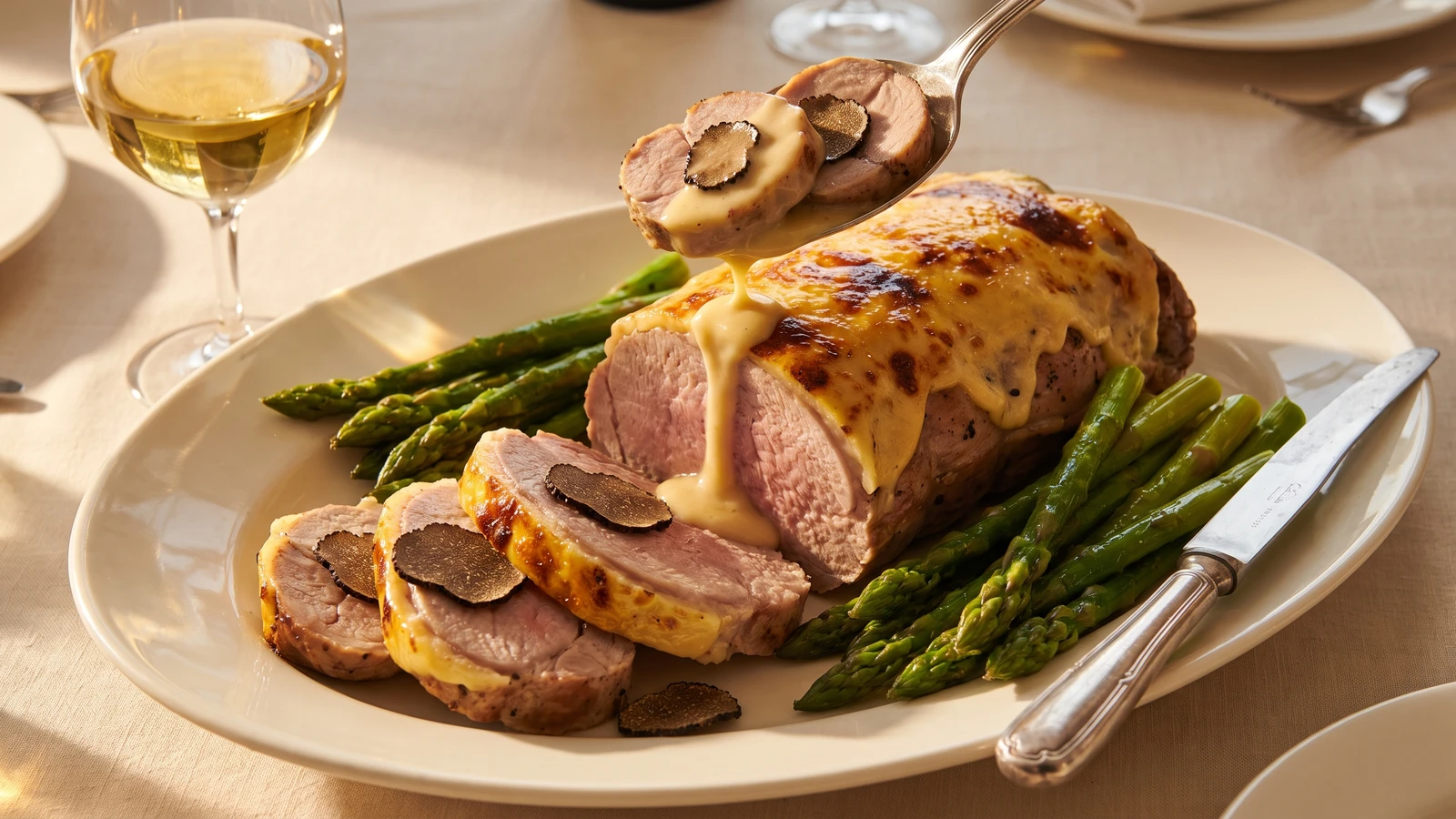
A home-scaled saddle of veal, braised gently, cut into collops with Soubise and truffle between them, then masked in Mornay-Soubise and flashed golden under the broiler.
Selle de Veau Prince Orloff (Prince Orloff-style saddle of veal) teaches the architecture of a composed roast. The veal must remain tender, the Sauce Soubise must hold between the collops, and the Mornay-Soubise mask must cling rather than puddle. Know this before touching the pan: a loose sauce undoes the whole construction.
The original assumed a whole saddle large enough for banquet service, a saucier tending separate pots, veal stock never off the fire, and a salamander ready to glaze the finished joint in seconds. At home, a tied center-cut veal loin replaces the brigade-sized saddle, the two sauces are prepared sequentially, a covered casserole manages the braise, and a fully heated broiler does the glazing. The bones and grand scale were scaffolding, so they go. The gentle braise, sliced collops, Soubise, fine truffle, Mornay-Soubise coating, and rapid glaze are the dish, so every one stays.
The source's quart of highly seasoned Sauce Soubise becomes one cup in the coating for four, with another half cup for layering. When the Orloff reaches the table, each pale slice shows a dark seam of truffle and onion, the ivory sauce wears small bronze blisters, and buttered asparagus brings the green beside it. The decisive step is the last one: have the veal, sauce, and broiler hot, then glaze quickly before the lean meat can overcook.
Selle de Veau Prince Orloff belongs to the Parisian grand-kitchen repertoire shaped in a Russian ambassador's household, where French cooks gave composed veal dishes the names of their patrons. It traveled from diplomatic table to banquet service because the sliced and re-formed saddle could be assembled in advance and glazed at the last moment. Many later versions add duxelles, but this entry is more exact: Sauce Soubise and fine truffle slices between the collops, followed by a Mornay-Soubise coating.
Quantity
1 roast, 3 lb (1.35 kg)
tied into an even cylinder
Quantity
2 teaspoons (10 ml / 12 g)
divided
Quantity
1 teaspoon (5 ml / 2 g)
divided
Quantity
4 tablespoons (60 ml / 56 g)
divided
Quantity
1 medium, about 1 cup (240 ml / 150 g)
diced
Quantity
1 medium, about 3/4 cup (180 ml / 90 g)
diced
Quantity
1
Quantity
2 cups (480 ml / 480 g)
Quantity
1 1/2 cups (360 ml / 360 g)
highly seasoned, reduced, and divided
Quantity
1 cup (240 ml / 250 g)
Quantity
1 oz (28 g)
fresh or preserved and very thinly sliced
Quantity
12 oz (340 g)
| Ingredient | Quantity |
|---|---|
| boneless center-cut veal loin roasttied into an even cylinder | 1 roast, 3 lb (1.35 kg) |
| fine sea saltdivided | 2 teaspoons (10 ml / 12 g) |
| freshly ground white or black pepperdivided | 1 teaspoon (5 ml / 2 g) |
| unsalted butterdivided | 4 tablespoons (60 ml / 56 g) |
| yellow oniondiced | 1 medium, about 1 cup (240 ml / 150 g) |
| carrotdiced | 1 medium, about 3/4 cup (180 ml / 90 g) |
| bouquet garni of parsley stems, thyme, and bay leaf | 1 |
| unsalted veal stock, or unsalted chicken stock | 2 cups (480 ml / 480 g) |
| finished Sauce Soubisehighly seasoned, reduced, and divided | 1 1/2 cups (360 ml / 360 g) |
| finished Sauce Mornay | 1 cup (240 ml / 250 g) |
| whole black trufflefresh or preserved and very thinly sliced | 1 oz (28 g) |
| asparagus tips | 12 oz (340 g) |
Heat the oven to 325°F (165°C). Pat the veal completely dry and season it with 1 1/2 teaspoons of the salt and 3/4 teaspoon of the pepper, pressing the seasoning over every surface. Let it stand for twenty minutes while the oven heats. Butter a shallow, broiler-safe gratin dish with 1 tablespoon of the butter and set it aside.
Melt 2 tablespoons of the butter in a heavy casserole over medium-high heat. When the foam subsides, brown the veal on every side, including both ends, until it wears an even hazelnut-colored crust, about ten minutes. Turn it only when each surface releases willingly. This fond is the braise's foundation; pale veal gives the stock very little to carry.
Lift the veal out briefly. Add the onion and carrot to the casserole and cook them in the butter and fond for five minutes, stirring until their edges color. Return the veal, tuck in the bouquet garni, and pour the stock around it, not over its crust. The liquid should reach roughly one-third of the way up the meat. Bring it just to a simmer, cover, and transfer it to the oven.
Braise for 55 to 75 minutes, turning the veal once, until its center reaches 138 to 140°F (59 to 60°C). The liquid must barely tremble. If it boils hard, lower the oven by 25°F (15°C) and leave the lid slightly ajar; if the casserole begins to dry, add hot stock a quarter cup at a time. Ça se rattrape. Lift the veal onto a board, tent it loosely, and rest it for fifteen minutes. Strain the braising liquor and reserve 1/2 cup (120 ml) for correcting the sauces if needed.
Set aside 1/2 cup (120 ml / 120 g) of the Sauce Soubise for the collops. Combine the remaining 1 cup (240 ml / 240 g) Sauce Soubise with the Sauce Mornay in a saucepan and warm it over gentle heat, stirring often. It must coat a spoon in a thick, unbroken layer. If it is too tight, add reserved braising liquor one tablespoon at a time; if it runs freely, simmer it gently until it holds. Taste and use the remaining salt and pepper only if needed.
Remove the strings and cut the veal across the grain into ten or twelve collops, neat slices about 1/2 inch (1.25 cm) thick, keeping them in their original order. Spread about 2 teaspoons of the reserved Sauce Soubise on each cut face and place a fine slice of truffle over it. Reassemble the collops snugly in the buttered gratin dish, overlapping them just enough to hold the roast's original shape. Work while everything is warm so the layers adhere.
Bring a wide pan of well-salted water to a boil. Add the asparagus tips and cook until vivid green and just tender, two to four minutes depending on thickness. Drain them thoroughly, return them to the dry warm pan, and roll them in the remaining tablespoon of butter. Cover and hold them off the heat while the veal is glazed.
Heat the broiler fully and place a rack about 6 inches (15 cm) below it. Spoon the hot Mornay-Soubise mixture over the re-formed veal, masking the top and sides in an even coat. Broil for two to four minutes, watching without interruption, until the surface blisters and turns spotted gold and the veal reaches at least 145°F (63°C). If the sauce slides off before it colors, remove the dish at once, scrape the coating into the saucepan, simmer until thicker, and mask again. Ça se rattrape. Arrange the buttered asparagus beside the veal and serve immediately. À table!
1 serving (about 490g)
Culinary guides, cultural storytelling, and the editorial depth that makes cooking meaningful.
Discover Culinary ExplorerChef Juliette
John Dory has the delicacy of sole and the firmness of turbot. A light flouring, a quick butter sauté, and nut-brown beurre noisette show exactly why looks never mattered.

Chef Juliette
Fresh haddock proves its delicacy in the meunière pan: a fine flour crust, moist pearly flakes, and beurre noisette sharpened with lemon and parsley, ready from one skillet in half an hour.
Chef Juliette
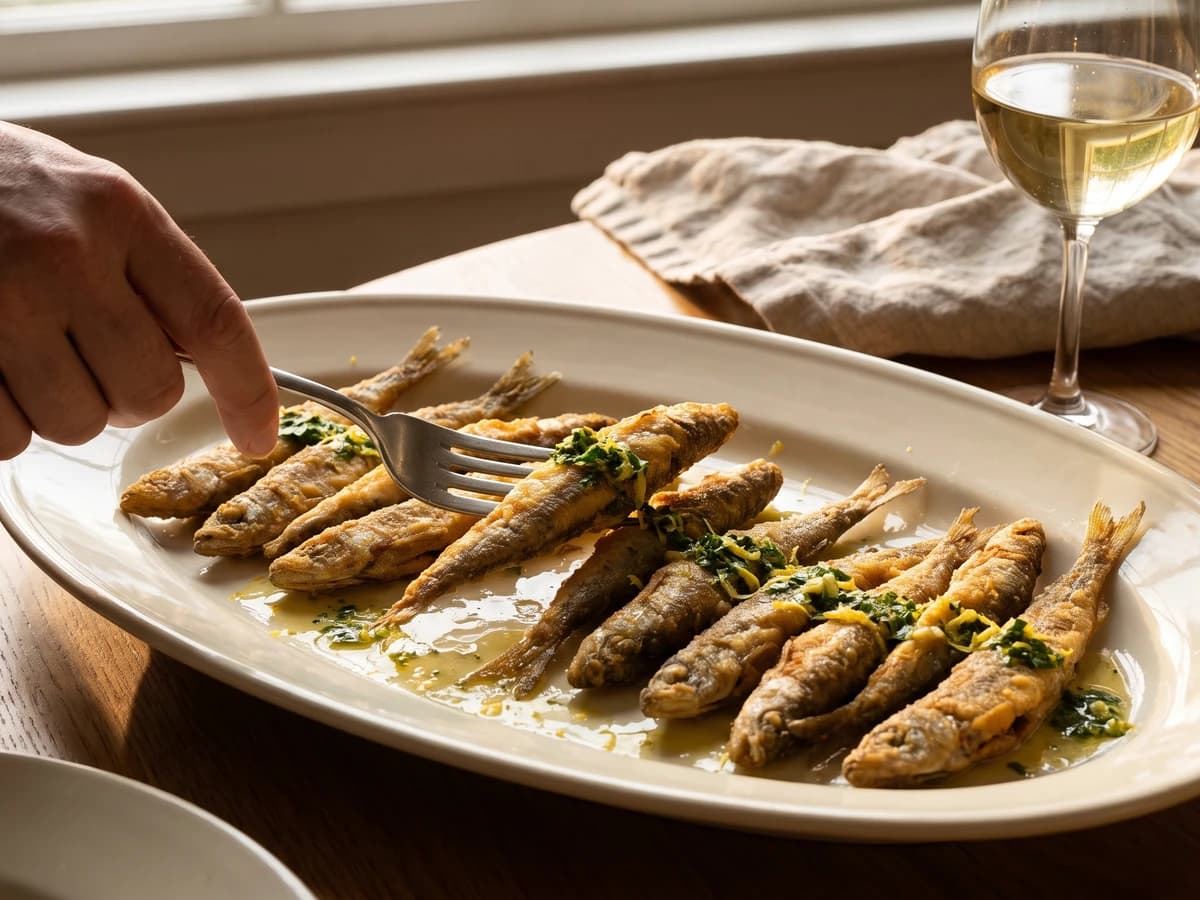
Éperlans à l’Anglaise turns small fish into a lesson in disciplined coating: boned smelts under a close, crisp crumb, pan-fried in clarified butter and finished with bright, half-melted maître d’hôtel butter.

Chef Juliette
Tiny smelts, shallot, mushrooms, white wine, gratin sauce, and fine bread raspings meet a fierce oven, where the fish must turn tender in the same breath the buttered crust bronzes.