
Chef Juliette
John Dory (St. Pierre)
John Dory has the delicacy of sole and the firmness of turbot. A light flouring, a quick butter sauté, and nut-brown beurre noisette show exactly why looks never mattered.
A cooking platform built around craft, culture, and the stories behind what we eat.

Created by Chef Juliette
Based on No. 1184, Selle de Veau à la Nelson, from Le Guide Culinaire (1907) by Auguste Escoffier
A veal saddle becomes edible architecture: Soubise and ham tucked into the carved loin, truffled Parmesan soufflé rising above it, and reduced braising liquor served alongside.
Selle de Veau à la Nelson (veal saddle Nelson-style) teaches architecture. The braised joint is carved, rebuilt with Soubise and ham, and crowned with truffled Parmesan soufflé until every serving carries the whole composition. Know one thing before you touch the pan: the buttered paper collar is a working mould, not decoration. Unless it stands firmly around the rebuilt saddle, the soufflé spreads instead of climbing.
The grand kitchen assumed a saucier on staff, a stock never off the fire, truffle purée by the quart, and spare hands to carve the veal while its liquor reduced. Here, a short centre-cut saddle serves four, one saucepan handles the reduction, and prepared black truffle purée supplies the concentrated truffle foundation. The brigade measure becomes three cups of soufflé and three quarters of a cup of purée, keeping their relation while fitting one joint. There is no salamander step to imitate; the source calls for a moderate oven, and your oven is precisely the right tool.
The spare hands and enormous quantities are scaffolding, so they go. The braise, orderly collops, Soubise and ham between them, one-inch truffled soufflé, buttered collar, and reduced liquor served apart are the dish, so every one stays. Build the collar snugly. That is the step that decides the crown.
Selle de Veau à la Nelson belongs to the composed showpieces of Parisian grand cuisine, where a joint could be braised, carved, garnished, rebuilt, and returned to the oven before appearing whole at table. The title à la Nelson reflects an honorific naming habit rather than a French region or a British household recipe; its identity lies in the precise assembly of Soubise, ham, Parmesan soufflé, and truffle. The reduced braising liquor is served separately so the crown reaches the table high and intact.
Quantity
1 saddle (4 to 4½ lb / 1.8 to 2 kg)
kidney and flank removed, loin muscles left attached
Quantity
2 teaspoons (10 ml / 12 g)
Quantity
1 teaspoon (5 ml / 2 g)
Quantity
3 tablespoons (45 ml / 43 g)
divided
Quantity
1 cup (240 ml / 150 g)
chopped
Quantity
¾ cup (180 ml / 100 g)
chopped
Quantity
½ cup (120 ml / 60 g)
chopped
Quantity
1 cup (240 ml / 240 g)
Quantity
3 cups (720 ml / 720 g)
Quantity
1
Quantity
¾ cup (180 ml / 190 g)
warmed and reduced until thick enough to hold a spoon track
Quantity
8 slices (about 4 oz / 115 g)
trimmed to match the veal collops
Quantity
3 cups (720 ml / 650 g) Soufflé au Parmesan (No. 2295a)
Quantity
¾ cup (180 ml / 190 g)
Quantity
1
whisked to firm peaks only if needed for rescue
| Ingredient | Quantity |
|---|---|
| centre-cut bone-in saddle of vealkidney and flank removed, loin muscles left attached | 1 saddle (4 to 4½ lb / 1.8 to 2 kg) |
| fine sea salt | 2 teaspoons (10 ml / 12 g) |
| finely ground white pepper | 1 teaspoon (5 ml / 2 g) |
| unsalted butterdivided | 3 tablespoons (45 ml / 43 g) |
| yellow onionchopped | 1 cup (240 ml / 150 g) |
| carrotchopped | ¾ cup (180 ml / 100 g) |
| celerychopped | ½ cup (120 ml / 60 g) |
| dry white wine | 1 cup (240 ml / 240 g) |
| unsalted veal stock | 3 cups (720 ml / 720 g) |
| bouquet garni of parsley stems, thyme, and bay leaf | 1 |
| prepared Soubisewarmed and reduced until thick enough to hold a spoon track | ¾ cup (180 ml / 190 g) |
| thin slices cooked hamtrimmed to match the veal collops | 8 slices (about 4 oz / 115 g) |
| prepared, unbaked Soufflé au Parmesan | 3 cups (720 ml / 650 g) Soufflé au Parmesan (No. 2295a) |
| smooth black truffle purée | ¾ cup (180 ml / 190 g) |
| large egg white (optional)whisked to firm peaks only if needed for rescue | 1 |
Set a rack in the lower third of the oven and heat it to 325°F (165°C). Pat the saddle completely dry, season it with the salt and white pepper, and tie it at 1½-inch (4 cm) intervals so the loins hold neatly against the bone. Cut a double-thickness band of strong parchment about 5 inches (13 cm) high and long enough to encircle the saddle with a 3-inch (8 cm) overlap. Butter one face with 1 tablespoon (15 ml / 14 g) of the butter and set it aside, buttered side up.
Melt the remaining 2 tablespoons (30 ml / 29 g) butter in a heavy lidded roasting pan over medium-high heat. When its foam subsides, brown the saddle deeply on every exposed meaty surface, turning it with two sturdy spoons rather than piercing it. Allow 10 to 12 minutes. The bronze film on the pan floor is the fond that gives the braising liquor its backbone; brown it, but never let it turn black.
Lift out the saddle. Add the onion, carrot, and celery to the pan and cook for 7 to 8 minutes, stirring, until softened and lightly coloured. Pour in the white wine and scrape every browned speck from the pan floor, then boil until the wine is reduced by half. Add the veal stock and bouquet garni, return the saddle bone-side down, and bring the liquid to a bare simmer. Cover and braise in the oven, basting every 20 minutes, until the centre of a loin reaches 132 to 135°F (56 to 57°C), usually 65 to 85 minutes. Stop there. The final bake finishes the veal; cooking it fully now would leave it dry beneath the soufflé. If the liquid falls below one quarter of the joint's height, add a little hot stock.
Transfer the saddle to the shallow ovenproof dish in which it will be served and let it rest for 15 minutes. Strain the braising liquor into a saucepan without pressing the vegetables, discard the bouquet garni, and skim away every visible trace of fat. Boil the liquor steadily until about 1½ cups (360 ml / 360 g) remain and it lightly coats a spoon. If grease continues to gather, touch a folded piece of absorbent paper briefly to the surface and lift it away. If the liquor becomes too salty or tight, loosen it with unsalted stock. Ça se rattrape. Hold it warm for serving.
Increase the oven to 375°F (190°C). Run a narrow boning knife along each side of the backbone and beneath the loin muscles, lifting each loin away in one piece while leaving the saddle structure intact. Cut the loins crosswise into even collops about ½ inch (1.25 cm) thick, keeping them in their original order. Spread about 3 tablespoons (45 ml / 48 g) Soubise in each cavity, then return the collops to their places. Between every two collops, tuck a matching piece of ham and a small spoonful of Soubise. Press the joint gently back into its original outline. If the slices begin to slide, encircle the meat with a narrow strip of buttered parchment and one loop of twine; this temporary brace will come away with the outer collar.
Stir about ½ cup (120 ml / 110 g) of the Soufflé au Parmesan (No. 2295a) into the black truffle purée to lighten it, then fold that mixture through the remaining soufflé with broad strokes, stopping as soon as the colour is even. If overmixing has left it visibly slack, whisk the optional egg white to firm peaks and fold it through in two or three strokes. Spread the truffled soufflé over the entire upper surface of the reconstructed saddle in a layer about 1 inch (2.5 cm) thick. Immediately encircle the joint with the prepared parchment, buttered side inward, and tie it snugly with two loops of kitchen twine. The paper should stand at least 2 inches (5 cm) above the topping.
Set the serving dish in the oven and bake for 15 minutes without opening the door during the first 12. The soufflé should rise within the collar, turn butter-gold with bronze patches, and feel set around the edges with a slight tremble at the centre. Check the veal from the side, beneath the crown; a collop should reach at least 145°F (63°C). If soufflé begins escaping beneath the band, slide the dish out, tighten the lower string, and push the escaped spoonful back inside with a wide spatula. Ça se rattrape. Return it to the oven at once.
Let the saddle stand for 3 minutes. Cut the twine, run a thin buttered knife wherever the crown touches the paper, and peel the collar slowly outward and upward. Do not transfer the joint; it goes to the table in the dish in which the soufflé baked. Pour the hot, degreased braising liquor into a warmed sauceboat and serve it separately so the crown stays proud. Carve through the soufflé and reconstructed collops together. À table!
1 serving (about 520g)
Culinary guides, cultural storytelling, and the editorial depth that makes cooking meaningful.
Discover Culinary ExplorerChef Juliette
John Dory has the delicacy of sole and the firmness of turbot. A light flouring, a quick butter sauté, and nut-brown beurre noisette show exactly why looks never mattered.

Chef Juliette
Fresh haddock proves its delicacy in the meunière pan: a fine flour crust, moist pearly flakes, and beurre noisette sharpened with lemon and parsley, ready from one skillet in half an hour.
Chef Juliette
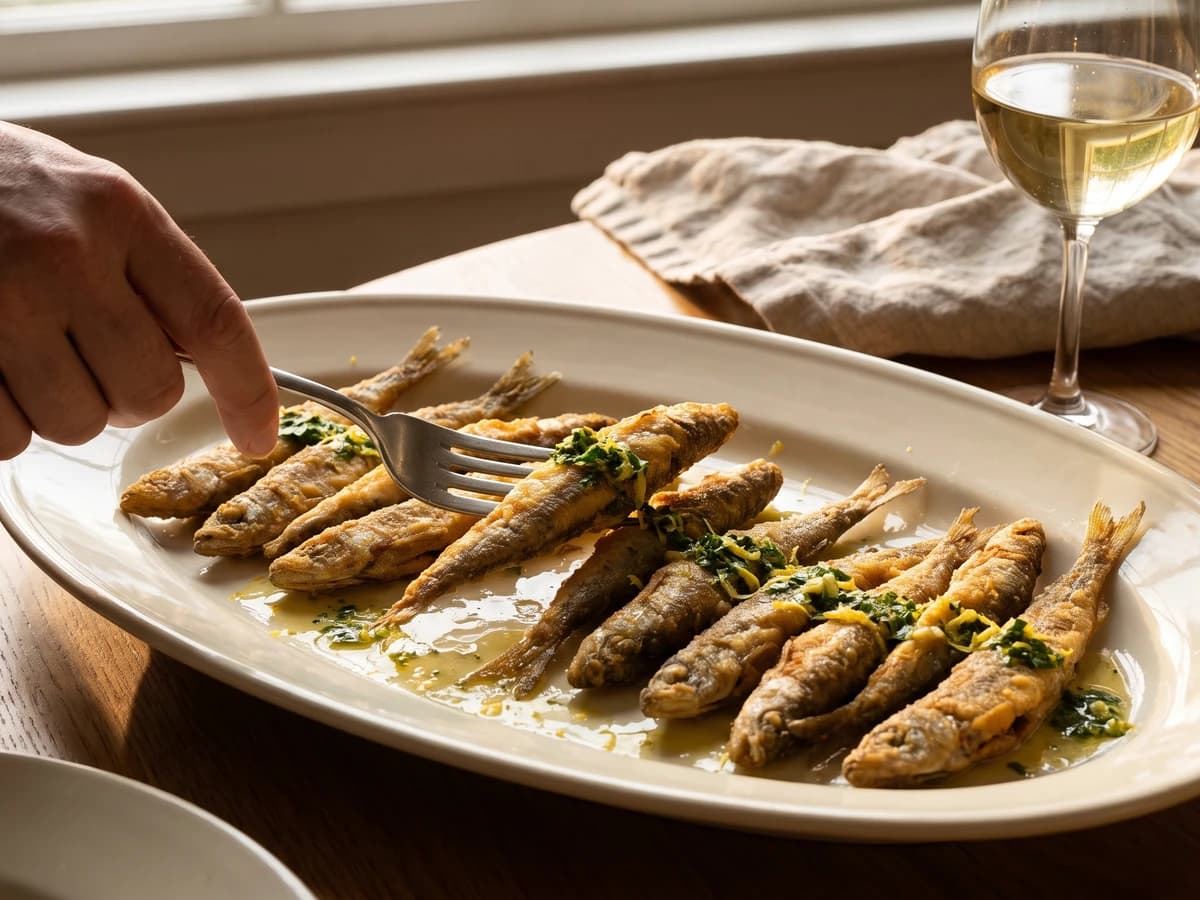
Éperlans à l’Anglaise turns small fish into a lesson in disciplined coating: boned smelts under a close, crisp crumb, pan-fried in clarified butter and finished with bright, half-melted maître d’hôtel butter.

Chef Juliette
Tiny smelts, shallot, mushrooms, white wine, gratin sauce, and fine bread raspings meet a fierce oven, where the fish must turn tender in the same breath the buttered crust bronzes.