
Chef Juliette
John Dory (St. Pierre)
John Dory has the delicacy of sole and the firmness of turbot. A light flouring, a quick butter sauté, and nut-brown beurre noisette show exactly why looks never mattered.
A cooking platform built around craft, culture, and the stories behind what we eat.

Created by Chef Juliette
Based on No. 1180, Tripes à la Mode de Caen, from Le Guide Culinaire (1907) by Auguste Escoffier
Ox tripe, ox foot, dry cider, and Calvados sealed beneath a flour galette and braised through the night, until Caen’s humble pot gives a clear, glossy gravy with the body only beef foot can bring.
Tripes à la mode de Caen (Caen-style braised tripe) teaches the patience of a sealed braise, but its first law comes before heat: ox foot, not calf’s foot, gives the gravy enough gelatin to cling while surviving the full ten-hour cook. Use calf’s foot in the same pot and it falls to shreds before the tripe is tender. The improvement defeats the dish.
The original did not lean on a saucier, a stock never off the fire, or a salamander. It assumed a complete set of tripe, four ox feet, many hands to prepare them, a special earthenware pot, and a baker’s oven whose heat waned evenly. For four people, cleaned mixed tripe, butcher-cut ox-foot pieces, and a six-quart cocotte do the same work; two oven temperatures reproduce the falling heat. The flour galette stays because it prevents evaporation and protects the tripe’s pale colour. That is the dish, not brigade scaffolding.
There is no fond or roux here, and adding either would rewrite the gravy. Its body comes from ox-foot gelatin, its character from cider and Calvados, and its concentration from ten sealed hours. Begin early, keep the pot snug and properly sealed, and let the oven supply the labor. The step that matters most is the unbroken, gentle braise; if the tripe remains chewy, it needs more time, not cleverness.
Tripes à la mode de Caen belongs specifically to Caen in Normandy, where cattle, orchard cider, and apple brandy meet in a long earthenware braise. From household and tripière kitchens, sealed pots traveled to the baker’s oven and then into the classical repertoire, which still insisted that the dish be served in heat-holding stoneware rather than silver. The persistent substitution of calf’s foot is no refinement: ox foot endures the long cooking and supplies the gelatinous body the gravy requires.
Quantity
3 pounds (1.36 kg)
cut into 2-inch pieces
Quantity
2 pounds (900 g)
split and cross-cut by the butcher
Quantity
2 medium (12 ounces / 340 g)
peeled and halved
Quantity
9 ounces (255 g)
peeled and cut into large rounds
Quantity
4
Quantity
1 (5 ounces / 140 g)
thoroughly washed
Quantity
8 (½ ounce / 15 g)
Quantity
2 sprigs
Quantity
1
Quantity
1 tablespoon plus ½ teaspoon (21 g)
Quantity
¾ teaspoon (1.5 g)
Quantity
6 ounces (170 g)
thinly sliced and soaked in cold water for 30 minutes
Quantity
6⅓ cups (1.5 L / 1.5 kg)
Quantity
¾ cup (180 ml / 170 g)
Quantity
3½ cups (440 g)
Quantity
1 cup plus up to 2 tablespoons (240 to 270 ml / 240 to 270 g)
| Ingredient | Quantity |
|---|---|
| cleaned mixed beef tripe, preferably paunch, honeycomb, manyplies, and reedcut into 2-inch pieces | 3 pounds (1.36 kg) |
| cleaned ox-foot piecessplit and cross-cut by the butcher | 2 pounds (900 g) |
| yellow onionspeeled and halved | 2 medium (12 ounces / 340 g) |
| carrotspeeled and cut into large rounds | 9 ounces (255 g) |
| whole cloves | 4 |
| large leekthoroughly washed | 1 (5 ounces / 140 g) |
| parsley stems | 8 (½ ounce / 15 g) |
| thyme | 2 sprigs |
| bay leaf | 1 |
| fine sea salt | 1 tablespoon plus ½ teaspoon (21 g) |
| freshly ground black pepper | ¾ teaspoon (1.5 g) |
| beef suetthinly sliced and soaked in cold water for 30 minutes | 6 ounces (170 g) |
| dry pale cider | 6⅓ cups (1.5 L / 1.5 kg) |
| Calvados | ¾ cup (180 ml / 170 g) |
| all-purpose flour | 3½ cups (440 g) |
| hot water | 1 cup plus up to 2 tablespoons (240 to 270 ml / 240 to 270 g) |
Put the prepared tripe in a large bowl of cold water and soak it for 1 hour, changing the water once. Rinse well, drain, and cut it into squares about 2 inches across. Rinse the ox-foot pieces, checking that no loose bone fragments remain. Drain the soaked suet separately. Prepared tripe needs refreshing, not aggressive bleaching at home; a clean, mild animal scent is right, while a harsh ammonia smell means the tripe should be returned to the seller.
Set a rack in the lower middle of the oven and heat it to 300°F (150°C). Stud each onion half with one clove. Tie the leek, parsley stems, thyme, and bay leaf firmly with butcher’s twine to make the herb faggot. Spread the carrots and onions across the bottom of a snug 6-quart cocotte, then arrange the meatiest ox-foot pieces over them.
Season the drained tripe evenly with the salt and pepper, then pack it over the ox foot without crushing it tight. Bury the herb bundle in the middle. Lay any long, especially bony foot pieces across the top, followed by the soaked slices of suet. Stir the cider and Calvados together and pour them slowly down the side until the tripe is just covered. The exact depth depends on the pot, which is why the cocotte must fit closely; the contents should be covered, not swimming in a broad pan.
Mix the flour with 1 cup of the hot water, adding only enough of the remaining water to make a stiff, plain dough. Pat or roll it into a galette, a flour-and-water paste lid, about ½ inch thick and slightly wider than the inside of the pot. Lay it over the contents and press its edge firmly against the inner wall just below the lid seat, leaving the outer rim clear for the cocotte lid later. If the galette tears, press a scrap of dough over the opening and seal it with wet fingers. Ça se rattrape. No gap should remain for rapid evaporation.
Put the cocotte in the oven without its metal lid and bake for 2 hours, until the galette has set into a firm shell. Do not pierce or lift it. Set the cocotte lid over the baked galette, reduce the oven to 250°F (120°C), and cook for 8 hours more. This descending heat is the home equivalent of the baker’s steadily waning oven. The suet and paste protect the tripe from drying and excessive colour while the ox foot slowly gives its gelatin to the cider.
After 10 hours of total cooking, lift off the metal lid and crack the galette from the far edge, keeping your face and hands back from the sudden heat beneath it. Test several kinds of tripe. Each should yield readily to the edge of a spoon without dissolving, and the edible skin and tendons around the ox foot should be soft and gelatinous. If the tripe is still rubbery, it is undercooked, not ruined. Remove the galette, add a little hot cider if the liquid has fallen below the tripe, cover with the metal lid, and return the pot to 250°F (120°C) for 1 to 2 hours.
Discard the galette, bare bones, suet, carrots, onions, and herb bundle. Lift the tripe and the softened edible pieces of ox foot into a warm bowl, distributing the different tripe textures evenly. Strain the cooking liquid into a saucepan and remove the fat thoroughly with a separator or careful skimming. The gravy should be glossy and lightly cling to a spoon. If it is watery, simmer it uncovered until it gains body; if it has become too concentrated, loosen it with a splash of cider. Do not add flour. Taste only after reduction, then correct the salt and pepper.
Divide the tripe among warmed stoneware or earthenware bowls and ladle the clear gravy over it. If the table is not ready, keep the filled bowls in a bain-marie, a hot-water bath held below a boil, for no more than 45 minutes. This dish loses its generosity when served merely warm, so bring it to the table with the gravy gleaming and the bowls properly hot. À table!
1 serving (about 475g)
Culinary guides, cultural storytelling, and the editorial depth that makes cooking meaningful.
Discover Culinary ExplorerChef Juliette
John Dory has the delicacy of sole and the firmness of turbot. A light flouring, a quick butter sauté, and nut-brown beurre noisette show exactly why looks never mattered.

Chef Juliette
Fresh haddock proves its delicacy in the meunière pan: a fine flour crust, moist pearly flakes, and beurre noisette sharpened with lemon and parsley, ready from one skillet in half an hour.
Chef Juliette
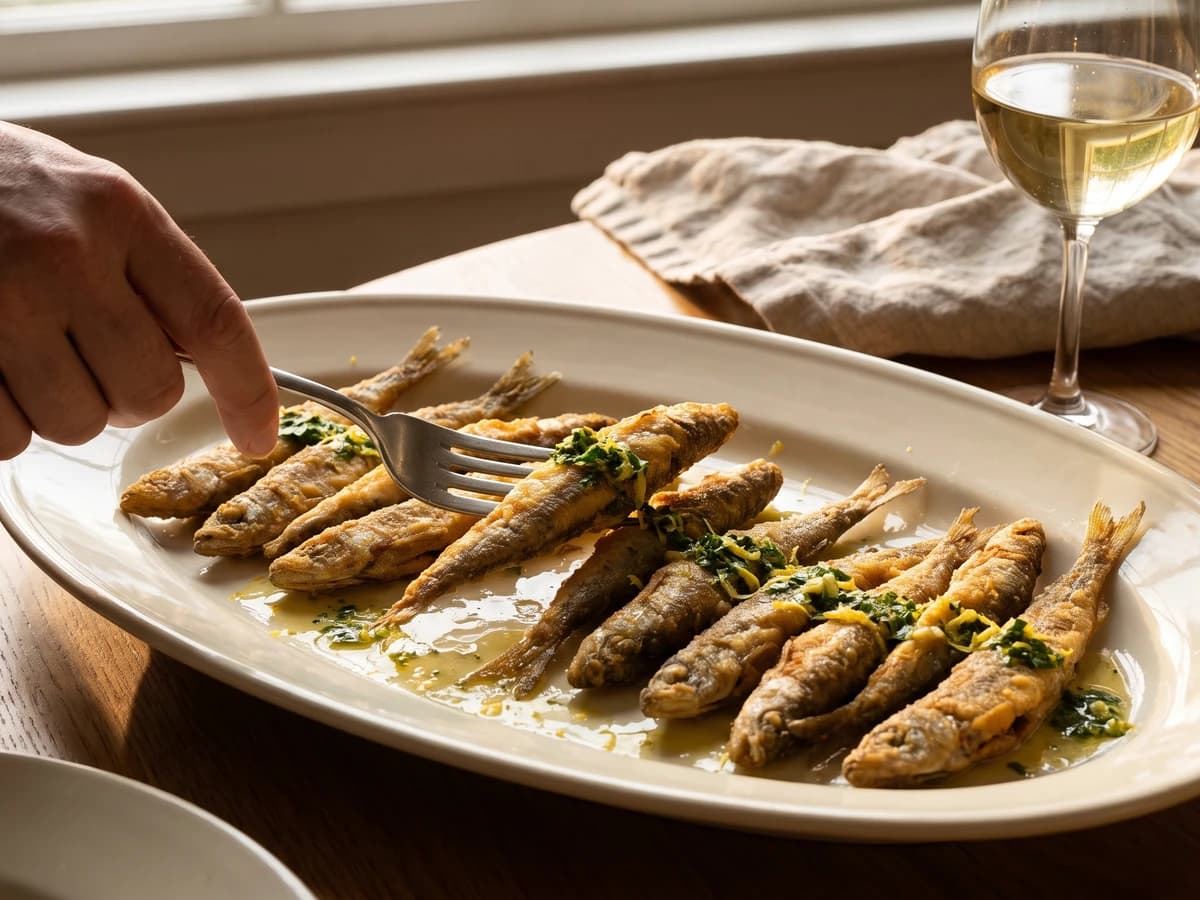
Éperlans à l’Anglaise turns small fish into a lesson in disciplined coating: boned smelts under a close, crisp crumb, pan-fried in clarified butter and finished with bright, half-melted maître d’hôtel butter.

Chef Juliette
Tiny smelts, shallot, mushrooms, white wine, gratin sauce, and fine bread raspings meet a fierce oven, where the fish must turn tender in the same breath the buttered crust bronzes.