
Chef Juliette
Bouillabaisse à la Marseillaise
Marseille's great fish stew, saffron-gold and garlic-scented, proves that a hard boil can be the careful choice: it binds olive oil into broth before the whole pot meets bread.
A cooking platform built around craft, culture, and the stories behind what we eat.

Created by Chef Juliette
Based on No. 1177, Goulash de Bœuf à la Hongroise, from Le Guide Culinaire (1907) by Auguste Escoffier
Beef, onions, paprika, tomatoes, and potatoes braised until tender, then reduced almost dry. The lesson is restraint: water starts the braise, but it must not remain as soup.
Goulash de Bœuf à la Hongroise (Hungarian-style beef goulash) teaches reduction, not abundance. The one true thing to know before touching the pan is this: the water is a timing device, not the finished sauce. It gives the beef and potatoes time to soften, then it must cook away until paprika-red liquor clings to every piece. Don't drown it.
The source assumed a brigade portion of three pounds of beef, a cook free to baste the potatoes often, and a timbale waiting for service. It called for neither a saucier's mother sauce nor stock kept perpetually hot, only water, because the meat, onions, tomatoes, paprika, and final reduction build the flavour themselves. For four people, two pounds of beef in a heavy home cocotte preserves the original ratios; two or three deliberate bastings replace the hovering cook, and a warmed deep serving bowl replaces the formal timbale. Those are service changes, not changes to the dish. One cook, one stove, one evening.
Keep what matters: beef and onions fried together in lard over moderate heat, paprika added before the tomatoes, potatoes introduced only after the first braise, and the final liquor reduced almost to nothing. The last reduction is the step that decides everything, so stay beside the pot for those final minutes.
Known in Hungary as gulyás, the dish belongs to the Alföld, the Great Hungarian Plain, where cattle herders cooked beef and onions in kettles and paprika became its defining scent over generations. As the preparation traveled into the French classical repertoire, it became goulash de bœuf à la hongroise, a compact oven braise enriched with tomatoes and potatoes. The nearly dry finish is a French canonical interpretation, not a universal Hungarian rule: Hungarian gulyás is often a soup, while the thicker pörkölt is its closer relative in texture.
Quantity
2 lb (907 g)
cut into roughly 2-inch (5 cm) pieces weighing about 3 oz (85 g) each
Quantity
⅓ cup (80 ml / 75 g)
Quantity
1 large, about 1¼ cups (300 ml / 150 g)
cut into ¾-inch (2 cm) dice
Quantity
2 tablespoons (30 ml / 14 g)
Quantity
1 teaspoon (5 ml / 6 g)
Quantity
2 cups (475 ml / 380 g)
gently squeezed of seeds and excess juice, then quartered
Quantity
¼ cup (60 ml / 60 g)
Quantity
2½ cups (600 ml / 380 g)
peeled and quartered
Quantity
½ cup (120 ml / 120 g)
| Ingredient | Quantity |
|---|---|
| boneless beef shoulder or boneless short ribcut into roughly 2-inch (5 cm) pieces weighing about 3 oz (85 g) each | 2 lb (907 g) |
| rendered pork lard | ⅓ cup (80 ml / 75 g) |
| large yellow onioncut into ¾-inch (2 cm) dice | 1 large, about 1¼ cups (300 ml / 150 g) |
| sweet Hungarian paprika | 2 tablespoons (30 ml / 14 g) |
| fine salt | 1 teaspoon (5 ml / 6 g) |
| peeled tomatoesgently squeezed of seeds and excess juice, then quartered | 2 cups (475 ml / 380 g) |
| water for the first braise | ¼ cup (60 ml / 60 g) |
| waxy potatoespeeled and quartered | 2½ cups (600 ml / 380 g) |
| water for cooking the potatoes | ½ cup (120 ml / 120 g) |
Heat the oven to 325°F (165°C), or 300°F (150°C) with a fan. Pat the beef thoroughly dry and cut it into large, roughly equal pieces; the source calls for substantial three-ounce chunks because small cubes would dry before the potatoes finish. Dice the onion, squeeze the watery seeds from the peeled tomatoes, and quarter them. Keep the potatoes whole until the first braise is nearly finished, then peel and quarter them so their cut surfaces don't discolor.
Melt the lard in a wide, heavy cocotte over medium heat. Add the beef and onion together, as the formula intends, and cook uncovered for 15 to 18 minutes, turning the meat and stirring the onion regularly. Stop when the onion is evenly golden, the beef has taken light colour, and the lard is sizzling cleanly around both. This is moderate frying, not an aggressive sear; scorched onion would follow the dish all the way to the table. If the beef releases water and the pot begins to simmer, keep it uncovered at the same heat until the moisture evaporates and the lard begins to sizzle again. Ça se rattrape.
Take the pot off the heat for about 30 seconds, then add the paprika and salt. Stir until the paprika coats the meat and onion in the hot lard, about 20 seconds, then immediately add the tomatoes and the first ¼ cup (60 ml) of water. Return the pot to medium heat and scrape the light fond from its floor as the liquid comes to a simmer. Paprika needs fat to release its fragrance, but it turns bitter when scorched. If it begins darkening too quickly, add the tomatoes at once and stir hard; caught before the aroma turns acrid, ça se rattrape.
Cover the cocotte tightly and place it in the oven for 1 hour 30 minutes. The liquid should barely tremble beneath the lid while the tomatoes collapse and the beef begins to soften. Check once after an hour; if a loose lid has allowed the pot to dry, add 1 tablespoon (15 ml / 15 g) of water and cover it again. At the end of this stage, the beef should yield when pressed with a fork but still offer some resistance.
Stir the second ½ cup (120 ml) of water into the concentrated tomato liquor. Add the quartered potatoes and turn them carefully so every cut face is coated with paprika and fat. Return the cocotte to the oven uncovered for 35 to 45 minutes. Every 12 to 15 minutes, spoon the liquor over the exposed meat and potatoes and turn the upper pieces into the sauce. This deliberate basting is the part of the original service that must stay; it cooks the potatoes evenly while the moisture escapes.
Watch the pot closely during the final 15 minutes. The goulash is ready when the beef yields easily, the potatoes are tender without collapsing, and tilting the cocotte reveals no pourable pool of liquid. A glossy paprika-red coating and a little clear lard at the edge are exactly right. If the solids become tender while too much liquor remains, lift them into a warm bowl and boil the liquor on the stovetop for 3 to 6 minutes before folding everything back in. If the pot dries before the potatoes soften, add water 1 tablespoon (15 ml) at a time, cover for 5 minutes, then uncover and continue reducing. Ça se rattrape. Do not reach for flour or stock; reduction is the sauce.
Rest the goulash uncovered for 10 minutes so the coating settles around the meat and potatoes. Carry it to the table in the cocotte or heap it into a warmed deep serving bowl, the honest home equivalent of the book's timbale. There is no loose broth to ladle and no garnish required. À table!
1 serving (about 410g)
Culinary guides, cultural storytelling, and the editorial depth that makes cooking meaningful.
Discover Culinary ExplorerChef Juliette
Marseille's great fish stew, saffron-gold and garlic-scented, proves that a hard boil can be the careful choice: it binds olive oil into broth before the whole pot meets bread.

Chef Juliette
Waterzoi asks fresh, bone-in river fish to thicken its own buttery broth, with parsley root and pepper for company. No flour, no stockpot, just a brisk simmer watched closely.
Chef Juliette
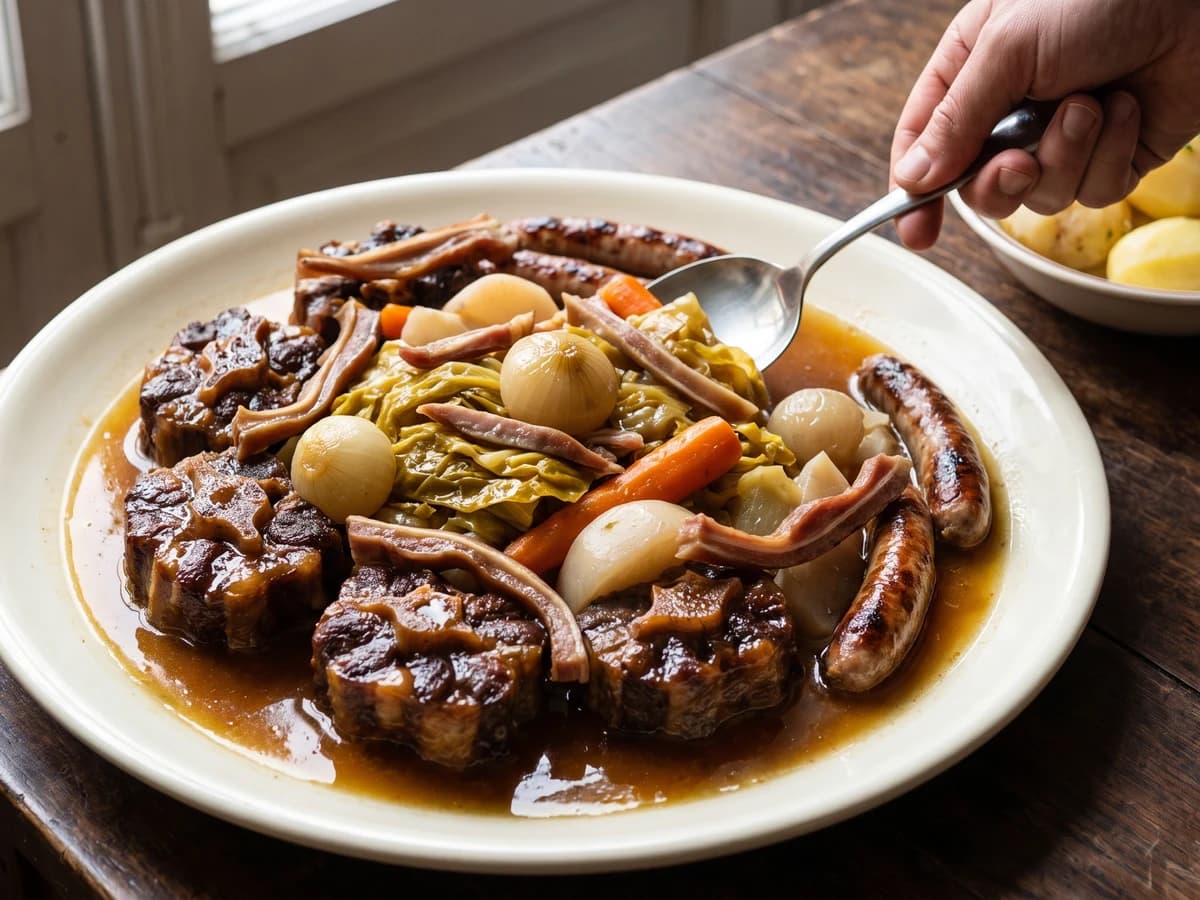
Queue de Bœuf en Hochepot gathers oxtail, pig's trotter and ear, cabbage, roots, and grilled chipolatas around a clear, gelatin-rich broth whose quiet simmer keeps every piece tender and distinct.

Chef Juliette
Beef shoulder larded with bacon, sharpened by red wine and vinegar, then sealed with garlic, vegetables, and dry lemon peel until the low oven turns it yielding and the gravy darkly glossy.