
Chef Juliette
John Dory (St. Pierre)
John Dory has the delicacy of sole and the firmness of turbot. A light flouring, a quick butter sauté, and nut-brown beurre noisette show exactly why looks never mattered.
A cooking platform built around craft, culture, and the stories behind what we eat.
Created by Chef Juliette
Based on No. 1173, Daube à la Provençale Froide, from Le Guide Culinaire (1907) by Auguste Escoffier
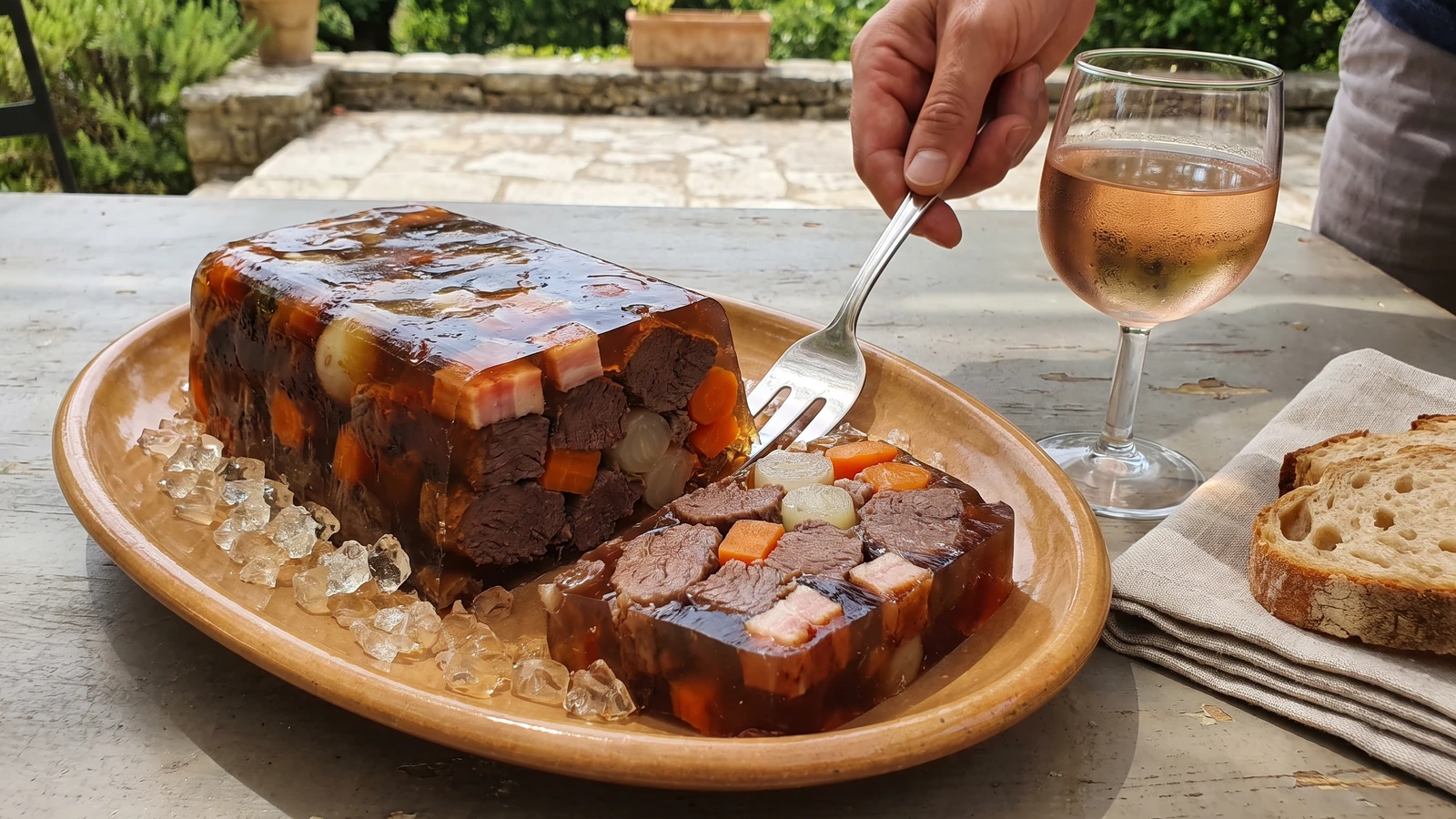
A Provençal lesson in leftovers: tender beef, vegetables, bacon rind, and gelatin-rich gravy packed into a terrine, chilled firm, turned out, and ringed with chopped aspic for a generous cold lunch.
Daube à la Provençale froide (cold-set Provençal beef daube) teaches the first law of a cold meat dish: the gravy is not something poured around the meat, it is the structure that holds every slice. If the gravy sets, the terrine stands; if it does not, even beautiful beef slumps on the platter. Test that setting power before you touch the mold.
The source assumes the remains of a daube already served hot, not a fresh braise made for display. It also assumes a saucier's gelatin-rich gravy from a stockpot never off the fire, a garde-manger with clear aspic ready, and a Terrine à Pâté (pâté terrine) on the shelf. A home cook gets the same intent with 600 g of leftover beef, its vegetables and bacon rind, a 1.2-liter loaf tin, and a measured dose of plain gelatin only when the chilled gravy proves too weak. The equipment and gel test changed because home stock is often leaner and the portion is smaller; the careful packing, strained gravy, long chill, clean unmolding, and chopped aspic stay, because they are the dish. One cook, one stove, one evening, then the cold does the work overnight.
When it is right, the daube froide turns out in one firm loaf, mahogany gravy holding distinct pieces of tender beef, carrot, onion, and pale bacon rind. Do not mash those pieces into submission. Pack them closely, let the gravy find every space, and remember that the one step deciding the whole dish is the cold-saucer test of the gravy.
Daube belongs to Provence, where beef was held at the gentlest simmer in a deep, lidded daubière and served generously from the same pot. Daube à la Provençale froide was generally not cooked as a separate showpiece; it was the practiced second life of a daube already served hot, its naturally gelatinous gravy setting the remaining meat and vegetables. Classical cold service gave that household thrift a neat Terrine à Pâté shape and a ring of chopped aspic, but the principle remained entirely domestic: nothing good from the pot was wasted.
Quantity
3½ cups (830 ml / 600 g)
cold and kept in large chunks
Quantity
¾ cup (180 ml / 125 g)
kept in pieces
Quantity
⅔ cup (160 ml / 100 g)
kept in pieces
Quantity
⅓ cup (80 ml / 50 g)
Quantity
1¼ cups (300 ml / 300 g)
including its natural jelly
Quantity
2 teaspoons (10 ml / 6 g)
use only if the chilled gravy remains loose
Quantity
2 tablespoons (30 ml / 30 g)
for blooming the optional gelatin
Quantity
1¼ cups (300 ml / 300 g)
chilled firm and coarsely chopped
| Ingredient | Quantity |
|---|---|
| cooked beef pieces from leftover Daube à la Provençalecold and kept in large chunks | 3½ cups (830 ml / 600 g) |
| cooked carrots from the daubekept in pieces | ¾ cup (180 ml / 125 g) |
| cooked onions from the daubekept in pieces | ⅔ cup (160 ml / 100 g) |
| cooked bacon rind squares from the daube | ⅓ cup (80 ml / 50 g) |
| gravy from the daubeincluding its natural jelly | 1¼ cups (300 ml / 300 g) |
| unflavored powdered gelatin (optional)use only if the chilled gravy remains loose | 2 teaspoons (10 ml / 6 g) |
| cold water (optional)for blooming the optional gelatin | 2 tablespoons (30 ml / 30 g) |
| prepared clear savory aspic jellychilled firm and coarsely chopped | 1¼ cups (300 ml / 300 g) |
Lift the cold beef from the leftover daube one piece at a time with a fork, preserving the large chunks rather than shredding them. Set aside the carrots, onions, and squares of bacon rind that remain nearly intact, and remove any spent herb stems or other loose aromatics. Measure the gravy separately. The source is quite deliberate here: recognizable pieces make the cold dish generous and handsome, while mashed remnants give a muddy slice.
Examine the refrigerated gravy before warming it. If it already holds as a soft jelly on the spoon, its natural gelatin is sufficient; warm it over the lowest heat only until it becomes fluid. If it flows while thoroughly cold, do not pack the terrine and hope. Ça se rattrape: sprinkle the powdered gelatin over the cold water, leave it for 5 minutes, then stir it into the gently warmed gravy until completely dissolved. Do not let the gravy boil. Spoon a little onto a cold saucer and chill it for 5 minutes; it should set softly but hold when the saucer is tilted.
Rinse a 1.2-liter Terrine à Pâté or straight-sided loaf tin with cold water and shake out the excess without drying it. Arrange a few attractive pieces of beef and carrot across the bottom, since this will become the top when unmolded. Pack in the remaining beef, carrots, onions, and bacon rind in close layers, distributing the vegetables and rind rather than leaving them in one pocket. Press just enough to remove large gaps, but keep every piece distinct.
Set an ordinary fine-mesh strainer directly over the packed terrine and pour the fluid gravy through it, pressing lightly with the back of a spoon. An ordinary strainer is enough; the aim is to remove coarse sediment while keeping the body of the gravy. Tap the mold gently against a folded towel and slide a thin skewer down two or three gaps so the gravy reaches the bottom. It should fill every crevice and come nearly to the top layer. If it falls short, repack the contents more closely; do not dilute the gravy with water.
Leave the terrine until the gravy is no longer warm, no more than 20 minutes, then cover and refrigerate it for at least 12 hours. Do not disturb or press it while it sets. The gravy needs a long, uninterrupted chill to bind the meat and vegetables into a cleanly sliceable loaf, and this waiting is part of the preparation, not brigade scaffolding that can be cut away.
Chill the serving platter, then coarsely chop the firm aspic into small, irregular crystals. Loosen only the upper rim of the daube with a thin knife, wrap the mold briefly in a warm damp towel, and invert it onto the cold platter. If it clings, hold the towel around it for another 5 seconds and try again; repeated gentle warmth releases the jelly, while prying tears the loaf. Return a soft terrine to the refrigerator rather than forcing it out.
Surround the unmolded daube with the chopped aspic, leaving the dark set loaf clearly visible. Slice it thickly with a sharp knife dipped in warm water and wiped dry between cuts. Keep the dish cold until it reaches the table or picnic cloth; the contrast between tender beef, firm savory jelly, and glittering chopped aspic is the entire pleasure. À table!
1 serving (about 370g)
Culinary guides, cultural storytelling, and the editorial depth that makes cooking meaningful.
Discover Culinary ExplorerChef Juliette
John Dory has the delicacy of sole and the firmness of turbot. A light flouring, a quick butter sauté, and nut-brown beurre noisette show exactly why looks never mattered.

Chef Juliette
Fresh haddock proves its delicacy in the meunière pan: a fine flour crust, moist pearly flakes, and beurre noisette sharpened with lemon and parsley, ready from one skillet in half an hour.
Chef Juliette
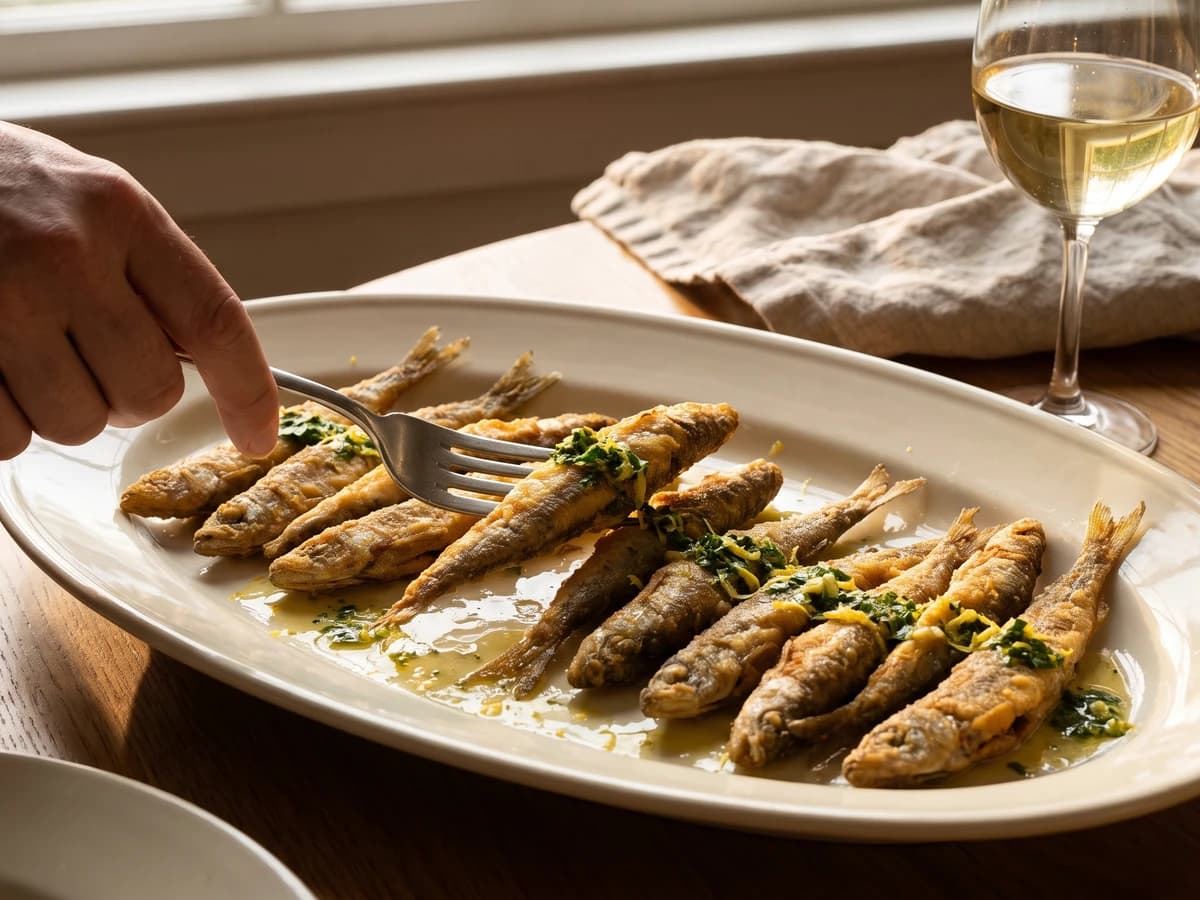
Éperlans à l’Anglaise turns small fish into a lesson in disciplined coating: boned smelts under a close, crisp crumb, pan-fried in clarified butter and finished with bright, half-melted maître d’hôtel butter.

Chef Juliette
Tiny smelts, shallot, mushrooms, white wine, gratin sauce, and fine bread raspings meet a fierce oven, where the fish must turn tender in the same breath the buttered crust bronzes.