
Chef Juliette
John Dory (St. Pierre)
John Dory has the delicacy of sole and the firmness of turbot. A light flouring, a quick butter sauté, and nut-brown beurre noisette show exactly why looks never mattered.
A cooking platform built around craft, culture, and the stories behind what we eat.

Created by Chef Juliette
Based on No. 1162, Queue de Bœuf Grillée, from Le Guide Culinaire (1907) by Auguste Escoffier
Tender oxtail is simmered with aromatics, dried until the surface will hold crumbs, then buttered and grilled to a deep bronze crust, with thick Soubise underneath to catch every rich, crisp-edged bite.
Queue de Bœuf Grillée (grilled oxtail) teaches a splendidly plain principle: a crumb crust only clings to a surface that is truly dry. The five-hour simmer does the tenderizing, but the quiet half-hour on a rack decides whether the butter and fine crumbs become a bronze shell or slide away in damp patches. The second part is not decoration. It is the dish.
The classical kitchen had a saucier holding several finished sauces, stockpots never off the fire, and a salamander ready to brown on command. This entry wisely calls for salted aromatic water rather than stock. For one cook, one stove, one evening, the butcher saws the tail into long sections, a heavy pot handles the simmer, prepared ordinary Soubise supplies the sauce, and a low home broiler replaces the salamander. Separate hands and a parade of accompaniments were brigade scaffolding and can go. The long simmer, thorough drying, melted butter, very fine crumbs, and gentle grilling must stay.
When it works, each section arrives tender to the bone beneath a crisp, butter-gold crust, with thick ivory Soubise waiting beside it. If the crumbs refuse to hold, don't press harder. Return the section to the rack, blot it again, and wait ten minutes. Ça se rattrape. Before the butter comes near the tail, make certain a fresh towel lifts away dry.
Queue de Bœuf Grillée belongs to the Parisian classical table rather than to one provincial larder, carrying the thrifty household practice of long-cooking tail into bourgeois and grand kitchens. The canon paired its rich meat with vegetable purées, onion-soft Soubise, or sharper sauces that cut through the gelatin and butter. Despite the name, grilling does not cook raw oxtail here; it sets and bronzes the crumb coating after the meat has already become tender in aromatic water.
Quantity
4½ lb (2 kg)
butcher-cut into 2½ to 3-inch (6 to 8-cm) sections
Quantity
4 quarts (3.8 L / 3.8 kg)
plus more if needed
Quantity
2 tablespoons (30 ml / 34 g)
Quantity
2 medium (14 oz / 400 g)
quartered
Quantity
2 medium (8 oz / 225 g)
cut into large pieces
Quantity
1 large (8 oz / 225 g)
white and light-green parts split and thoroughly washed
Quantity
1
Quantity
1 teaspoon (5 ml / 3 g)
Quantity
12 tablespoons (180 ml / 170 g)
melted
Quantity
2 cups (475 ml / 180 g)
Quantity
3 tablespoons (45 ml / 45 g)
for use with a highly seasoned sauce
Quantity
1½ cups (360 ml / 375 g)
prepared and kept warm
| Ingredient | Quantity |
|---|---|
| oxtailbutcher-cut into 2½ to 3-inch (6 to 8-cm) sections | 4½ lb (2 kg) |
| cold waterplus more if needed | 4 quarts (3.8 L / 3.8 kg) |
| fine sea salt | 2 tablespoons (30 ml / 34 g) |
| yellow onionsquartered | 2 medium (14 oz / 400 g) |
| carrotscut into large pieces | 2 medium (8 oz / 225 g) |
| leekwhite and light-green parts split and thoroughly washed | 1 large (8 oz / 225 g) |
| bouquet garni of parsley stems, thyme, and bay leaf | 1 |
| black peppercorns | 1 teaspoon (5 ml / 3 g) |
| unsalted buttermelted | 12 tablespoons (180 ml / 170 g) |
| very fine dry breadcrumbs | 2 cups (475 ml / 180 g) |
| Dijon mustard (optional)for use with a highly seasoned sauce | 3 tablespoons (45 ml / 45 g) |
| thick ordinary Soubiseprepared and kept warm | 1½ cups (360 ml / 375 g) |
Inspect the sawn faces of the oxtail and wipe away any bone dust with damp kitchen paper. Arrange the long sections in an 8-quart heavy pot, add the cold water, salt, onions, carrots, leek, bouquet garni, and peppercorns, and make certain the meat is covered by about 1 inch (2.5 cm). Add a little more cold water if the shape of your pot requires it.
Bring the pot slowly toward a simmer, skimming away the grey foam as it gathers. Lower the heat until only lazy bubbles break the surface, partially cover, and cook for five hours, turning the sections carefully once or twice and adding boiling water if the level falls below the meat. A skewer should pass into the thickest meat with little resistance, yet the meat should still hold to the bone. A hard boil can knock the sections apart; if the pot begins to gallop, pull it off the heat for two minutes, lower the flame, and resume gently. Ça se rattrape.
Lift each section with a broad slotted spoon, supporting it from beneath, and arrange the pieces on a wire rack set over a tray. Let them drain for five minutes, then blot every surface and crevice with clean kitchen paper. Leave them uncovered for 25 to 30 minutes, turning once, until the exterior feels dry rather than tacky. This is the step that decides the crust. If a fresh towel lifts away damp, wait another ten minutes before coating.
Set an oven rack about 8 inches (20 cm) below the broiler and preheat the broiler on low. Warm the ordinary Soubise over gentle heat until it is sufficiently thick to hold the track of a spoon. If it is loose, let it reduce quietly; if it has tightened too far, stir in a tablespoon of strained oxtail cooking liquor. Keep it warm without letting it catch.
Put the melted butter in one shallow dish and the very fine breadcrumbs in another. When serving the ordinary Soubise, dip each dry oxtail section directly in butter. If choosing a highly seasoned sauce instead, brush the sections first with a thin, complete coat of Dijon mustard, then dip them in butter. Roll every section in breadcrumbs, pressing lightly so the crumbs catch without forming heavy clumps, and return it to the rack. If the coating slides, the meat is still damp. Blot it, rest it ten minutes, and begin that section again.
Set the rack and tray beneath the low broiler, sprinkle or brush the sections with the remaining melted butter, and grill gently for 10 to 14 minutes. Turn them every three or four minutes so the irregular surfaces bronze evenly. The finished crust should be deep golden, crisp under the spoon, and visibly glossed with butter. If one side darkens too quickly, lower the tray rather than letting the crumbs burn; move it one level closer only for the final minute if the colour remains pale.
Spoon the thick ordinary Soubise into a warmed oval serving dish, keeping it in a broad mound rather than a loose pool. Arrange the Queue de Bœuf Grillée over the centre so most of the crumb crust remains exposed, and bring it to the table at once. Tender meat, crisp crumbs, thick sauce. Nothing fancier is required. À table!
1 serving (about 400g)
Culinary guides, cultural storytelling, and the editorial depth that makes cooking meaningful.
Discover Culinary ExplorerChef Juliette
John Dory has the delicacy of sole and the firmness of turbot. A light flouring, a quick butter sauté, and nut-brown beurre noisette show exactly why looks never mattered.

Chef Juliette
Fresh haddock proves its delicacy in the meunière pan: a fine flour crust, moist pearly flakes, and beurre noisette sharpened with lemon and parsley, ready from one skillet in half an hour.
Chef Juliette
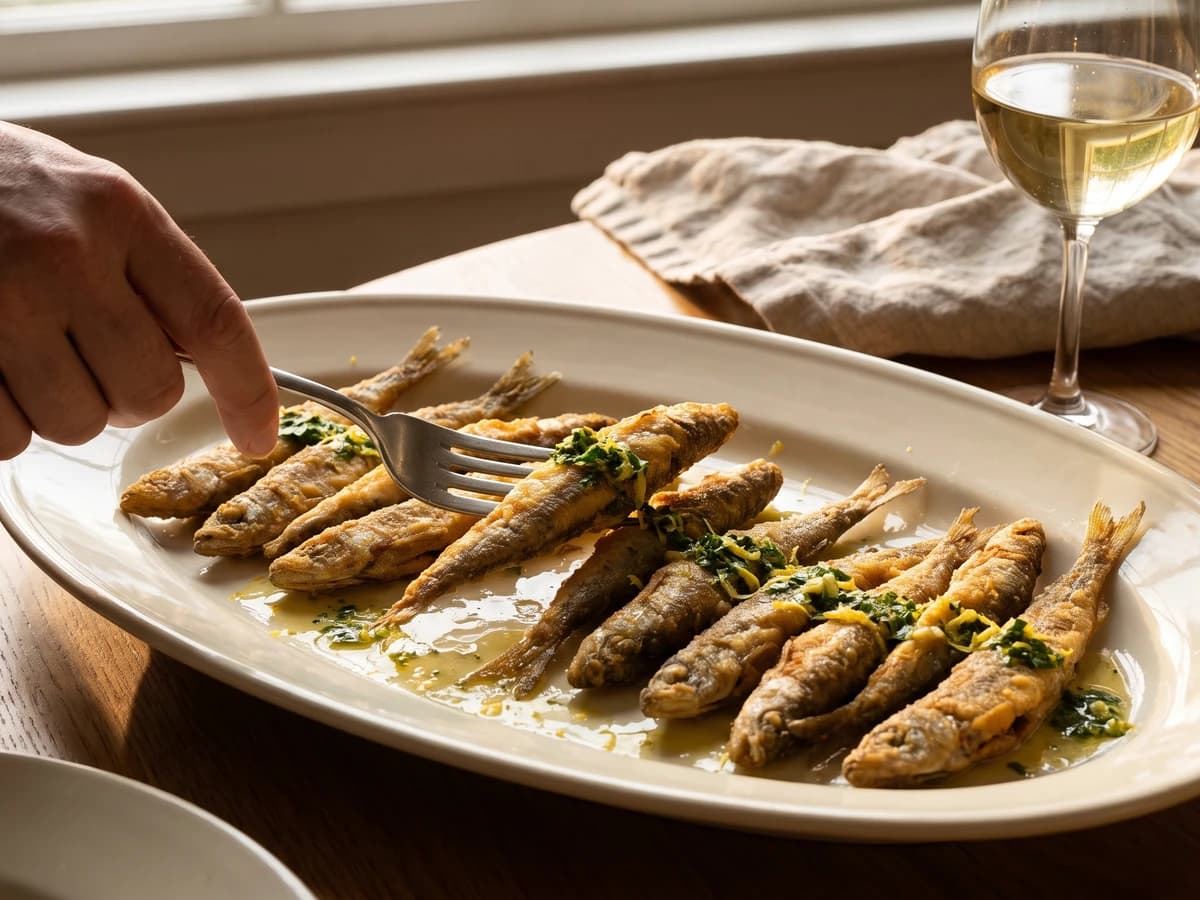
Éperlans à l’Anglaise turns small fish into a lesson in disciplined coating: boned smelts under a close, crisp crumb, pan-fried in clarified butter and finished with bright, half-melted maître d’hôtel butter.

Chef Juliette
Tiny smelts, shallot, mushrooms, white wine, gratin sauce, and fine bread raspings meet a fierce oven, where the fish must turn tender in the same breath the buttered crust bronzes.