
Chef Juliette
John Dory (St. Pierre)
John Dory has the delicacy of sole and the firmness of turbot. A light flouring, a quick butter sauté, and nut-brown beurre noisette show exactly why looks never mattered.
A cooking platform built around craft, culture, and the stories behind what we eat.
Created by Chef Juliette
Based on No. 1123, Tournedos Piémontaise, from Le Guide Culinaire (1907) by Auguste Escoffier
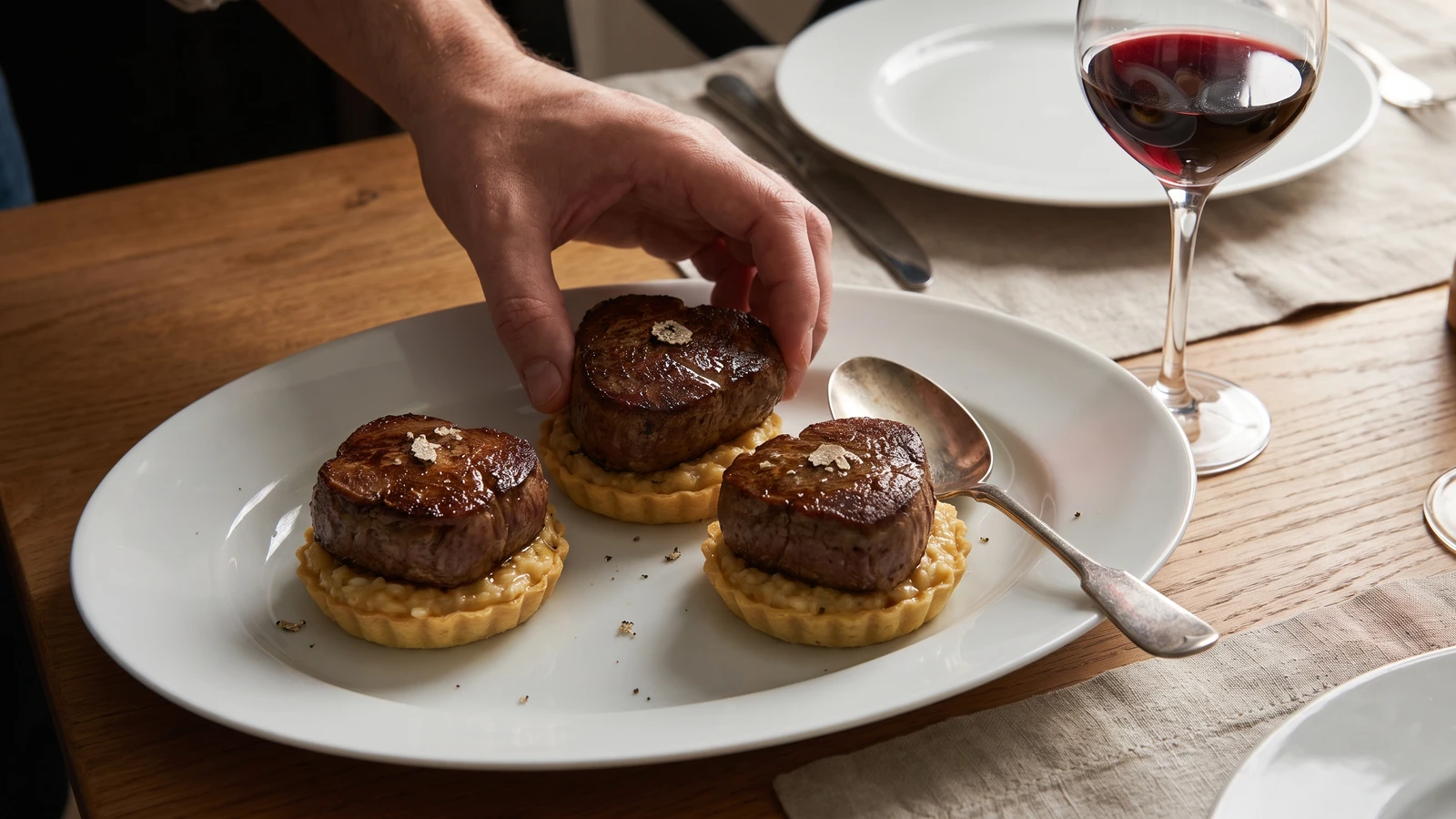
Hot, butter-seared tournedos sit on white-truffle Rizotto à la Piémontaise tartlets. The lesson is timing: mold the rice, sear the fillet fast, then bring both together at the last minute.
Tournedos Piémontaise (beef tenderloin medallions on white-truffle risotto tartlets) teaches coordination. The one true thing to know before touching the pan is that lean fillet waits for nothing: the truffled rice bases must be molded, hot, and ready to turn out before the beef begins its brief sear.
The original entry assumed a saucier on staff, a stockpot never off the fire for the named rice preparation, an entremetier filling identical tartlet moulds, and a hot cupboard holding everything for service. Your honest equivalents are prepared Rizotto à la Piémontaise, four shallow molds or ramekins, a low oven, and one broad skillet. A salamander has no work here, and neither does an invented sauce. The simultaneous station work was brigade scaffolding; the molded truffle rice and the fierce, fast cooking of the tournedos are the dish and must stay.
Turned out at the last minute, each rice tartlet should hold its shape beneath a deeply bronzed tournedos, the clarified butter still gleaming on the crust and the white truffle warming just enough to perfume the plate. Have the rice hot and the platter waiting before you sear. That order decides everything.
Piémontaise points across the Alps to Piedmont, whose rice fields and celebrated white truffles supplied the defining flavors, but the composed tournedos belongs to the French classical grand table. French cooks often used a regional adjective to identify a garnish rather than the birthplace of the complete dish; here Piémontaise means Piedmontese rice and truffle supporting a French-cut tournedos. What traveled into the canon was Piedmont's larder, arranged according to French service.
Quantity
4, each about 5½ ounces (155 g) and 1½ inches (4 cm) thick
trimmed and tied
Quantity
3 cups (720 ml / 660 g)
Quantity
2 tablespoons (30 ml / 20 g)
brushed clean and cut into small dice
Quantity
1 tablespoon (15 ml / 14 g)
softened, for the molds
Quantity
3 tablespoons (45 ml / 42 g)
divided
Quantity
1 teaspoon (5 ml / 6 g)
Quantity
½ teaspoon (2.5 ml / 1 g)
| Ingredient | Quantity |
|---|---|
| center-cut beef tenderloin tournedostrimmed and tied | 4, each about 5½ ounces (155 g) and 1½ inches (4 cm) thick |
| hot prepared Rizotto à la Piémontaise | 3 cups (720 ml / 660 g) |
| fresh white trufflebrushed clean and cut into small dice | 2 tablespoons (30 ml / 20 g) |
| unsalted buttersoftened, for the molds | 1 tablespoon (15 ml / 14 g) |
| clarified butterdivided | 3 tablespoons (45 ml / 42 g) |
| fine sea salt | 1 teaspoon (5 ml / 6 g) |
| freshly ground black pepper | ½ teaspoon (2.5 ml / 1 g) |
Set the tournedos out for twenty minutes while you prepare the molds, then pat every surface thoroughly dry. Check that each piece is tied into an even round of equal thickness, because four different shapes become four different degrees of doneness. Leave the salt and pepper beside the stove and season only when the skillet is ready.
Heat the oven to 200°F (95°C) and place the serving platter inside to warm. Butter four shallow 4-inch (10 cm) tartlet molds or 6-ounce (180 ml) ramekins generously. Fold the diced white truffle through the hot prepared Rizotto à la Piémontaise without crushing the grains, then divide it among the molds. Press just firmly enough to remove empty pockets and level the tops. Set the molds on a tray, cover loosely, and hold them in the oven for no more than fifteen minutes.
Heat a broad, heavy skillet over high heat until properly hot. Season the tournedos evenly with the salt and pepper. Add 2 tablespoons (30 ml / 28 g) of the clarified butter and swirl it across the pan; it should shimmer immediately without leaving burnt milk solids, which is precisely why clarified butter belongs here.
Set the tournedos in the skillet with space between them and leave them untouched until the first faces develop a deep Maillard bronze, about 2½ to 3 minutes. Turn once, add the remaining 1 tablespoon (15 ml / 14 g) clarified butter, and cook the second faces for another 2½ to 3 minutes, briefly rolling the edges through the butter with tongs. For medium-rare, remove them when the centers reach 125°F (52°C); they will rise as they rest. If the pan loses its heat and the meat begins releasing liquid, lift the tournedos out, pour away the liquid, reheat the skillet fiercely, and return them for a brief finishing sear. Ça se rattrape. Do not leave them simmering in their own juices.
Transfer the tournedos to the warmed edge of the platter and rest them for four minutes. Take the rice molds from the oven, run a thin knife around each rim, and invert them onto the center of the platter in a ring. If a tartlet clings or slumps, don't fuss at it with a spoon. Pack it back into the buttered mold, wait thirty seconds, and turn it out again. Ça se rattrape, and the tournedos will cover the small evidence.
Remove the strings and place one tournedos squarely on each Rizotto à la Piémontaise tartlet, arranging the four in the source entry's crown. Serve at once while the beef remains rosy and the warmth releases the truffle's perfume. The entry calls for no added sauce, so don't bury the rice beneath one. Clarified butter, bronze crust, truffle, and timing carry the plate. À table!
1 serving (about 300g)
Culinary guides, cultural storytelling, and the editorial depth that makes cooking meaningful.
Discover Culinary ExplorerChef Juliette
John Dory has the delicacy of sole and the firmness of turbot. A light flouring, a quick butter sauté, and nut-brown beurre noisette show exactly why looks never mattered.

Chef Juliette
Fresh haddock proves its delicacy in the meunière pan: a fine flour crust, moist pearly flakes, and beurre noisette sharpened with lemon and parsley, ready from one skillet in half an hour.

Chef Juliette
Éperlans à l’Anglaise turns small fish into a lesson in disciplined coating: boned smelts under a close, crisp crumb, pan-fried in clarified butter and finished with bright, half-melted maître d’hôtel butter.

Chef Juliette
Tiny smelts, shallot, mushrooms, white wine, gratin sauce, and fine bread raspings meet a fierce oven, where the fish must turn tender in the same breath the buttered crust bronzes.