
Chef Juliette
John Dory (St. Pierre)
John Dory has the delicacy of sole and the firmness of turbot. A light flouring, a quick butter sauté, and nut-brown beurre noisette show exactly why looks never mattered.
A cooking platform built around craft, culture, and the stories behind what we eat.

Created by Chef Juliette
Based on No. 1097, Tournedos Henri IV, from Le Guide Culinaire (1907) by Auguste Escoffier
Beef tenderloin, a butter-fried croûton, tepid Béarnaise, and an artichoke crown of pommes noisette: four classical elements timed by one cook, with the emulsion kept soft and alive.
Tournedos Henri IV (grilled beef tenderloin on a butter-fried bread round, ringed with Béarnaise and crowned with an artichoke bottom and pommes noisette, hazelnut-size potato balls) teaches timing. The one true thing to know before touching a pan is that Béarnaise is a warm emulsion, not a hot sauce: keep it tepid and supple, or the butter escapes from the yolks. The beef may rest for five minutes; the sauce cannot sit over heat and be bullied.
The source gives only a handful of commands because it assumed a saucier at the Béarnaise, an entremetier turning artichokes and potatoes, a grill cook at the beef, and a hot cupboard keeping the pieces aligned. It needs no stockpot and no salamander. At home, a tepid water bath replaces the saucier's station, a melon baller replaces the potato scoop, artichoke bottoms packed in water replace brigade trimming, and a low oven replaces the hot cupboard. Those are scaffolding changes, made because one pair of hands must do every job.
What cannot go is the dish itself: beef grilled deep bronze, a croûton fried in real butter, artichoke, pommes noisette, and Béarnaise laid as a thread around the meat. One cook, one stove, one evening. The step that decides the plate is the tepid hold: make the Béarnaise before the steaks meet the grill, then keep it between 115 and 122°F (46 and 50°C) while everything else comes home.
Tournedos Henri IV belongs to the named garnishes of Parisian classical service, where a title told the brigade exactly which sauce, vegetable, and potato accompanied the meat. Although Béarnaise and Henri IV both point toward Béarn, the composition is not a farmhouse dish of southwestern France; its artichoke bottom, tiny butter-cooked potatoes, fried croûton, and sauce form a grand-kitchen shorthand. The royal name is a menu convention, not evidence that Henri IV ate this tournedos, and the dish traveled well because its identity rests on a fixed assembly rather than an obscure ingredient.
Quantity
4, each 6 ounces (170 g) and about 1½ inches (4 cm) thick
Quantity
4, each about 3 inches (7.5 cm) across and ½ inch (1.25 cm) thick, about 4 ounces (115 g) total
Quantity
4, about 8 ounces (225 g) drained
rinsed and dried thoroughly
Quantity
3, about 1½ pounds (680 g)
peeled
Quantity
1 cup (240 ml / 225 g)
clarified
Quantity
6 tablespoons (90 ml / 85 g)
divided
Quantity
1 tablespoon (15 ml / 14 g)
Quantity
2 tablespoons (30 ml / 30 g)
Quantity
2 tablespoons (30 ml / 30 g)
Quantity
1, about 1 ounce (30 g)
finely chopped
Quantity
8
lightly crushed
Quantity
4
Quantity
2 tablespoons (30 ml / 6 g)
finely chopped
Quantity
1 tablespoon (15 ml / 3 g)
finely chopped
Quantity
3
preferably pasteurized
Quantity
1
preferably pasteurized
Quantity
3 tablespoons (45 ml / 45 g)
divided
Quantity
to taste
Quantity
to taste
| Ingredient | Quantity |
|---|---|
| center-cut beef tenderloin tournedos | 4, each 6 ounces (170 g) and about 1½ inches (4 cm) thick |
| firm white pain de mie rounds | 4, each about 3 inches (7.5 cm) across and ½ inch (1.25 cm) thick, about 4 ounces (115 g) total |
| cooked artichoke bottoms packed in waterrinsed and dried thoroughly | 4, about 8 ounces (225 g) drained |
| large Yukon Gold potatoespeeled | 3, about 1½ pounds (680 g) |
| unsalted butter for the Béarnaiseclarified | 1 cup (240 ml / 225 g) |
| unsalted butter for the croûtons, artichokes, and potatoesdivided | 6 tablespoons (90 ml / 85 g) |
| neutral oil | 1 tablespoon (15 ml / 14 g) |
| dry white wine | 2 tablespoons (30 ml / 30 g) |
| white wine vinegar | 2 tablespoons (30 ml / 30 g) |
| small shallotfinely chopped | 1, about 1 ounce (30 g) |
| black peppercornslightly crushed | 8 |
| fresh tarragon stems | 4 |
| fresh tarragon leavesfinely chopped | 2 tablespoons (30 ml / 6 g) |
| fresh chervilfinely chopped | 1 tablespoon (15 ml / 3 g) |
| large egg yolkspreferably pasteurized | 3 |
| additional large egg yolk for Béarnaise rescue (optional)preferably pasteurized | 1 |
| cold waterdivided | 3 tablespoons (45 ml / 45 g) |
| fine sea salt | to taste |
| freshly ground black pepper | to taste |
Preheat the oven to 200°F (95°C) and set a wire rack over a small sheet pan. Melt the cup of butter gently, skim away the surface foam, then pour the clear golden butterfat into a jug, leaving the milky sediment behind. Keep this clarified butter near 120°F (49°C). Combine the wine, vinegar, shallot, peppercorns, and tarragon stems in a small saucepan. Boil gently until only 1 tablespoon of sharp, fragrant liquid remains, then strain and let it cool. Reduction is the spine of Béarnaise; leave it watery and the sauce tastes weak, reduce it dry and the acidity disappears.
Use a small melon baller, about ⅝ inch (1.5 cm), to cut at least 28 even balls from the potatoes. Keep the trimmings for soup or purée. Rinse the potato balls until the water runs clear, then dry them very thoroughly. Trim the bread into neat rounds matching the width of the tournedos. Rinse the artichoke bottoms briefly, pat them dry, and set them cup-side up. Tie each tournedos around its middle with butcher's twine if it is not already holding a compact round shape, then leave the beef out for about 30 minutes.
Melt 2 tablespoons of the butter in a skillet over medium heat. Fry the bread rounds for 2 to 3 minutes per side, adding them only after the butter foams, until both faces are evenly golden and crisp at the edges. Transfer them to the rack in the low oven. Add 1 tablespoon butter to the skillet and warm the artichoke bottoms gently for about 2 minutes per side. Season lightly and hold them cup-side up beside the croûtons. The oven is a holding cupboard here, not a second cooking stage, so keep it low.
Set a heatproof bowl over a saucepan of barely simmering water without letting the bowl touch the water. Whisk the 3 yolks with the cooled reduction and 1 tablespoon of the cold water until pale, swollen, and thick enough to leave a ribbon, about 4 minutes; the mixture should reach about 145°F (63°C). Remove the bowl from the heat. Whisk in the warm clarified butter first by droplets, then in a thin steady stream once the emulsion has taken hold. Fold in the chopped tarragon and chervil, then season with salt and pepper. Hold the bowl over tepid water between 115 and 122°F (46 and 50°C) for no longer than 45 minutes. If the sauce merely tightens, whisk in reserved water a teaspoon at a time. If it turns oily or grainy, stop. Ça se rattrape: whisk the optional fresh yolk with 1 teaspoon reserved cold water in a clean bowl, then add the broken sauce one teaspoon at a time until it reforms. Never put Béarnaise over direct heat.
Melt the remaining 3 tablespoons butter in a clean skillet over medium-low heat. Add the completely dry potato balls in one layer, season with salt, and roll them through the butter every couple of minutes until tender inside and butter-gold all over, about 12 to 16 minutes. If they brown before a knife tip enters easily, add 1 tablespoon of the reserved water and cover for 2 minutes; uncover, let the water evaporate, and continue rolling them until the butter gloss returns. Hold the finished pommes noisette on the rack in the low oven while the beef cooks.
Heat a heavy cast-iron grill pan over high heat until thoroughly hot. Pat the tournedos dry, brush them with the neutral oil, and season firmly with salt and pepper. Grill without shifting them for 3 to 4 minutes, turn once, and cook the second side for another 3 to 4 minutes. Briefly press the rounded edges against the pan with tongs if they remain pale. For medium-rare, remove the beef at 125 to 130°F (52 to 54°C); it will rise as it rests. Rest the tournedos uncovered on a rack for 5 minutes, then remove the twine. Covering them traps moisture and softens the grilled surface.
Whisk the Béarnaise once and loosen it with a few drops of tepid water if it no longer falls softly from the spoon. Place one butter-fried croûton on each warm plate and settle a rested tournedos on top. Lay a thin thread of Béarnaise around the upper edge of each steak, keeping the centre clear. Set an artichoke bottom on top, cup-side up, and crown it with 6 or 7 pommes noisette. Carry the remaining Béarnaise in a warmed sauceboat. The source also permits serving all the sauce separately, which is the sensible choice if the plates must wait even a minute. À table!
1 serving (about 435g)
Culinary guides, cultural storytelling, and the editorial depth that makes cooking meaningful.
Discover Culinary ExplorerChef Juliette
John Dory has the delicacy of sole and the firmness of turbot. A light flouring, a quick butter sauté, and nut-brown beurre noisette show exactly why looks never mattered.

Chef Juliette
Fresh haddock proves its delicacy in the meunière pan: a fine flour crust, moist pearly flakes, and beurre noisette sharpened with lemon and parsley, ready from one skillet in half an hour.
Chef Juliette
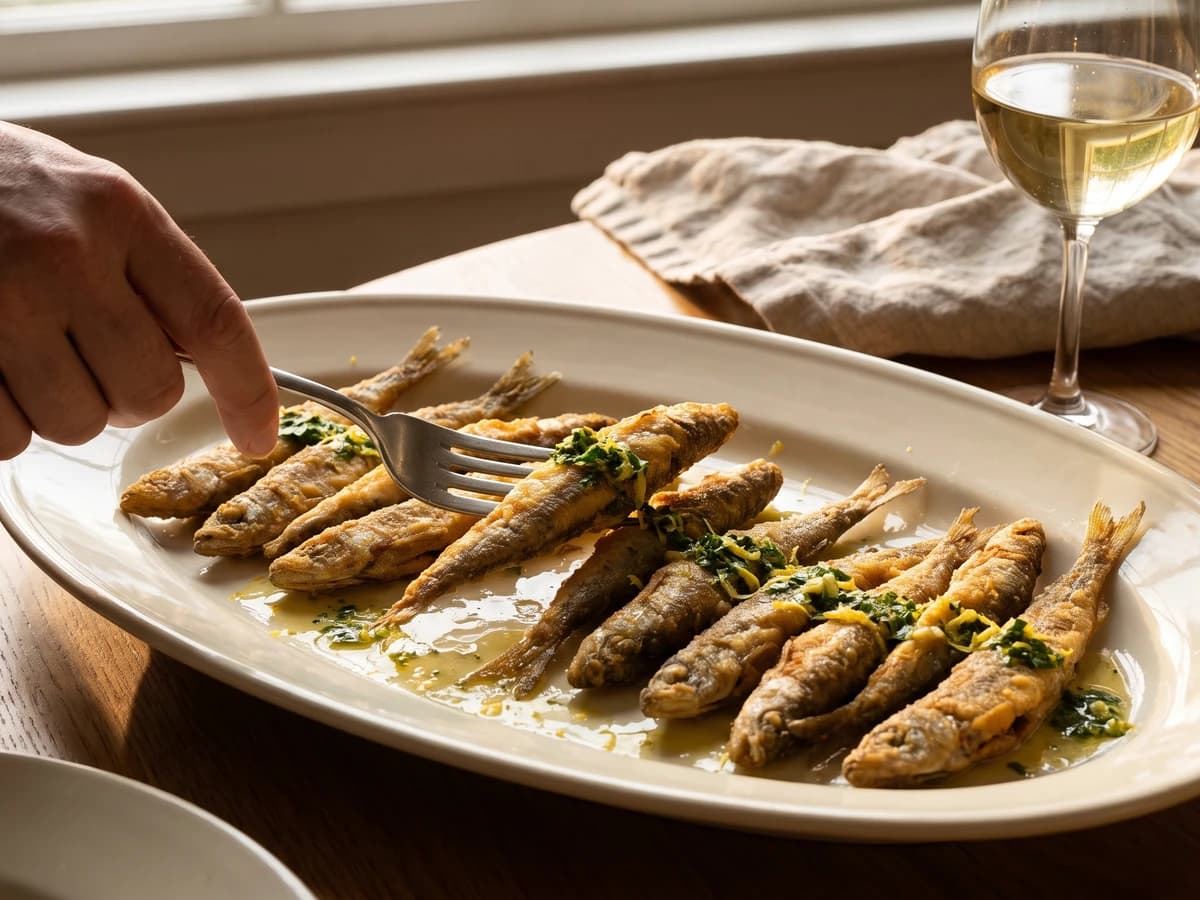
Éperlans à l’Anglaise turns small fish into a lesson in disciplined coating: boned smelts under a close, crisp crumb, pan-fried in clarified butter and finished with bright, half-melted maître d’hôtel butter.

Chef Juliette
Tiny smelts, shallot, mushrooms, white wine, gratin sauce, and fine bread raspings meet a fierce oven, where the fish must turn tender in the same breath the buttered crust bronzes.