
Chef Juliette
John Dory (St. Pierre)
John Dory has the delicacy of sole and the firmness of turbot. A light flouring, a quick butter sauté, and nut-brown beurre noisette show exactly why looks never mattered.
A cooking platform built around craft, culture, and the stories behind what we eat.
Created by Chef Juliette
Based on No. 1038, Matelote au Vin Blanc, from Le Guide Culinaire (1907) by Auguste Escoffier
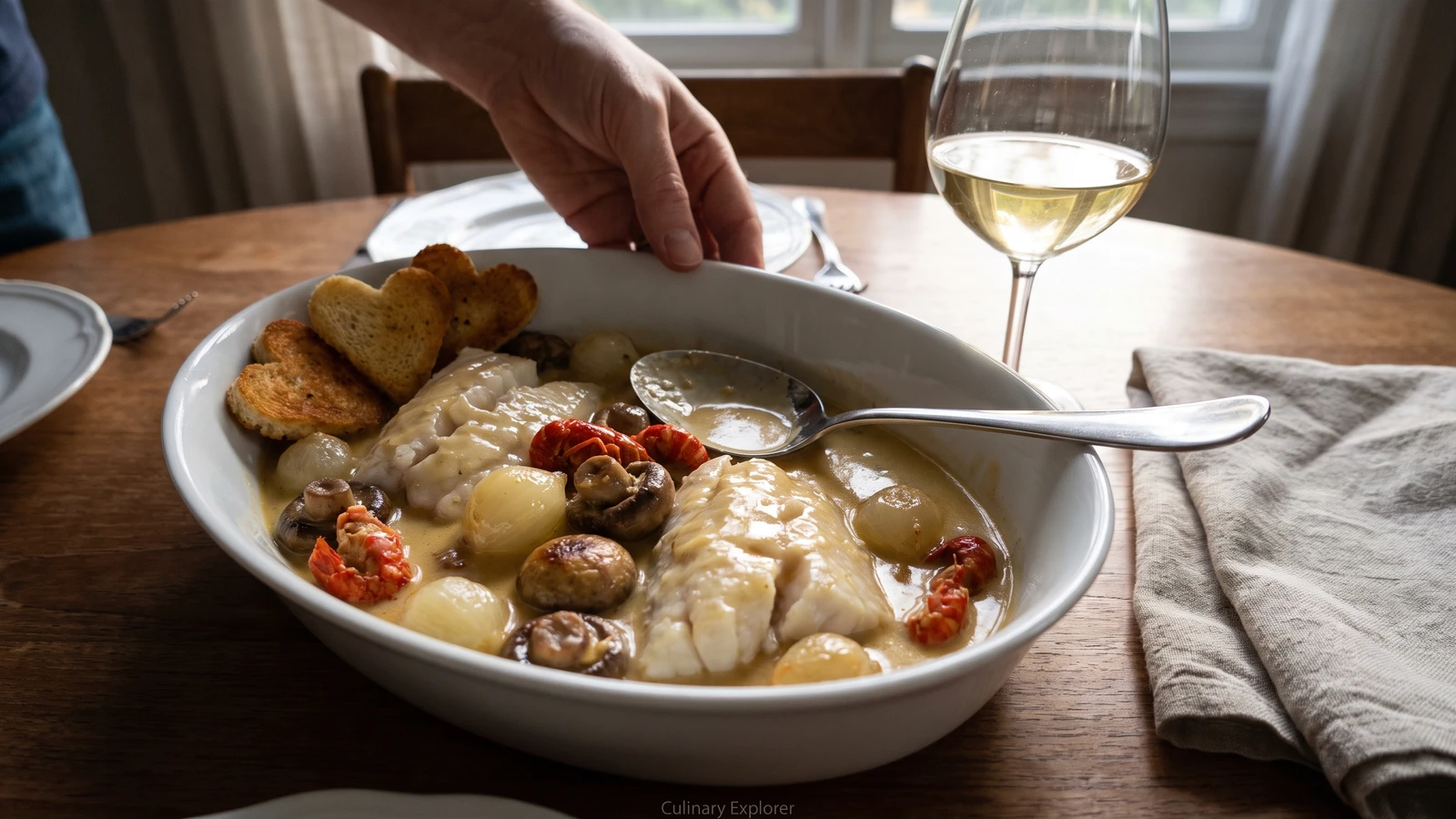
Fish poached gently in white wine, its liquor reduced and joined with fish velouté, then mounted with butter and ringed by crayfish and heart croûtons: company cooking built on control, not fuss.
Matelote au Vin Blanc (mixed fish poached in white wine) teaches one essential discipline: the fish and its sauce run on separate clocks. Lift each piece the moment it is barely cooked, then reduce the liquor without it. Leave the fish in while the wine concentrates and you will have a splendid sauce surrounding dry fish, which is a rather expensive way to learn patience.
The original kitchen assumed mixed river fish arriving whole, fish velouté waiting beside a stockpot that never went cold, a saucier watching the reduction, and other hands cooking onions, mushrooms, crayfish, and croûtons. Here, evenly cut boneless fish replaces an awkward assortment of bony pieces, and the cooked fish waits directly in a warmed deep serving dish instead of passing through another saucepan and a timbale. That extra holding pan was brigade scaffolding. The reduction to a little less than half, the fish velouté, the cold-butter finish, and the ring of crayfish and heart croûtons are the dish itself, so all of them stay. One cook, one stove, one evening.
Have every garnish finished before the fish meets the wine. Once poaching begins, give the pan your full attention and lift the pieces individually as they become opaque and yield under gentle pressure. That moment decides the matelote.
Matelote belongs to the river tables of Île-de-France, particularly the inns and guinguettes along the Seine and Marne, where mixed freshwater fish from the day's catch were simmered in wine. The classical kitchen carried that boatmen's stew into formal service by straining and reducing its liquor, binding it with fish velouté, and surrounding the finished dish with crayfish and butter-fried croûtons. Despite the pale, glossy sauce, this white-wine version is not cream based: reduction and velouté give it body, while the final butter supplies its sheen.
Quantity
1 lb (450 g)
skinned, boned, and cut into 2-inch pieces
Quantity
1 lb (450 g)
skinned, boned, and cut into 2-inch pieces
Quantity
1¼ teaspoons (6 ml / 7.5 g)
divided
Quantity
½ teaspoon (2.5 ml / 1 g)
Quantity
7 tablespoons (105 ml / 100 g)
divided
Quantity
1 cup (240 ml / 150 g), from 1 medium onion
thinly sliced
Quantity
1
Quantity
¼ cup (60 ml / 57 g)
Quantity
3 cups (720 ml / 710 g)
Quantity
1¼ cups (300 ml / 200 g), about 12
peeled
Quantity
2 cups (475 ml / 225 g)
trimmed and halved only if large
Quantity
1¼ cups (300 ml / 310 g)
Quantity
2 tablespoons (30 ml / 28 g)
diced
Quantity
4 cups (960 ml / 960 g)
Quantity
8 (14 oz / 400 g)
rinsed
Quantity
8 slices (7 oz / 200 g), about ½ inch thick
cut into small hearts
| Ingredient | Quantity |
|---|---|
| dense fish, such as eel or monkfishskinned, boned, and cut into 2-inch pieces | 1 lb (450 g) |
| firm-flaked fish, such as pike, perch, hake, or halibutskinned, boned, and cut into 2-inch pieces | 1 lb (450 g) |
| fine sea saltdivided | 1¼ teaspoons (6 ml / 7.5 g) |
| freshly ground white pepper | ½ teaspoon (2.5 ml / 1 g) |
| unsalted butter for cookingdivided | 7 tablespoons (105 ml / 100 g) |
| yellow onionthinly sliced | 1 cup (240 ml / 150 g), from 1 medium onion |
| bouquet garni of parsley stems, thyme, and bay leaf | 1 |
| brandy | ¼ cup (60 ml / 57 g) |
| dry white wine | 3 cups (720 ml / 710 g) |
| pearl onionspeeled | 1¼ cups (300 ml / 200 g), about 12 |
| small button mushroomstrimmed and halved only if large | 2 cups (475 ml / 225 g) |
| prepared fish velouté | 1¼ cups (300 ml / 310 g) |
| cold unsalted butter for finishingdiced | 2 tablespoons (30 ml / 28 g) |
| prepared court-bouillon | 4 cups (960 ml / 960 g) |
| whole raw crayfishrinsed | 8 (14 oz / 400 g) |
| firm white breadcut into small hearts | 8 slices (7 oz / 200 g), about ½ inch thick |
Keep the cut fish cold while you finish every garnish. Set the prepared fish velouté beside the stove, measure the brandy into a small cup rather than leaving it in the bottle, and place a tight-fitting lid within reach for the flambage. Warm a deep serving dish shortly before the fish is cooked. Once the poaching begins, there should be nothing left to peel, slice, or hunt through a cupboard.
Bring the court-bouillon to a full boil in a covered saucepan. Before adding the crayfish, reserve ½ cup (120 ml) of the clean liquid for cooking the onions and adjusting the sauce. Lower in the crayfish, cover, and cook for 4 to 6 minutes after the liquid returns to the boil, until the shells are scarlet and the tail meat is opaque and firm. Lift them out immediately and keep them covered; prolonged boiling makes the tails rubbery.
Melt 2 tablespoons of the cooking butter in a skillet over medium-low heat. Add the pearl onions with ¼ cup of the reserved court-bouillon, cover, and cook gently for 10 to 12 minutes. Uncover and roll them through the remaining butter until tender and lightly glazed, without browning them hard. Transfer them to a plate. Raise the heat, add another 2 tablespoons butter and the mushrooms, then sauté until their moisture has evaporated and their edges are golden. Season both garnishes sparingly and hold them together.
Wipe the skillet clean and melt 2 tablespoons butter over medium heat. Fry the bread hearts in a single layer until crisp and butter-gold on both sides, adding only a little of the remaining butter if the pan dries. Drain them on a rack rather than paper so their undersides remain crisp. These croûtons are not decoration pasted onto the plate; they are there to catch the sauce.
Melt the final tablespoon of cooking butter in a wide sauté pan. Soften the sliced onion for 4 to 5 minutes without colouring it, then add the bouquet garni. Season the fish with most of the salt and the white pepper, and arrange the pieces over the aromatics. Remove the pan from the burner, pour in the measured brandy, and return it to low heat for about 20 seconds. Draw the pan away again, ignite the brandy at the edge with a long taper, and stand back while the flame subsides. Never pour brandy from its bottle near a flame. If it does not ignite promptly, stop trying and simmer it for 90 seconds before continuing. Pour in the white wine, bring it only to a bare tremble, and cover partly. Check the fish after 4 minutes, lifting out each piece as soon as it turns opaque and yields gently at the centre; most pieces will need 5 to 9 minutes, depending on density.
Arrange the cooked fish in the warmed deep serving dish with the pearl onions and mushrooms, keeping the pieces close but not piled. Cover loosely and hold it in a warm place for no more than 15 minutes. Strain the poaching liquor through a fine sieve into a measuring jug without pressing the aromatics, then return it to the wide pan. The original second holding saucepan can go; the serving dish performs that job perfectly well at home.
Measure the strained liquor, then boil it briskly until a little less than half remains. Three cups should finish near 1⅓ cups, though the fish may have contributed enough liquid to alter the starting amount. Trust the measure and the taste, not the clock. The reduction should smell rounded and vinous, without the raw edge of newly poured wine.
Lower the heat and whisk in the prepared fish velouté a little at a time. Simmer gently for 4 to 6 minutes, skimming if necessary, until the sauce is smooth, glossy, and nappant, meaning it coats the back of a spoon without running off like broth. If it remains thin, give it another minute of reduction. If it tightens too far, whisk in the reserved court-bouillon one spoonful at a time. Taste before adding the remaining salt, because both the velouté and the reduced liquor already carry seasoning.
Take the pan completely off the heat. Monter au beurre, mount the sauce with butter, by whisking in the cold diced butter a few pieces at a time until the sauce takes on a supple sheen. Do not boil it again. If the butter separates into oily beads, stop adding it and whisk 1 teaspoon of cold water in a clean bowl, then incorporate the broken sauce gradually. Ça se rattrape.
Pour the sauce evenly over the fish, onions, and mushrooms, letting it pool generously in the dish. Arrange the crayfish around the rim with the butter-fried heart croûtons between them. Serve at once while the fish is tender and the croûtons still resist the spoon. À table!
1 serving (about 550g)
Culinary guides, cultural storytelling, and the editorial depth that makes cooking meaningful.
Discover Culinary ExplorerChef Juliette
John Dory has the delicacy of sole and the firmness of turbot. A light flouring, a quick butter sauté, and nut-brown beurre noisette show exactly why looks never mattered.

Chef Juliette
Fresh haddock proves its delicacy in the meunière pan: a fine flour crust, moist pearly flakes, and beurre noisette sharpened with lemon and parsley, ready from one skillet in half an hour.

Chef Juliette
Éperlans à l’Anglaise turns small fish into a lesson in disciplined coating: boned smelts under a close, crisp crumb, pan-fried in clarified butter and finished with bright, half-melted maître d’hôtel butter.

Chef Juliette
Tiny smelts, shallot, mushrooms, white wine, gratin sauce, and fine bread raspings meet a fierce oven, where the fish must turn tender in the same breath the buttered crust bronzes.