
Chef Lupita
Arroz a la Oaxaqueña
Oaxaca's red rice, stained with tomato and fried in lard, steamed with carrots, ejotes, black beans, and epazote. The side that anchors a Oaxacan family meal and earns its place beside the main.
A cooking platform built around craft, culture, and the stories behind what we eat.
Created by
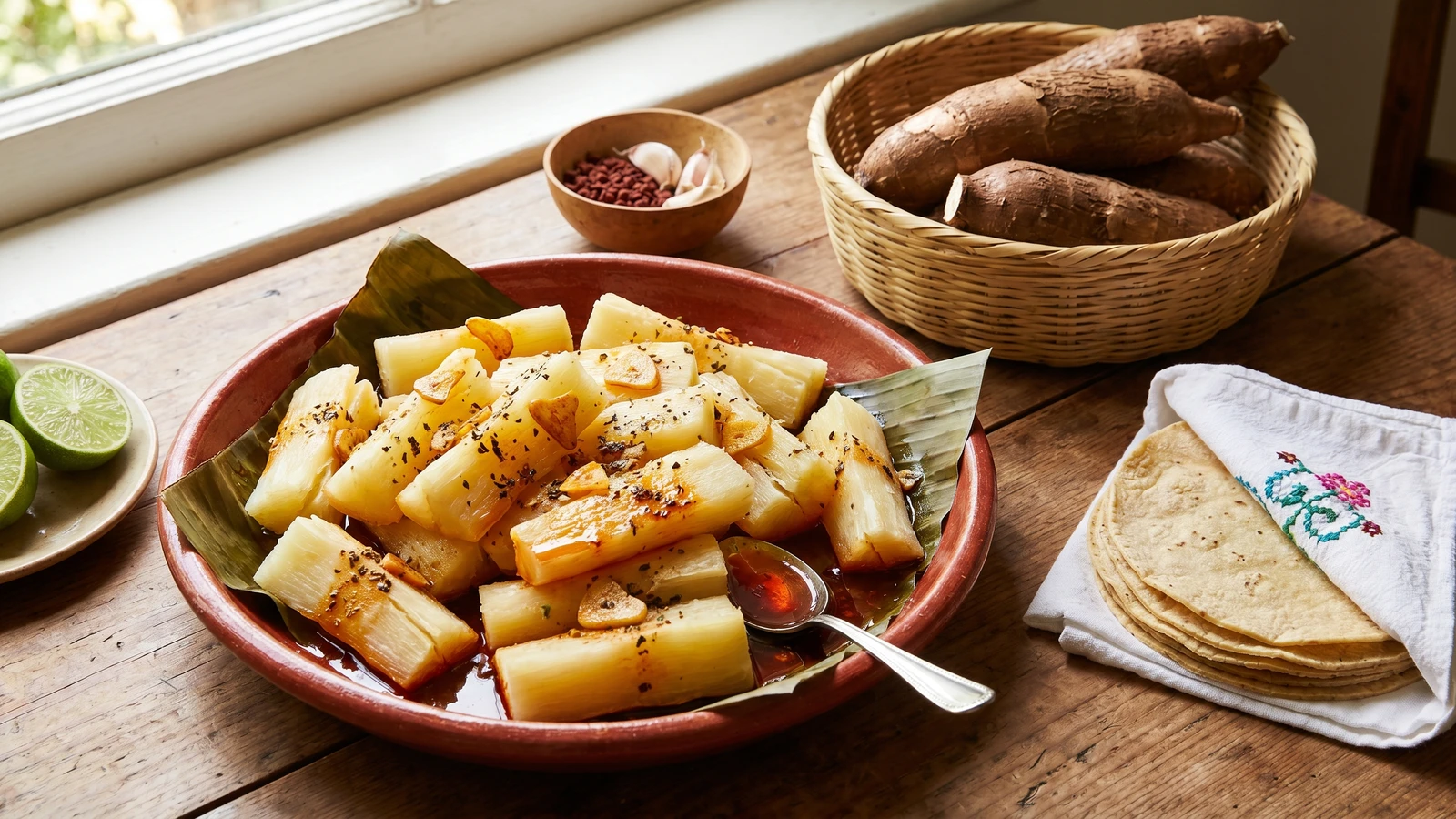
Veracruz's coastal yuca, boiled until the fibers loosen, then tossed in a hot garlic, achiote, olive oil, and vinegar mojo that belongs beside fried mojarra or robalo.
Veracruz, especially the Sotavento coast and the port kitchens facing the Gulf, is where this yuca belongs in Mexico. The road from Alvarado to Tlacotalpan teaches you the smell first: fish frying, garlic hitting oil, cane vinegar sharp enough to clear your head. This is jarocho home food, a side dish set next to mojarra frita, robalo, black beans, and tortillas wrapped in a servilleta.
The ingredient that defines it is yuca, yes, but the technique is the mojo. You sancochar the root until the edges open, then dress it while hot so the garlic oil slips into the fibers. The women I learned from in Veracruz did not mash it, did not bury it in cheese, and did not pretend every Mexican dish needs chile. Ajo, achiote, vinagre de cana, aceite de oliva. Asi se hace y punto.
Yuca, malanga, and platano macho sit in Veracruz kitchens because the Gulf was never closed. Indigenous roots, Caribbean traffic, Spanish port ingredients, and Afro-Mexican hands made a pantry that is not Oaxaca, not Yucatan, not Cuba. Veracruz is Veracruz. The mojo tastes of that crossing without losing its accent.
My mother was from Jalisco, so this was not her daily food, but she understood the rule: if the market gives you a good root and good garlic, do not complicate it. Cook it correctly. Feed people well. Saber cocinar es saber vivir.
Yuca, also called cassava or mandioca, was domesticated in tropical South America thousands of years before the conquest and moved through Caribbean and Gulf trade routes long before modern borders existed. After Villa Rica de la Vera Cruz was founded by Spaniards in 1519, the Gulf port became a main entry point for olive oil and vinegar, and for enslaved Africans whose descendants helped define jarocho cooking. The use of yuca, malanga, and platano macho with garlic-vinegar sauces belongs to that Atlantic coast history, not to a single pan-Latin category.
Quantity
2 1/2 pounds
peeled through the pink layer and cut into 3-inch pieces
Quantity
2 quarts, or enough to cover the yuca by 1 inch
Quantity
1 tablespoon, plus more to taste
Quantity
1/2 medium
Quantity
2
Quantity
1/2 cup
Quantity
1 tablespoon
Quantity
10
thinly sliced
Quantity
1
stemmed and left whole
Quantity
1/3 cup
Quantity
1 teaspoon
crumbled
Quantity
1/2 teaspoon
Quantity
2 tablespoons, as needed
Quantity
for serving
| Ingredient | Quantity |
|---|---|
| fresh yuca (cassava)peeled through the pink layer and cut into 3-inch pieces | 2 1/2 pounds |
| water | 2 quarts, or enough to cover the yuca by 1 inch |
| kosher salt | 1 tablespoon, plus more to taste |
| white onion | 1/2 medium |
| bay leaves | 2 |
| extra-virgin olive oil | 1/2 cup |
| achiote seeds | 1 tablespoon |
| large garlic clovesthinly sliced | 10 |
| dried chile de arbol (optional)stemmed and left whole | 1 |
| vinagre de cana (Mexican cane vinegar) | 1/3 cup |
| dried Mexican oreganocrumbled | 1 teaspoon |
| freshly ground black pepper | 1/2 teaspoon |
| reserved yuca cooking water (optional) | 2 tablespoons, as needed |
| lime halves (optional) | for serving |
Cut off the ends of the yuca. Peel away the brown bark and the pink layer underneath. You want clean white flesh. If you see gray streaks, black lines, or a sour smell, throw that piece away. Raw yuca is not for tasting. It needs full cooking. Preguntale a las senoras del mercado and they will tell you the same thing.
Put the yuca in a heavy pot with the water, kosher salt, white onion, and bay leaves. Bring to a steady boil, then lower to a strong simmer. Cook 25 to 35 minutes, until the edges split open and a knife slides through without resistance. Do not cook it al dente. Yuca should surrender, not fight your teeth.
Reserve 1/2 cup of the cooking water, then drain the yuca. Discard the onion and bay leaves. While the pieces are still warm, split them open and pull out the tough fibrous core from the center. Keep the yuca covered so it stays tender while you make the mojo.
Set a wide clay cazuela or heavy skillet over medium-low heat. Add the olive oil and achiote seeds. Cook 2 to 3 minutes, stirring, until the oil turns brick red and smells earthy. Spoon out and discard the seeds. The achiote gives color and coastal Veracruz character. Do not burn it.
Add the sliced garlic to the achiote oil. Add the whole chile de arbol if using. Cook slowly, stirring often, until the garlic turns pale gold, 3 to 5 minutes. Not brown. Brown garlic is bitter garlic, and bitter garlic will bully the whole cazuela.
Carefully pour in the vinagre de cana. It will jump when it hits the oil. Stir in the Mexican oregano, black pepper, and 1/2 teaspoon salt. Simmer for 1 minute, just long enough for the vinegar to lose its raw edge. If the mojo looks too tight, add 1 or 2 tablespoons of the reserved yuca water.
Add the warm yuca to the cazuela and turn it gently through the mojo. Use a spoon to bathe the split edges with the garlic oil. Cook 3 to 4 minutes, until the yuca drinks in the oil and vinegar without falling apart. Do not mash it. This is yuca sancochada, not puree. Asi se hace y punto.
Spoon the yuca into a red barro cazuela or carry the cooking cazuela straight to the table. Scrape every slice of garlic over the top. Serve with lime halves, fried mojarra or robalo, black beans, and warm corn tortillas. No cheese, no crema, no decoration pretending to be tradition. Cada estado, su propia cocina.
1 serving (about 310g)
Culinary guides, cultural storytelling, and the editorial depth that makes cooking meaningful.
Discover Culinary ExplorerChef Lupita
Oaxaca's red rice, stained with tomato and fried in lard, steamed with carrots, ejotes, black beans, and epazote. The side that anchors a Oaxacan family meal and earns its place beside the main.

Chef Lupita
Sinaloa's home-cook white rice topped with cold cubes of cream cheese that soften into the warm grain, finished with crema and a sprinkle of chiltepin at the table. The trick that makes a side dish feel like a small luxury.

Chef Lupita
Sonora's white rice, toasted in butter and steamed with sweet corn and tender peas. The clean, quiet partner to a plate of carne asada, not the red rice of central Mexico.

Chef Lupita
Yucatán's white rice with sweet corn kernels, toasted in lard with garlic and onion. The quiet base that holds up against the peninsula's bold achiote-stained stews.