
Chef Lupita
Acúmara Tatemada al Comal
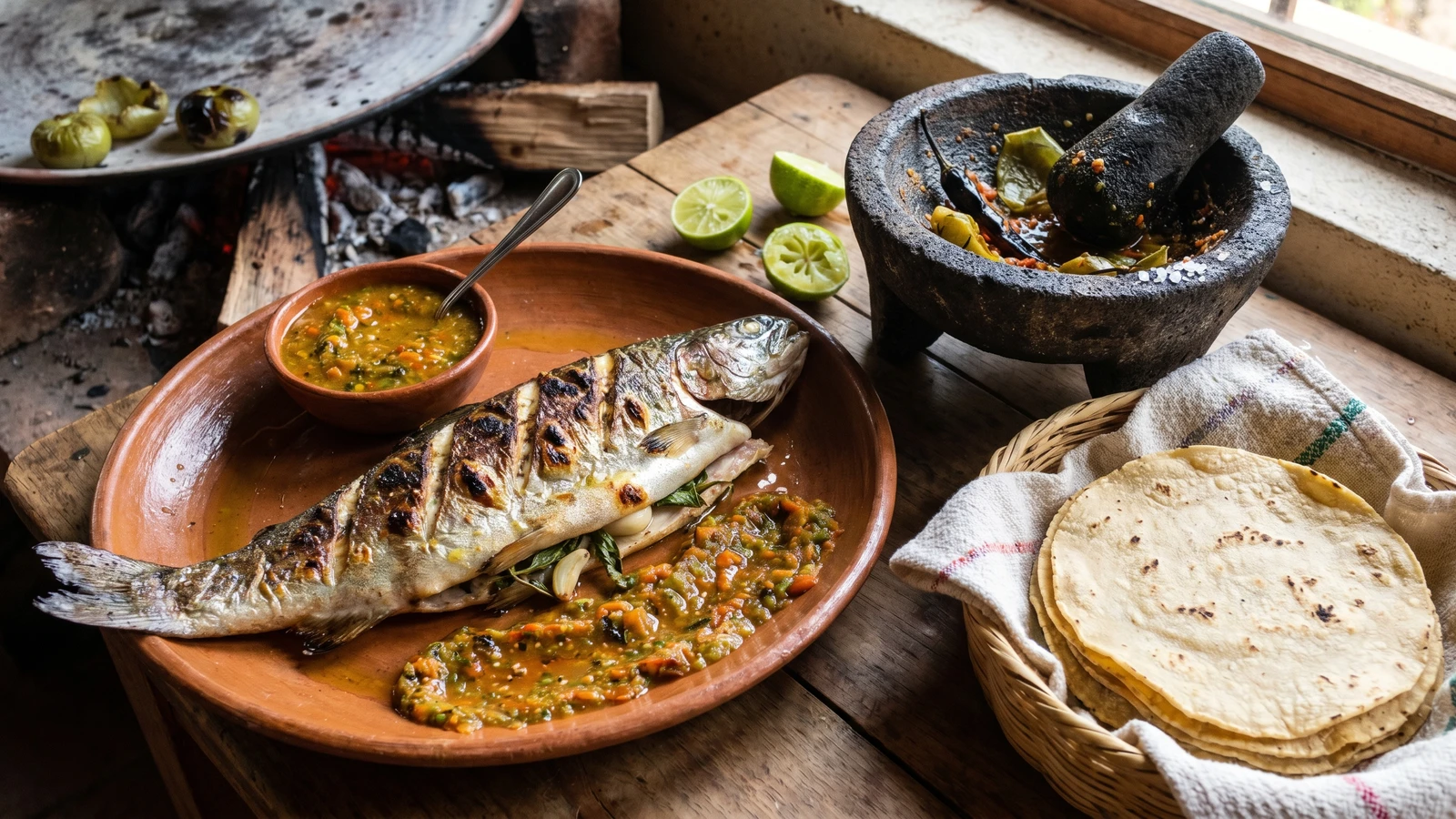
Michoacán's Lake Pátzcuaro acúmara, a whole kurucha from the lago tatemada on a comal de leña and served with chile perón atápakua, corn tortillas, and P'urhépecha discipline.
A cooking platform built around craft, culture, and the stories behind what we eat.
Created by
Michoacán's eastern highland trout, cooked whole over carbón and finished with lime, epazote, and salsa de chile perón, the mountain answer to the kurucha of Lake Pátzcuaro.
Michoacán, the eastern sierra around Zitácuaro, is where this trucha lives. Not in the lago of Pátzcuaro, not as pescado blanco, but in cold mountain ponds fed by springs near the monarch forests, where the fish can go from water to parrilla the same day.
The chile that marks the plate is chile perón, round, thick-fleshed, orange or yellow when ripe, with black seeds and a sharp fruit underneath the heat. You roast it on a comal with tomatillo milpero, onion, and garlic, then grind it rough. The salsa should taste like Michoacán highland air: green, direct, a little wild. If your chile vendor gives you jalapeños and calls that good enough, pregúntale a las señoras del mercado and start again.
When I traveled Michoacán, the cocineras tradicionales of Zacán, Janitzio, Cocucho, Cherán, and Uruapan taught me the grammar of this kitchen. The milpa gives the tomatillo and tortilla. The monte gives epazote, leña, and the discipline of fire. The lago gives kurucha and acúmara, and the mountain farms around Zitácuaro give this newer trout. Different water, same seriousness.
Do not drown the fish in batter. Do not hide it under cheese. Score it, salt it, brush it with manteca, and cook it whole until the skin browns and the flesh releases from the bone. The salsa goes beside it, the tortillas go in a servilleta, and the barro goes to the center of the table. Así se hace y punto.
Rainbow trout, trucha arcoiris, is not pre-Columbian to Michoacán; aquaculture programs expanded it in cold mountain zones during the 20th century, including eastern municipalities such as Zitácuaro, where spring-fed ponds suited the fish. Michoacán's older fish cookery belongs to P'urhépecha lake communities around Pátzcuaro, where kurucha and acúmara were tied to the lago long before the Cazonci ruled from Tzintzuntzan in the late Postclassic period. The 2010 UNESCO recognition of Traditional Mexican Cuisine used the Michoacán paradigm, including milpa systems and the public work of cocineras tradicionales, to show that ingredients, technique, and community transmission are one system.
Quantity
4, about 10 to 12 ounces each
scaled, gutted, rinsed, and patted very dry
Quantity
2 teaspoons
divided
Quantity
4
divided
Quantity
3 tablespoons
for the trout
Quantity
1/2 teaspoon
crumbled
Quantity
8
Quantity
4 tablespoons
melted
Quantity
12
husked and rinsed
Quantity
3 to 4
stemmed
Quantity
1/4 medium
Quantity
1/2 cup
Quantity
1 tablespoon
for the salsa
Quantity
2 tablespoons
only if needed to loosen the salsa
Quantity
for serving
warmed
Quantity
for serving
| Ingredient | Quantity |
|---|---|
| whole rainbow troutscaled, gutted, rinsed, and patted very dry | 4, about 10 to 12 ounces each |
| sal de grano or kosher saltdivided | 2 teaspoons |
| garlic clovesdivided | 4 |
| fresh lime juicefor the trout | 3 tablespoons |
| dried Mexican oreganocrumbled | 1/2 teaspoon |
| fresh epazote sprigs | 8 |
| manteca de cerdomelted | 4 tablespoons |
| tomatillos milperoshusked and rinsed | 12 |
| fresh chile perónstemmed | 3 to 4 |
| white onion | 1/4 medium |
| fresh cilantro leaves and tender stems | 1/2 cup |
| fresh lime juicefor the salsa | 1 tablespoon |
| warm water (optional)only if needed to loosen the salsa | 2 tablespoons |
| hand-pressed corn tortillas (optional)warmed | for serving |
| lime halves (optional) | for serving |
Lay the trout on a board and pat them dry again. Make three shallow diagonal cuts on each side, down to the flesh but not through the backbone. Whole fish needs these cuts so the salt, lime, and heat reach the thickest part before the skin burns. Wet fish sticks to the parrilla. Dry fish behaves.
In a molcajete, grind 2 garlic cloves with 1 teaspoon of salt until you have a rough paste. Stir in the 3 tablespoons lime juice and the crumbled Mexican oregano. Rub this into the cuts and inside the belly of each trout. Tuck 2 sprigs of epazote into each cavity and let the fish rest for 15 minutes. No more. Lime is useful, but leave fish in lime too long and it tightens like rope.
Heat a dry comal over medium heat, preferably over leña or carbón. Roast the tomatillos milperos, chile perón, onion, and the remaining 2 unpeeled garlic cloves. Turn everything with tongs. The tomatillos should soften and turn olive-gold with blackened patches, the chile perón should blister, and the garlic should feel soft inside its skin. This is where the salsa gets its backbone.
Peel the roasted garlic. Grind it in the molcajete with the remaining 1 teaspoon salt. Add the roasted onion and chile perón, then grind to a rough paste. Add the tomatillos and crush them until the salsa is loose but still textured. Stir in the cilantro and 1 tablespoon lime juice. Add warm water only if the salsa is too thick to spoon. Do not make it smooth. A blender works only if you pulse it. No me vengas con atajos that turn a molcajete salsa into green soup.
Build a medium fire with carbón, or heat a heavy cast iron comal or grill pan until a drop of water jumps on contact. Brush the grate or pan with a little melted manteca. Brush the trout on both sides with the remaining manteca. La manteca es el sabor, but here it also protects the skin and carries the garlic into the heat.
Set the trout on the parrilla and leave them alone for 5 to 7 minutes. The skin will release when it is ready. Flip once, carefully, and cook the second side 4 to 6 minutes more. The flesh should flake at the backbone and read 145F at the thickest part if you use a thermometer. If the skin tears a little, nobody dies. If the fish is raw at the bone, put it back on the fire.
Move the trout to a wide Capula or Tzintzuntzan barro platter. Spoon salsa de chile perón along the side of each fish, not buried over the whole thing. Set warm corn tortillas and lime halves on the table. This is outdoor Michoacán food: fish from cold water, chile from the highlands, tomatillo from the milpa, fire from the monte. Cada estado, su propia cocina.
1 serving (about 300g)
Culinary guides, cultural storytelling, and the editorial depth that makes cooking meaningful.
Discover Culinary ExplorerChef Lupita
Michoacán's Lake Pátzcuaro acúmara, a whole kurucha from the lago tatemada on a comal de leña and served with chile perón atápakua, corn tortillas, and P'urhépecha discipline.

Chef Lupita
Puebla's weekday adobo of pork shoulder braised in a thick guajillo and ancho sauce sharpened with vinegar, cumin, and clove. The deep red of a market spice stall, the dish a poblana cooks without thinking.

Chef Lupita
Loreto's pit-roasted clams, planted hinge-up in beach sand and tatemadas under a fast fire of dried romerillo brush, the resinous Baja desert shrub that gives this dish its smoke.

Chef Lupita
Oaxaca's eighth mole, the silky, almond-and-cinnamon almendrado, served over poached chicken. Mild, sweet, restrained, and a quiet rebuttal to anyone who thinks Mexican food has to be hot to be Mexican.