
Chef Lupita
Acúmara Tatemada al Comal
Michoacán's Lake Pátzcuaro acúmara, a whole kurucha from the lago tatemada on a comal de leña and served with chile perón atápakua, corn tortillas, and P'urhépecha discipline.
A cooking platform built around craft, culture, and the stories behind what we eat.
Created by
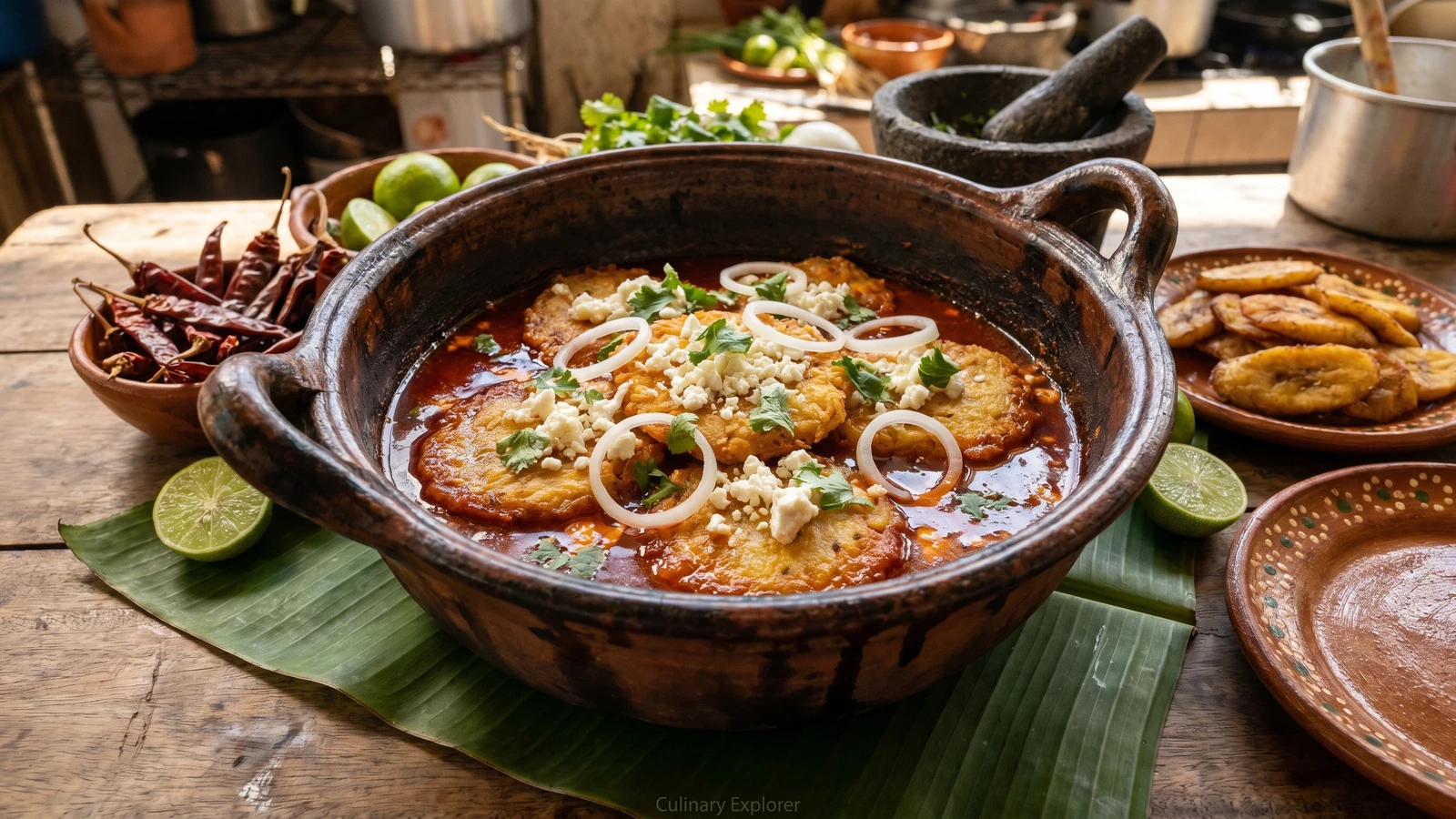
From the Costa Chica de Oaxaca, where Mexico's Black communities have cooked for four centuries: grated cassava and queso fresco patties fried in pork lard, then bathed in a brick-red caldillo built on fruity chile costeño.
This is from the Costa Chica de Oaxaca, the Pacific coast that runs from Pinotepa Nacional down through Collantes and Corralero to the lagoons of Chacahua. Black Mexico lives here. Afromexicanos, the descendants of enslaved Africans brought to this coast more than four hundred years ago, who built towns, herded cattle, and cooked a food that is neither Indigenous nor Spanish but its own thing. La tercera raíz, the third root of this country. No es nota al pie. Es plato principal. This dish is the proof.
Yuca did not grow here first. Cassava came across the Atlantic with the Columbian exchange, and with it came the hands that knew what to do: grate it, squeeze it dry in a cloth, fry it in pork fat. That frying habit is African and Caribbean, and on this coast it never left. The pantry around it tells the same story. Plátano macho, cacahuate, ajonjolí, coco. Ingredients that traveled with a people and stayed. Here, grated yuca and queso fresco become tortitas, fried in manteca until the edges turn gold. La manteca es el sabor. Don't argue with the lard.
The caldillo is where Oaxaca speaks. Chile costeño is the small red chile that grows on this coast and almost nowhere else, fruity and sharp and hotter than it looks. You toast it with guajillo, char a few tomatoes on the comal, blend, strain, and fry the puree in manteca until it darkens and the fat rises. Then you loosen it into a brothy sauce and let the tortitas drink it. The caldillo finishes cooking them. That is the design, not an accident.
My mother was from Jalisco. She never cooked yuca a day in her life, and her notebook has not one word about the Costa Chica. I learned this on the road, in a kitchen in Collantes, from a señora who grated the yuca on her lap while she told me her grandmother did it the same way. She fried the tortitas in lard rendered that morning and bathed them in a costeño caldillo so red it stained the clay. I wrote it down the way I write everything down, so it does not disappear. Saber cocinar es saber vivir.
Africans were brought to New Spain in large numbers beginning in the 16th century, and the Costa Chica of Guerrero and Oaxaca became one of the densest concentrations of Afro-descendant population in the colony, where they worked the cattle haciendas and the coast. Cassava (yuca), domesticated in South America and carried across the Atlantic world, entered this regional diet through Caribbean and Afro-descendant foodways more than through the central Mexican corn tradition. Mexico's Afro-descendant communities were recognized in the federal Constitution only with a 2019 reform to Article 2, and the 2020 national census was the first to count them, identifying roughly two and a half million people.
Quantity
2 pounds
peeled, cored, and grated on the large holes
Quantity
6 ounces
crumbled, plus more for serving
Quantity
1 large
lightly beaten
Quantity
3/4 teaspoon, plus more to taste
Quantity
1/2 cup
for frying the tortitas
Quantity
6
stemmed and seeded
Quantity
3
stemmed and seeded
Quantity
1 1/2 pounds (about 4 medium)
Quantity
1/4, plus thinly sliced for serving
Quantity
3 cloves
unpeeled
Quantity
1/2 teaspoon
Quantity
2 tablespoons
for the caldillo
Quantity
2 cups
Quantity
for serving
Quantity
for serving
Quantity
for serving
Quantity
for serving
| Ingredient | Quantity |
|---|---|
| fresh yuca (cassava)peeled, cored, and grated on the large holes | 2 pounds |
| queso frescocrumbled, plus more for serving | 6 ounces |
| egglightly beaten | 1 large |
| kosher salt | 3/4 teaspoon, plus more to taste |
| manteca de cerdo (pork lard)for frying the tortitas | 1/2 cup |
| dried chile costeñostemmed and seeded | 6 |
| dried chile guajillostemmed and seeded | 3 |
| ripe tomatoes | 1 1/2 pounds (about 4 medium) |
| white onion | 1/4, plus thinly sliced for serving |
| garlicunpeeled | 3 cloves |
| dried Oaxacan oregano | 1/2 teaspoon |
| manteca de cerdo (pork lard)for the caldillo | 2 tablespoons |
| water or light vegetable broth | 2 cups |
| chopped cilantro (optional) | for serving |
| lime wedges (optional) | for serving |
| cooked white rice (optional) | for serving |
| fried ripe plátano macho (optional) | for serving |
Yuca has a thick, bark-like skin over a pink underlayer. Take all of it off with a knife, not a peeler. Cut the peeled root into chunks and pull out the tough, woody fiber running through the center; it never softens. Grate the flesh on the large holes of a box grater. Pile the gratings into a clean kitchen cloth, gather it up, and squeeze hard over the sink. A lot of cloudy liquid will run out. That liquid carries the bitterness you don't want, and getting rid of it is what lets the tortitas hold together. Raw yuca is never eaten. It has to be cooked, and it will be, twice, before it reaches the table.
Put the squeezed yuca in a bowl with the crumbled queso fresco, the beaten egg, and the salt. Work it together with your hands until it holds its shape when you press a handful. The cheese and egg bind it, and the starch left in the yuca does the rest. If it feels too wet to hold, you didn't squeeze hard enough. Wring it again. Mix this close to frying time, because grated raw yuca grays as it sits.
Heat a dry comal or heavy skillet over medium. Toast the chile costeño and the chile guajillo separately, pressing them flat for a few seconds a side until they smell toasty and turn a shade darker. The costeño is small and thin and it scorches in a blink, so keep it moving and pull it the second it puffs. Drop the toasted chiles into a bowl, cover with hot water, not boiling, and let them soften for 15 to 20 minutes.
On the same comal, char the whole tomatoes, the onion piece, and the unpeeled garlic. Turn them until the tomato skins blister and blacken in spots and the garlic is soft and spotted inside its skin. Slip the garlic out of its papers. Those blackened spots are not a mistake. They give the caldillo a roasted depth you cannot get from raw tomato.
Drain the chiles. Put them in the blender with the charred tomatoes, the onion, the peeled garlic, the oregano, and about half a cup of the chile soaking water. Blend until completely smooth. Pass it through a fine-mesh strainer, pressing on the solids and discarding the skins. You want a clean, pourable caldillo, not a thick salsa.
Melt the 2 tablespoons of manteca in a wide clay cazuela or heavy skillet over medium heat. When it shimmers, pour in the strained puree all at once. It will sputter, so stand back. Fry it for 6 to 8 minutes, stirring, until it darkens from bright red to brick and the fat starts to rise at the edges. That is the sazón, the moment the raw chile turns round and deep. La manteca es el sabor. Stir in the water or broth and a good pinch of salt. Bring it to a gentle simmer and cook 10 minutes, until it coats a spoon but still runs off it. A caldillo is a sauce you ladle, not a paste.
Heat the 1/2 cup manteca in a skillet over medium-high until a pinch of the masa sizzles on contact. Scoop about 1/4 cup of the yuca mixture, pat it into a patty a little under half an inch thick, and lay it in the fat. Don't crowd the pan. Fry until the underside is deep golden and crisp, 3 to 4 minutes, then turn once and do the same on the other side. They have to cook all the way through. The center should turn tender, never chalky. Drain them on a wire rack, not paper, so they stay crisp.
Bring the caldillo back to a bare simmer and slide the fried tortitas in, spooning the sauce over the tops. Let them sit in it for 3 to 5 minutes so they drink the caldillo and finish cooking through. Don't stir hard or they break. Serve them in a brown clay cazuela with the caldillo pooled around, crumbled queso fresco and raw onion over the top, cilantro, and lime on the side. A plate of white rice and some fried plátano macho make it the full Costa Chica meal. Así se hace y punto.
1 serving (about 425g)
Culinary guides, cultural storytelling, and the editorial depth that makes cooking meaningful.
Discover Culinary ExplorerChef Lupita
Michoacán's Lake Pátzcuaro acúmara, a whole kurucha from the lago tatemada on a comal de leña and served with chile perón atápakua, corn tortillas, and P'urhépecha discipline.

Chef Lupita
Puebla's weekday adobo of pork shoulder braised in a thick guajillo and ancho sauce sharpened with vinegar, cumin, and clove. The deep red of a market spice stall, the dish a poblana cooks without thinking.

Chef Lupita
Loreto's pit-roasted clams, planted hinge-up in beach sand and tatemadas under a fast fire of dried romerillo brush, the resinous Baja desert shrub that gives this dish its smoke.

Chef Lupita
Oaxaca's eighth mole, the silky, almond-and-cinnamon almendrado, served over poached chicken. Mild, sweet, restrained, and a quiet rebuttal to anyone who thinks Mexican food has to be hot to be Mexican.