
Chef Fai
Crispy Rice with Coconut Dip (Khao Tang Na Tang)
The kreung tam doesn't rest, not even for a snack. Pounded paste cracked into coconut cream, spooned over golden rice that shatters on contact. Four pillars in every bite.
A cooking platform built around craft, culture, and the stories behind what we eat.

Created by
The kreung tam doesn't sit underneath this dish or beside it. It's inside it, pounded directly into the fish. Red curry paste, kaffir lime, long beans, fried until the whole thing bounces back when you bite.
Tod man pla is what happens when the kreung tam stops being a base and becomes the dish itself. In a curry, the paste cooks in coconut cream. In a stir-fry, it blooms in oil. In a fish cake, it's pounded directly into the protein. The paste IS the fish cake. That's the principle.
Ajarn always said the kreung tam is the foundation of Thai cooking. Tod man pla takes that literally. You pound red curry paste (prik gaeng daeng) into raw fish until the two become one substance. The chili, the galangal, the lemongrass, the shrimp paste, they don't flavor the fish from the outside. They live inside it. Every bite is the kreung tam.
Here's what separates a real tod man pla from the rubber discs you get at bad Thai restaurants: the slap. After you combine the fish and paste, you pick up the mixture and throw it against the bowl. Over and over. Thirty, forty times. This develops the proteins in the fish, creating a bouncy, springy texture that snaps when you bite. Skip the slapping and you get a dense, mealy puck. Do it right and the fish cake has life in it. Street vendors in Bangkok do this with their bare hands, fast and rhythmic, like kneading bread but violent. The sound carries down the soi.
The kaffir lime leaves (bai makrut) go in sliced hair-thin. The long beans (thua fak yao) go in chopped small. These aren't mixed in for color. They're aromatic punctuation, tiny bursts of citrus and crunch in every bite. Fish sauce for salt. No sugar in the cake itself. The sweetness comes from the ajad, the cucumber relish served alongside. That's the four pillars split across two components: the cake handles salt, heat, and aromatics. The relish handles sweet and sour. Together, they're complete. Principles, not recipes.
Tod man pla is a Central Thai preparation with roots in Bangkok's canal-side communities, where freshwater fish like pla grai (featherback fish, Notopterus notopterus) was abundant and cheap. The featherback's flesh has an unusually high protein content that creates the signature bouncy texture when slapped and kneaded, a technique shared with Chinese fish ball preparation but adapted with Thai kreung tam. The dish became a street food staple in the mid-20th century as vendors discovered it could be formed ahead and fried to order in seconds, making it the perfect walk-and-eat snack.
Quantity
500g
roughly chopped
Quantity
3 tablespoons
Quantity
1
Quantity
2 tablespoons
Quantity
5
central vein removed, sliced hair-thin
Quantity
50g
sliced into very thin rounds
Quantity
for deep-frying
Quantity
120ml
Quantity
100g
Quantity
1 teaspoon
Quantity
1 small
quartered lengthwise and sliced thin
Quantity
2
sliced thin
Quantity
2
sliced thin
Quantity
2 tablespoons
roughly crushed
Quantity
for garnish
| Ingredient | Quantity |
|---|---|
| firm white fish fillets (featherback, mackerel, or cod)roughly chopped | 500g |
| red curry paste (kreung tam phrik gaeng daeng) | 3 tablespoons |
| egg | 1 |
| fish sauce (nam pla) | 2 tablespoons |
| kaffir lime leaves (bai makrut)central vein removed, sliced hair-thin | 5 |
| long beans (thua fak yao)sliced into very thin rounds | 50g |
| vegetable oil | for deep-frying |
| rice vinegar | 120ml |
| granulated sugar | 100g |
| salt | 1 teaspoon |
| cucumberquartered lengthwise and sliced thin | 1 small |
| shallotssliced thin | 2 |
| bird's eye chilies (prik khi nu)sliced thin | 2 |
| roasted peanutsroughly crushed | 2 tablespoons |
| fresh cilantro leaves (optional) | for garnish |
In a small saucepan, heat the rice vinegar, sugar, and salt over medium heat. Stir until the sugar dissolves completely. Don't boil it. Just warm enough to dissolve. Let it cool to room temperature. Once cool, add the sliced cucumber, shallots, and chilies. Toss in the crushed peanuts. This is ajad (อาจาด), and it's not optional. The fish cake handles salt and heat. The ajad handles sweet and sour. Without it, you're eating half a dish.
If you're making your own red curry paste (and you should be), it needs to be done before this step. The paste should already be smooth. Now: add the chopped fish to a large mixing bowl. If you have a granite mortar big enough, pound the fish directly. Most home cooks don't, so use the bowl method. Add the red curry paste, fish sauce, and egg to the fish. Use a fork or your hands to mash and combine everything until no streaks of paste remain. The mixture should be uniform in color, a warm orange-red from the paste.
This is the step that matters most. Pick up the entire fish mixture in your hand and throw it back into the bowl. Hard. Pick it up again. Throw it again. Repeat this thirty to forty times. You'll feel the texture change under your hand. It goes from loose and sticky to tight and elastic. The proteins in the fish are cross-linking, forming a network that gives the fish cake its signature bounce. When the paste pulls away from the bowl cleanly and feels like thick, springy dough, you're done. This takes about five minutes. Your arm will know.
Add the hair-thin kaffir lime leaf slivers and the sliced long beans to the fish paste. Fold them in gently with your hands. Don't knead. Don't slap anymore. You've already built the protein network. Now you're distributing the aromatics. Every bite should have a thread of lime leaf and a dot of green bean. That's the design.
Wet your hands with water to prevent sticking. Take about two tablespoons of the fish paste and flatten it into a disc, roughly 6 centimeters across and 1 centimeter thick. Not too thick or the center stays raw. Not too thin or you lose the bounce. Set them on an oiled plate. You should get about 20 cakes from this amount. They'll look rough. Good. Street vendors don't use ring molds.
Heat oil in a wok or deep pan to 170°C (340°F). Test with a small pinch of paste: it should sink, then float immediately with steady bubbles. Slide in the fish cakes, five or six at a time. Don't crowd the oil. Fry for 3 to 4 minutes, flipping once, until deep golden on both sides. The color should be rich and even, not pale, not dark brown. Lift out with a slotted spoon or spider and drain on a wire rack. Not paper towels. Paper towels trap steam against the bottom and you lose your crust.
Pile the fish cakes on a plate. Spoon the cucumber relish into a small bowl alongside. That's it. The fish cake gives you salt and heat and the deep aroma of the kreung tam in every bite. The ajad gives you sweet and sour and crunch. Dip, bite, repeat. If you made the relish an hour ago, the cucumber will have softened into the sweet vinegar and the chilies will have bloomed. That's when it's best.
1 serving (about 250g)
Culinary guides, cultural storytelling, and the editorial depth that makes cooking meaningful.
Discover Culinary ExplorerChef Fai
The kreung tam doesn't rest, not even for a snack. Pounded paste cracked into coconut cream, spooned over golden rice that shatters on contact. Four pillars in every bite.
Chef Fai
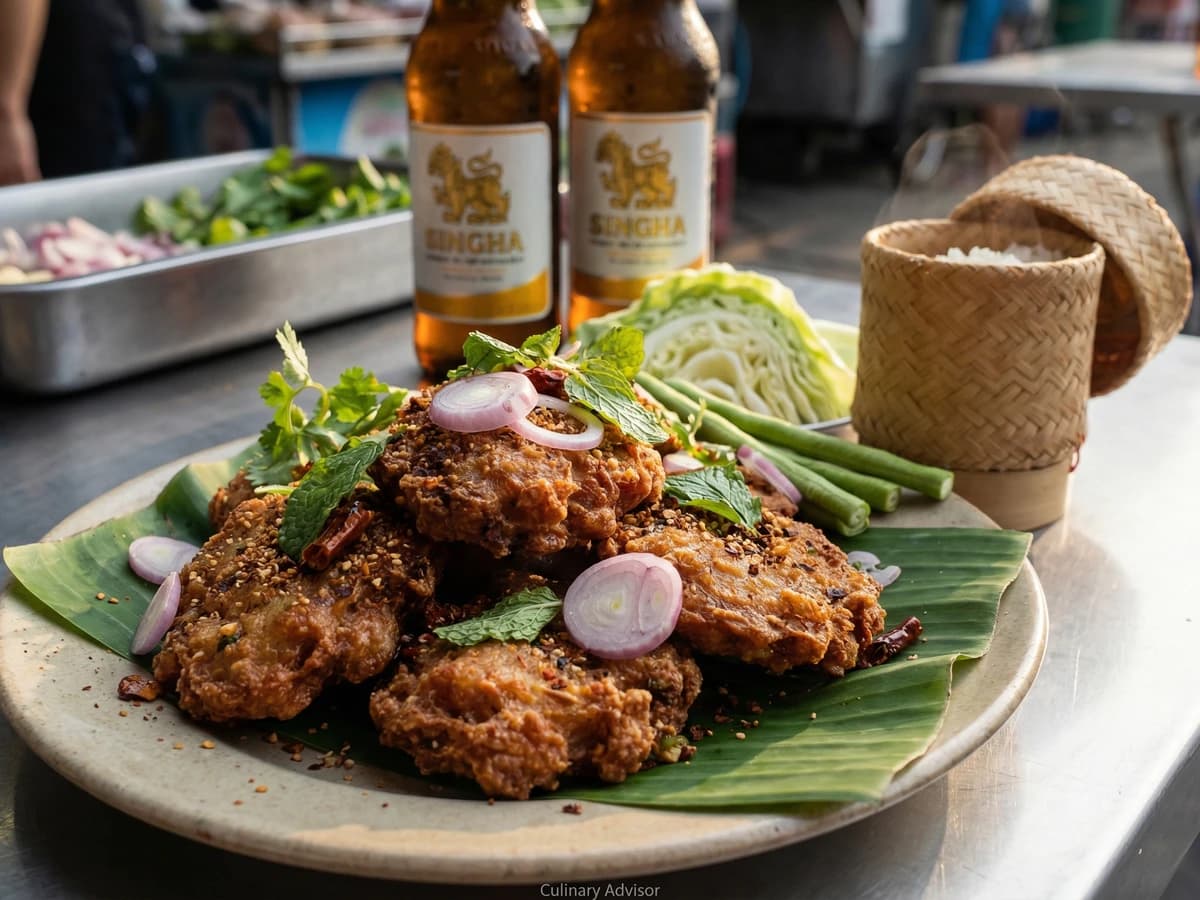
Isan's larb principles pressed into patties and fried golden: fish sauce for salt, lime for sour, khao khua for structure and crunch, prik pon for heat. No sugar. That's the rule that separates Isan from everything else.

Chef Fai
A kreung tam pounded in the krok, dissolved into cracked coconut cream, sweet crab folded through at the end. All four pillars balanced in a dip so silky you'll forget it started in a granite mortar. Central Thai home cooking at its most principled.

Chef Fai
Twenty-four meatballs, eight bamboo skewers, a charcoal grill the size of a shoebox, and one pot of nam jim built on the four pillars. The simplest vendor setup in Thailand proves the system works everywhere.