
Chef Fai
Crispy Rice with Coconut Dip (Khao Tang Na Tang)
The kreung tam doesn't rest, not even for a snack. Pounded paste cracked into coconut cream, spooned over golden rice that shatters on contact. Four pillars in every bite.
A cooking platform built around craft, culture, and the stories behind what we eat.
Created by
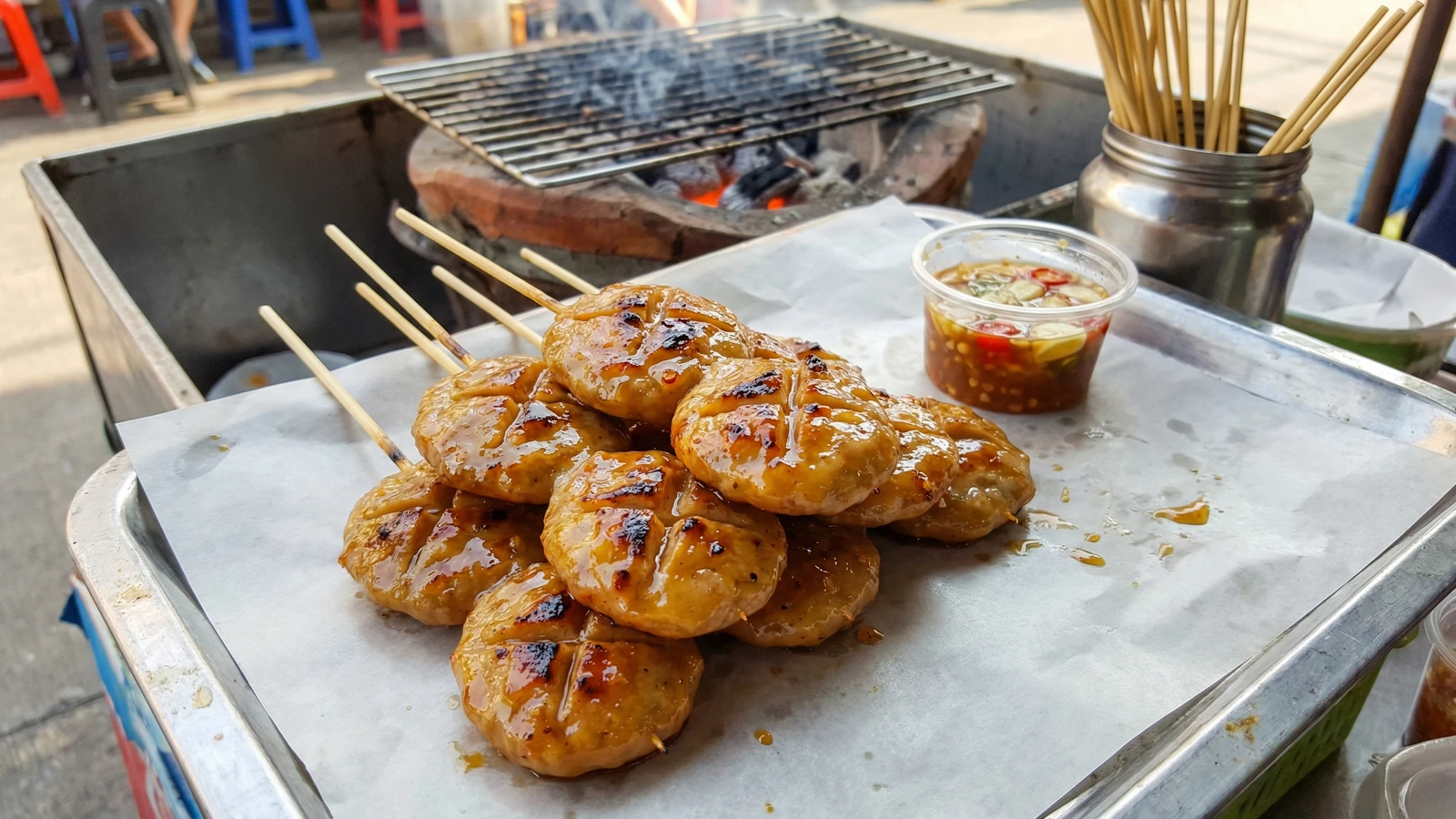
Twenty-four meatballs, eight bamboo skewers, a charcoal grill the size of a shoebox, and one pot of nam jim built on the four pillars. The simplest vendor setup in Thailand proves the system works everywhere.
Look chin ping is the most stripped-down vendor operation in Thailand. A small charcoal grill. A jar of bamboo skewers. A pot of sweet chili glaze. That's the entire business. No kitchen. No menu board. No prep station. A vendor can set up on any sidewalk with a hundred baht of equipment and start selling. Kids line up after school with coins in their fists. Construction workers grab a few sticks on the way to a job site. It's the kind of food so simple and so everywhere that most people walk right past without thinking. And that's exactly why it matters. Because even here, at the absolute minimum of Thai street food, the four pillars hold.
The meatballs are Chinese heritage. Look chin comes from Teochew meatball technique: meat pounded and kneaded with ice and starch until the proteins bind into something springy, something that snaps when you bite through it. That bounce is the whole identity of look chin. Thai vendors didn't invent the meatball. They inherited it from Chinese immigrants who settled Bangkok's Yaowarat district generations ago. But what makes look chin ping Thai, what pulls it into the system, is the nam jim. The glaze. The sauce. That's where the principles live.
Fish sauce for salt. Sugar for sweet. Vinegar for sour. Chili for heat. Four ingredients in a pot, simmered until syrupy. Brushed onto the meatballs in the last minutes of grilling so the sugar hits the charcoal heat and caramelizes into a sticky, glossy crust. Ajarn always said the four pillars aren't just for complex dishes. They govern everything, from a forty-ingredient royal curry to a five-baht meatball on a stick. The system scales. It doesn't care how fancy you think you are.
The charcoal is not decorative. Gas gives you even heat. Charcoal gives you uneven heat, smoke, and those unpredictable hot spots where the glaze catches and turns to candy. That's the flavor. The irregularity is the point. If you're stuck with a grill pan, you'll manage. But if you have charcoal and twenty minutes, use it. The vendor with the shoebox grill and the plastic stool isn't cutting corners. She's using the right tool for the job.
Look chin (ลูกชิ้น) traces directly to Teochew and Hokkien Chinese meatball traditions brought to Thailand by immigrants settling in Bangkok's Yaowarat (Chinatown) district during the 18th and 19th centuries. The word likely derives from the Teochew pronunciation of '肉圓' (meat ball). While the bouncing and kneading technique remains Chinese in origin, Thai vendors transformed the product by grilling it on skewers and glazing it with a sweet chili sauce built on the four-pillar flavor framework, creating one of the country's most ubiquitous and affordable street snacks by the mid-20th century.
Quantity
24 (about 500g)
Quantity
8
soaked in water for 30 minutes
Quantity
for brushing grill
Quantity
80g
chopped (or substitute granulated sugar)
Quantity
60ml
Quantity
1 tablespoon
Quantity
2 tablespoons
Quantity
2
finely sliced
Quantity
2
finely sliced
Quantity
2 cloves
minced
Quantity
pinch
| Ingredient | Quantity |
|---|---|
| Thai pork meatballs (look chin moo) or fish meatballs (look chin pla) | 24 (about 500g) |
| bamboo skewerssoaked in water for 30 minutes | 8 |
| vegetable oil | for brushing grill |
| palm sugar (nam tan pip)chopped (or substitute granulated sugar) | 80g |
| rice vinegar | 60ml |
| fish sauce (nam pla) | 1 tablespoon |
| water | 2 tablespoons |
| red spur chilies (prik chee fa)finely sliced | 2 |
| bird's eye chilies (prik khi nu)finely sliced | 2 |
| garlicminced | 2 cloves |
| salt | pinch |
Combine the palm sugar, rice vinegar, fish sauce, water, and salt in a small saucepan over medium heat. Stir until the sugar dissolves completely. Bring to a gentle boil, then reduce to a simmer. Let it cook for 5 to 7 minutes until the sauce reduces by about a third and coats the back of a spoon. It should be syrupy but still pourable. Thicker than water, thinner than honey. In the last minute, stir in the garlic and both types of sliced chilies. Remove from heat. The sauce will thicken further as it cools. Taste it: sweet first, then sour from the vinegar, salty from the nam pla, heat building from the chilies. That's the four pillars in a pot.
Take each meatball and press it gently between your palms to flatten it slightly into a thick disc. Then score an X into the top with a knife, cutting about a quarter of the way through. Don't go deep. The flattening gives you more surface area for char and glaze. The X opens up during grilling so the sauce seeps into the cracks. Thread 3 meatballs onto each soaked bamboo skewer, leaving a small gap between each one so heat can reach all sides.
Get your charcoal grill to medium-high heat. You want consistent glowing coals, not open flame. Brush the grate with oil. Lay the skewers across the grill. Let them sit for 2 to 3 minutes without moving. You want the meatball skin to tighten and blister, and you want grill marks. Actual char. Turn once. Another 2 to 3 minutes on the other side. The meatballs should be heated through, slightly puffed, with golden-brown marks where they contacted the grill.
In the last 2 minutes of grilling, brush the nam jim generously over the meatballs. Use a basting brush and don't be shy. The sugar in the sauce will hit the heat and start to caramelize immediately. You'll hear it sizzle. Turn the skewers and brush the other side. One more turn if you want extra layers. The surface should be glossy, sticky, and slightly tacky when you pull them off the grill. The color deepens from pale to amber-gold where the glaze has caught. Serve the skewers on a plate or standing in a cup the way street vendors do, with the remaining nam jim in a small bowl alongside for dipping.
1 serving (about 185g)
Culinary guides, cultural storytelling, and the editorial depth that makes cooking meaningful.
Discover Culinary ExplorerChef Fai
The kreung tam doesn't rest, not even for a snack. Pounded paste cracked into coconut cream, spooned over golden rice that shatters on contact. Four pillars in every bite.
Chef Fai
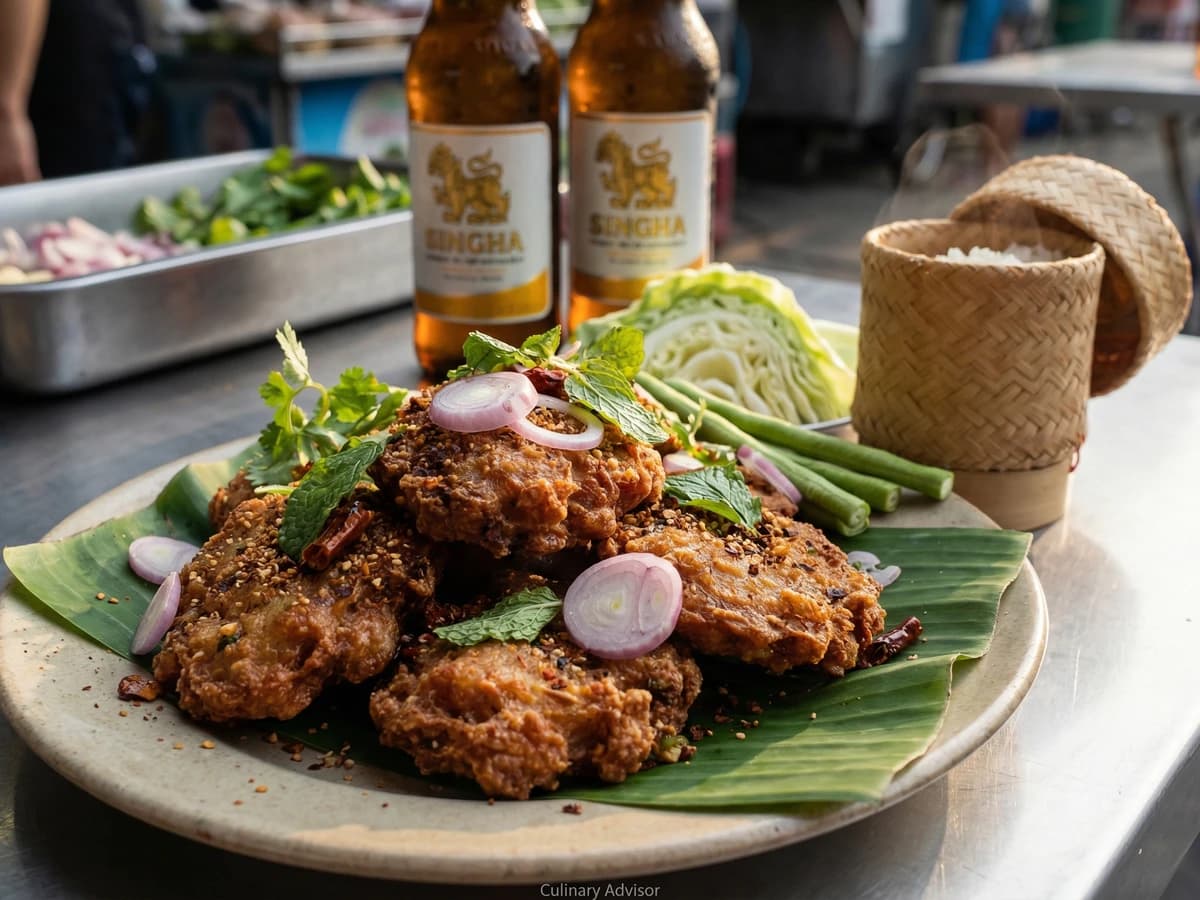
Isan's larb principles pressed into patties and fried golden: fish sauce for salt, lime for sour, khao khua for structure and crunch, prik pon for heat. No sugar. That's the rule that separates Isan from everything else.

Chef Fai
A kreung tam pounded in the krok, dissolved into cracked coconut cream, sweet crab folded through at the end. All four pillars balanced in a dip so silky you'll forget it started in a granite mortar. Central Thai home cooking at its most principled.
Chef Fai
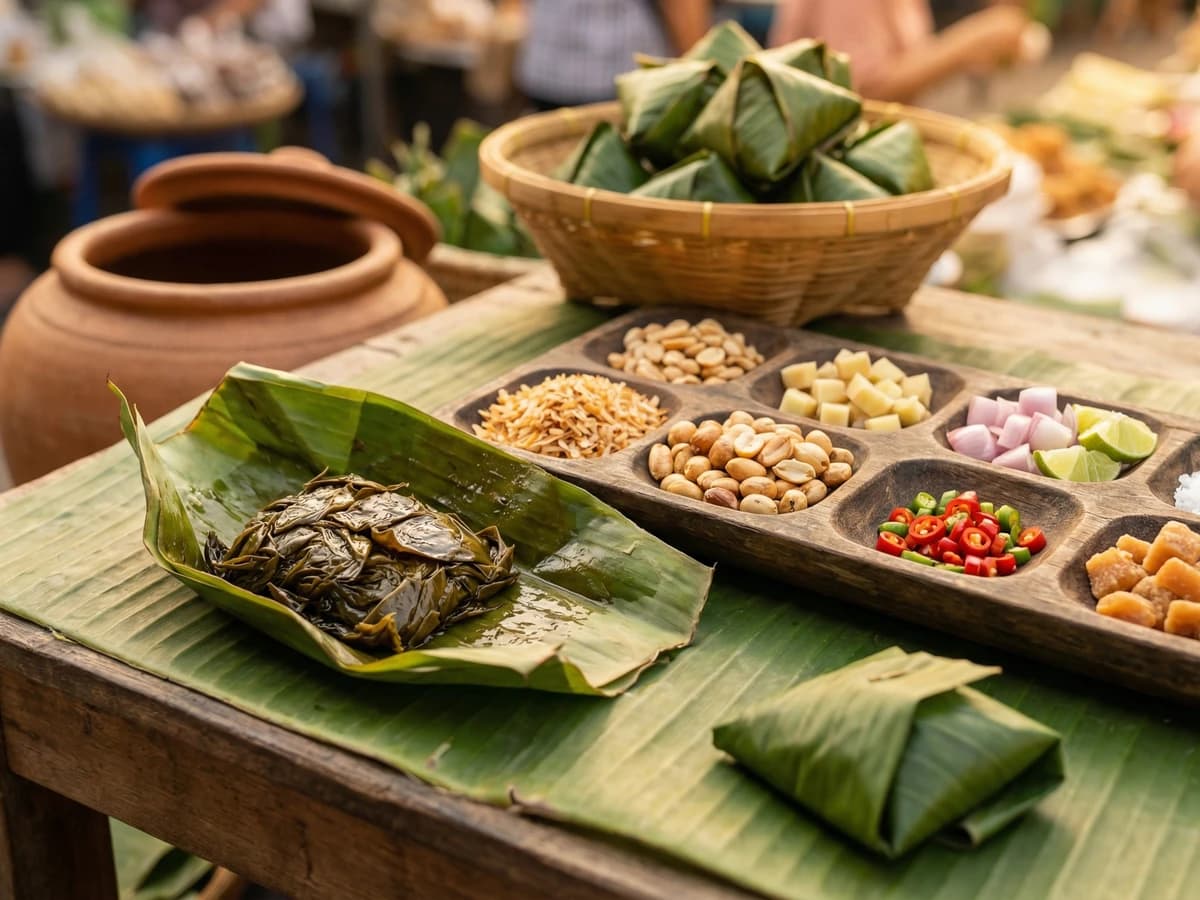
Lanna's oldest fermented tradition: wild tea leaves steamed, packed tight in banana leaf, and transformed by lactic acid bacteria over months. Time is the ingredient no one can skip.