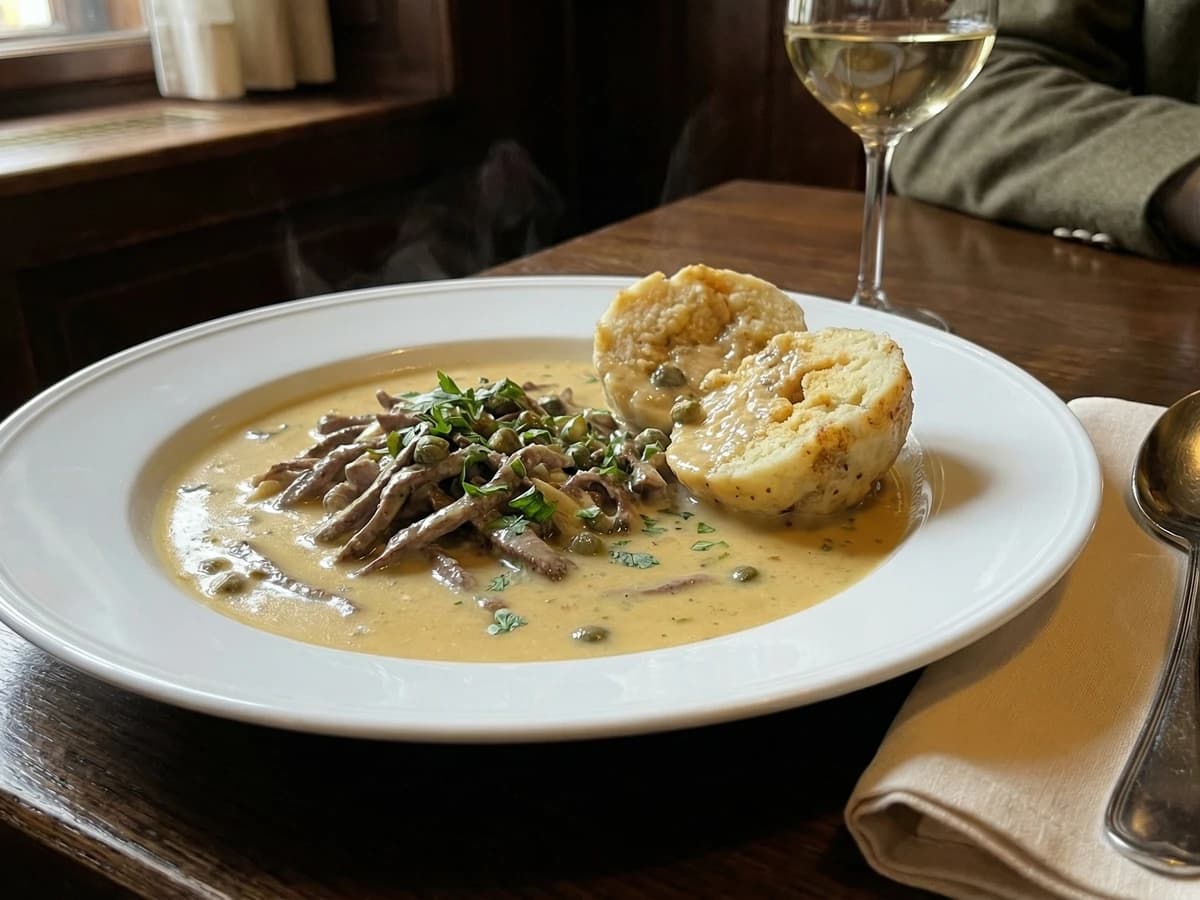
Paprika-braised pork shoulder stirred through tangy sauerkraut and finished with a generous swirl of sour cream, the dish that proves Austrian and Hungarian kitchens were always talking to each other.
Soups & Stews
Austrian
Comfort Food
Make Ahead
30 min
Active Time
2 hr cook•2 hr 30 min total
Yield6 servings
Gretel always said the Hungarian dishes in Austrian cooking aren't borrowings. They're family. Centuries of shared empire means the food crossed borders so many times nobody can draw a clean line anymore. Szegediner Gulasch sits right on that line, and it belongs to both kitchens.
This was a winter dish in my grandmother Eva's house in Kent. She made it when the weather turned grey and stayed grey, which in Kent was most of the year. The smell of sweet paprika and onions cooking down in pork fat would fill the kitchen for an hour before the food hit the table. I'd come in from school and know immediately what was for dinner. The sauerkraut goes in toward the end, and that sharp, fermented tang lifts the whole pot. Without it, you just have pork goulash. Good, but not this.
The technique is forgiving. You brown the pork in batches, cook a mountain of onions until they dissolve into sweetness, add enough paprika to turn the pot brick red, and then you let time and low heat do the rest. The sour cream goes in at the very end, off the heat, stirred through until the sauce turns from deep red to a warm, rosy gold. Serve it with bread or Nockerl. A cold beer doesn't hurt.
This is good Austrian home cooking at its most honest. Simple ingredients, proper technique, patience. The kind of food that makes people go quiet at the table for a few minutes and then ask for seconds.
Despite its name suggesting the Hungarian city of Szeged, the dish is most likely named after the Hungarian writer and journalist József Székely, who supposedly asked a Budapest restaurant cook to combine his goulash with sauerkraut sometime around the 1840s. The confusion between Székely (the writer's name) and Szegedi (meaning 'from Szeged') became permanent. The dish traveled to Vienna through the shared Habsburg kitchen, where it became a fixture in Gasthäuser and Beisln across Austria. Austrians adopted it so completely that most Viennese consider it part of their own culinary tradition, which tells you everything about how the empire's food actually worked.
The technique, the tradition, and the story behind every dish.
fresh dill or flat-leaf parsley (optional)roughly chopped
small handful
Equipment Needed
•Heavy-bottomed Dutch oven or braising pot (5-liter minimum)
•Wooden spoon
•Sharp knife and cutting board
Instructions
1
Brown the pork
Pat the pork cubes dry with paper towels. This matters. Wet meat doesn't brown, it steams, and you'll end up with grey, sad cubes instead of a deep golden crust. Heat the lard in a heavy pot or Dutch oven over high heat until it shimmers. Brown the pork in two or three batches, giving each piece room to breathe. Don't move them for two minutes per side. You want a proper crust, the kind that sticks to the bottom of the pot. That's flavor you're going to dissolve later. Set the browned pork aside on a plate.
Lard is traditional and gives the best flavor here. If you can find good-quality rendered lard, use it. Sunflower oil works but the taste won't be quite the same.
2
Cook the onions down
Reduce the heat to medium. Add the diced onions to the same pot with a pinch of salt. There's a lot of onion here. That's correct. In Austrian and Hungarian goulash, onions are not a supporting ingredient. They're the foundation of the sauce. Cook them slowly, stirring often, until they turn soft, golden, and almost translucent. This takes a good fifteen minutes. Don't rush it. If you rush the onions, you'll taste raw onion in the finished dish and nothing can fix that later.
The ratio of onion to meat in a proper goulash shocks people. You want roughly one onion for every 300g of meat. The onions melt into the sauce and give it body. Trust the quantity.
3
Add garlic and paprika
Add the minced garlic and stir for thirty seconds until fragrant. Now pull the pot off the heat entirely. Add the three tablespoons of sweet paprika and the caraway seeds. Stir immediately so the paprika coats the onions evenly. You take the pot off the heat because paprika burns in seconds and burnt paprika turns bitter and acrid. This is the single most common mistake people make with goulash. Off the heat. Stir. Then back on.
Buy Hungarian sweet paprika, not the dusty stuff that's been sitting in your cupboard for two years. Fresh paprika should smell warm and fruity when you open the tin. If it smells like nothing, it will taste like nothing. Szeged or Kalocsa brands are what you want.
4
Deglaze and braise
Return the pot to medium heat. Stir in the tomato paste and cook for one minute. Pour in the white wine and scrape up all the browned bits stuck to the bottom. Those bits are called fond and they're concentrated flavor. Let the wine bubble for two minutes until it reduces by half. Add the stock and the bay leaf, then return the browned pork and any juices from the plate. The liquid should come about two-thirds of the way up the meat. Bring to a gentle simmer, cover with the lid slightly ajar, and let it braise for one hour.
A Grüner Veltliner or other dry Austrian white wine works beautifully here. The acidity balances the richness of the pork and paprika. Don't use anything you wouldn't drink.
5
Prepare the sauerkraut
While the pork braises, drain the sauerkraut and squeeze it gently to remove excess liquid. Don't rinse it. You want that fermented tang. If your sauerkraut is very sharp, squeeze a little harder. If it's mild, leave more moisture in. Taste it before it goes in the pot. You're the cook. You decide how much sourness you want in the finished dish. Toss the drained sauerkraut with the extra teaspoon of paprika.
6
Add sauerkraut and finish braising
After one hour, the pork should be tender but not yet falling apart. Stir the paprika-dusted sauerkraut into the pot, folding it through the meat and sauce. Add a splash more stock if the pot looks dry. Cover again and braise for another forty-five minutes to an hour, until the pork yields easily to a fork and the sauerkraut has softened and absorbed the paprika sauce. The kitchen will smell extraordinary. That's how you know you're close.
7
Finish with sour cream
Remove the pot from the heat. Fish out the bay leaf. Let the gulasch settle for two minutes, then stir in the sour cream. Off the heat. This is important. If you add sour cream to a boiling pot, it will curdle and you'll have grainy white streaks instead of a smooth, rosy sauce. Stir gently until the sauce turns from deep paprika red to a warm, creamy coral. Taste and adjust the salt. The sauerkraut brings its own salt, so go carefully.
8
Serve generously
Ladle the Szegediner Gulasch into warm bowls. Add a spoonful of fresh sour cream on top and scatter dill or parsley over it. Serve with good bread, Semmelknödel, or plain boiled potatoes. Nothing fancy. This dish carries itself. Mahlzeit!
Chef Tips
•This gulasch is better the next day. The flavors deepen overnight and the sauerkraut mellows into the sauce. Make it on Saturday, eat it on Sunday. You'll thank yourself.
•Pork shoulder is the right cut. It has enough fat running through it to stay moist and tender through the braise. Lean cuts like loin will dry out and turn stringy. Don't substitute here.
•If you can find fresh sauerkraut from a market or deli counter, use it. The stuff in jars works, but fresh sauerkraut has a livelier tang and better texture. In Salzburg, the market stalls at the Grünmarkt sell it by weight from big wooden barrels.
•Caraway seeds are not optional. They're the quiet backbone of this dish. Without them, something will taste missing and you won't be able to name what it is. That's the caraway.
Advance Preparation
•Szegediner Gulasch can be made up to three days ahead and refrigerated. The flavor improves with each reheating. Warm it gently over low heat and add the sour cream fresh each time you serve.
•The pork can be browned and the onion base prepared the day before. Refrigerate separately and resume braising the next day.
•Leftover gulasch freezes well for up to two months. Freeze without the sour cream and stir it in fresh after thawing and reheating.
Frequently Asked Questions
Nutrition Information
1 serving (about 450g)
Calories
610 calories
Total Fat
44 g
Saturated Fat
17 g
Trans Fat
0 g
Unsaturated Fat
26 g
Cholesterol
140 mg
Sodium
1200 mg
Total Carbohydrates
17 g
Dietary Fiber
6 g
Sugars
7 g
Protein
32 g
Where cooking meets culture.
Culinary guides, cultural storytelling, and the editorial depth that makes cooking meaningful.