Chef Elsa
Altwiener Salonbeuschel
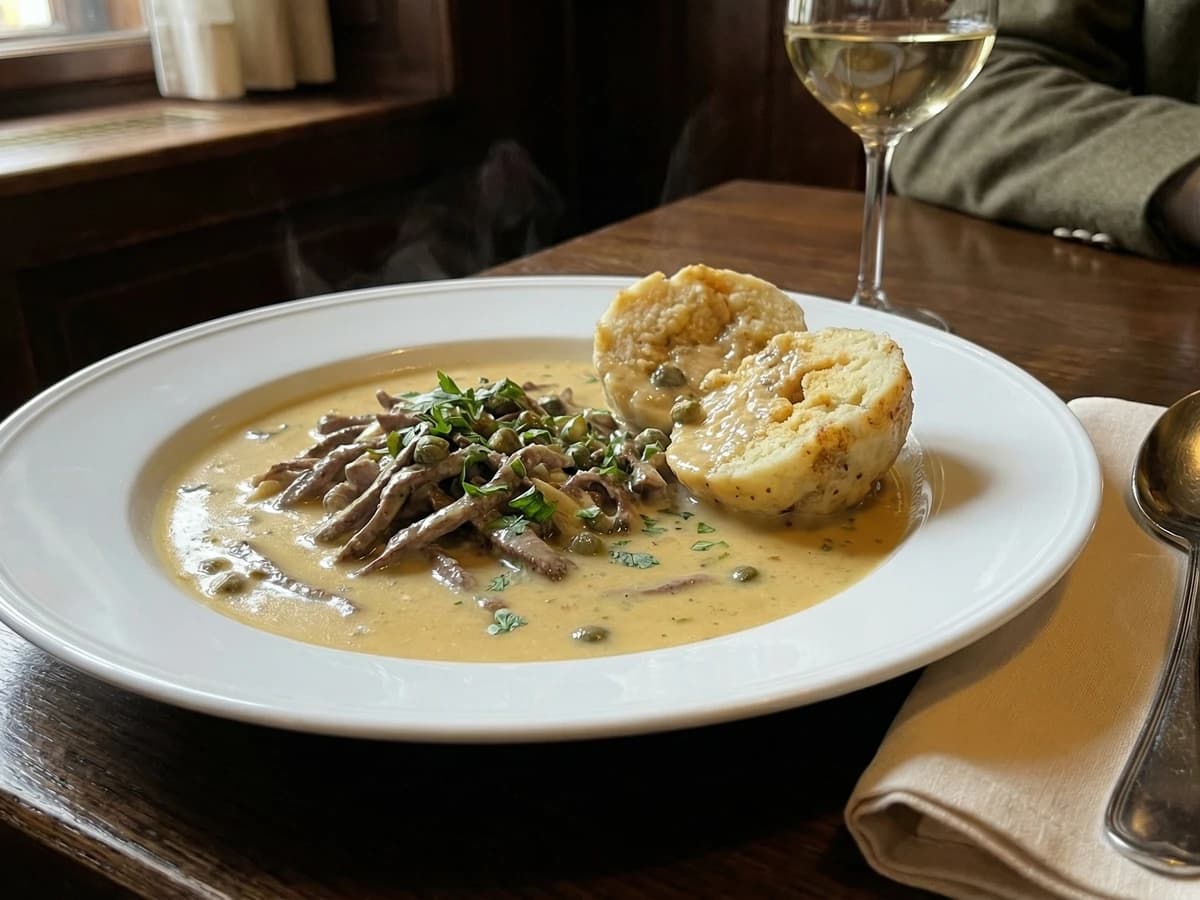
Veal lung and heart braised tender in a velvety cream sauce spiked with capers, anchovies, and lemon zest, served the only way Vienna allows: with a proper Semmelknödel to soak up every last drop.
A cooking platform built around craft, culture, and the stories behind what we eat.
Created by
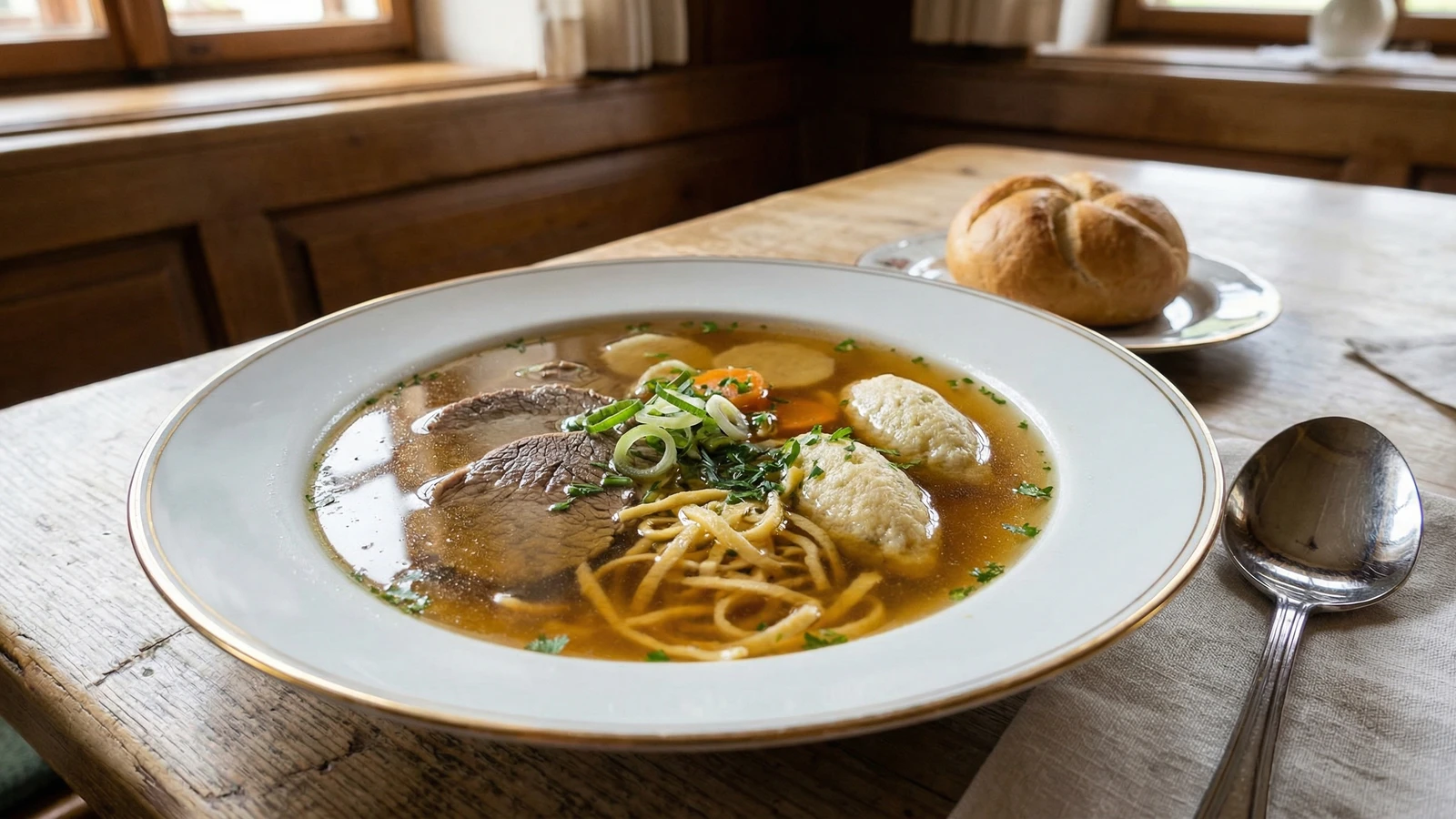
Vienna's grandest soup bowl, golden beef broth ladled over sliced boiled beef, tender root vegetables, silky Frittaten, and pillowy Griesnockerl, the kind of first course that makes the rest of dinner nervous.
In my grandmother Eva's kitchen in Kent, Gretel Beer kept a rule about soup. If you were making broth, you made enough for a crowd. If the crowd was special, you gave them everything: the beef sliced on a warm plate, the vegetables from the pot, pancake strips, dumplings, all of it swimming in clear golden liquid. That was a Suppentopf. Not a recipe so much as a declaration that the people at your table mattered.
Alt-Wiener Suppentopf is the Sunday-best version of Rindssuppe. In Vienna, a proper bowl of beef broth usually comes with one Einlage, one garnish: Frittaten or Leberknödel or Griesnockerl. You choose. But for a feast, for a birthday, for the kind of evening where you want the table to go quiet when the first course arrives, you serve them all. The broth is the foundation. It has to be clear, golden, and honest. Then you build on it.
Gretel always said that the secrets of Viennese cuisine live in the soup pot. She meant it literally. The broth tells you everything about the cook: whether they started with cold water, whether they skimmed with patience, whether they let time do the work instead of turning up the heat. A good Suppentopf is simple food done well. Bones, beef, root vegetables, salt, and three hours of your afternoon. The Frittaten and Griesnockerl come together while the broth simmers, so by the time the pot is ready, so is everything else.
This is good Austrian home cooking at its most generous. It looks like a production when it arrives at the table, but the truth is that each piece is straightforward on its own. The magic is in the assembly, in that moment when you ladle shimmering broth over beef and dumplings and pancake strips and watch someone's face change.
The Viennese Suppentopf tradition grew from the Bürgerlich kitchen of the 19th century, where a clear beef broth with multiple Einlagen (garnishes) signaled an occasion worth celebrating. Vienna's obsession with soup garnishes produced dozens of varieties, from Frittaten to Leberknödel to Griesnockerl to Backerbsen, each with its own regional loyalties. The custom of serving boiled beef in the broth rather than as a separate course, as you would with Tafelspitz, reflects the older, more rustic Alt-Wiener style that predates the formal two-course Tafelspitz service popularized by Vienna's grand hotels in the late Habsburg era.
Quantity
1.5 kg
Quantity
800g
in one piece
Quantity
4 liters
Quantity
2 medium
peeled and left whole
Quantity
1 large
peeled and left whole
Quantity
1/4
peeled and left in one piece
Quantity
1
cleaned and halved lengthwise
Quantity
1 medium
halved and charred cut-side down
Quantity
6
Quantity
2
Quantity
4 sprigs
Quantity
1 sprig
Quantity
1 tablespoon
Quantity
3 large
Quantity
150g
Quantity
200ml
Quantity
pinch
Quantity
1 tablespoon
Quantity
60g
Quantity
30g
softened
Quantity
1 large
Quantity
pinch
freshly grated
Quantity
pinch
Quantity
for garnish
finely cut
Quantity
for garnish
chopped
| Ingredient | Quantity |
|---|---|
| beef bones with marrow | 1.5 kg |
| beef shoulder or brisketin one piece | 800g |
| cold water | 4 liters |
| carrotspeeled and left whole | 2 medium |
| parsnippeeled and left whole | 1 large |
| celeriacpeeled and left in one piece | 1/4 |
| leekcleaned and halved lengthwise | 1 |
| onionhalved and charred cut-side down | 1 medium |
| whole black peppercorns | 6 |
| bay leaves | 2 |
| fresh flat-leaf parsley | 4 sprigs |
| fresh lovage (optional) | 1 sprig |
| salt (for broth) | 1 tablespoon |
| eggs (for Frittaten) | 3 large |
| plain flour (for Frittaten) | 150g |
| whole milk (for Frittaten) | 200ml |
| salt (for Frittaten batter) | pinch |
| butter (for frying Frittaten) | 1 tablespoon |
| fine semolina (Weizengriess) | 60g |
| unsalted butter (for Griesnockerl)softened | 30g |
| egg (for Griesnockerl) | 1 large |
| nutmegfreshly grated | pinch |
| salt (for Griesnockerl) | pinch |
| fresh chivesfinely cut | for garnish |
| fresh flat-leaf parsleychopped | for garnish |
Place the beef bones and the whole piece of shoulder or brisket in your largest pot. Cover with four liters of cold water. This is where most people go wrong: they use warm water, or worse, boiling. Cold water draws the proteins out of the bones gradually, which gives you a clear, golden broth. Hot water seals them in and you end up with something cloudy and thin. Set the pot over medium heat and bring it slowly to a simmer. Don't walk away yet.
As the water heats, gray foam will rise to the surface. This is protein and impurities leaving the bones and meat. Skim it off with a ladle or a large spoon, patiently, repeatedly, until the foam turns white and stops coming. This takes fifteen to twenty minutes. Don't stir the pot during this stage. Stirring pushes the foam back into the liquid and clouds the broth. You want to see the surface settle into a gentle, lazy simmer with only the occasional bubble breaking through.
Once the broth is skimmed clean, add the whole carrots, parsnip, celeriac, halved leek, charred onion, peppercorns, bay leaves, parsley sprigs, and lovage if you have it. Add a tablespoon of salt. The charred onion is doing two jobs: it gives the broth that deep golden color and adds a subtle roasted sweetness. Cut it in half and char the flat side directly on a gas burner or under a hot grill until it's nearly black. Drop it in. Reduce the heat so the surface barely trembles. Let it simmer, uncovered, for two and a half to three hours.
While the broth simmers, whisk together three eggs, 150g flour, 200ml milk, and a pinch of salt until you have a smooth, thin batter. It should coat the back of a spoon lightly and run off in a clean stream. If it's too thick, add a splash more milk. Let the batter rest for fifteen minutes. The gluten needs time to relax, and rested batter spreads more evenly in the pan, which means thinner, more delicate pancakes.
Melt a small knob of butter in a non-stick pan over medium heat. Pour in just enough batter to coat the bottom in a single thin layer, tilting the pan to spread it evenly. Cook until the edges lift and the underside turns a light gold, about one minute. Flip and cook thirty seconds more. Stack the finished pancakes on a board and let them cool. You should get four to five thin pancakes from this batter. Once cool, roll each pancake tightly and slice into strips about half a centimeter wide. Set the Frittaten aside.
Beat the softened butter until creamy. Add the egg and beat again until combined. Stir in the semolina, a good pinch of salt, and the nutmeg. The mixture will look loose and unpromising. That's fine. Cover it and let it rest in the fridge for thirty minutes. The semolina absorbs the liquid as it sits, and the mixture will firm up enough to shape. This resting step is not optional. If you skip it, your dumplings will dissolve in the broth and you'll be fishing for ghosts.
Bring a small pot of salted water to a gentle simmer. With wet hands, shape the semolina mixture into small dumplings, about walnut-sized. You should get eight to ten. Slide them into the simmering water. Don't let it boil. A rolling boil will break them apart. Let them poach for fifteen to twenty minutes. They're done when they float to the surface and have nearly doubled in size. Lift them out with a slotted spoon and set aside.
After three hours, the beef should be fork-tender. Lift it out carefully and set it on a warm cutting board. Cover it loosely so it doesn't dry out. Lift out the carrots, parsnip, and celeriac. These have given their flavor to the broth but they've kept enough of their own to be worth eating. Slice the carrots and parsnip into thick rounds. Cut the celeriac into rough pieces. Discard the leek, onion, bay leaves, and peppercorns. Slice the beef against the grain into pieces about a centimeter thick.
Strain the broth through a fine-mesh sieve lined with a clean muslin cloth or kitchen towel into a clean pot. The broth should be clear and deeply golden, the color of afternoon light in October. If it's pale, it needed more time. If it's cloudy, the simmer was too aggressive at some point. Taste it now and adjust the salt. The broth has to stand on its own because it's carrying the whole dish. Bring it back to a gentle simmer.
Warm your widest, deepest soup bowls. In each bowl, arrange a few slices of beef, two or three pieces of root vegetable, a small nest of Frittaten strips, and one or two Griesnockerl. Ladle the hot, clear broth over everything slowly, letting it fill the bowl and surround each element. The Frittaten will unfurl. The Griesnockerl will bob gently. The beef and vegetables will settle into the golden liquid like they belong there, because they do. Scatter fresh chives and parsley over the top. Serve immediately, with good bread on the side. Mahlzeit!
1 serving (about 750g)
Culinary guides, cultural storytelling, and the editorial depth that makes cooking meaningful.
Discover Culinary ExplorerChef Elsa
Veal lung and heart braised tender in a velvety cream sauce spiked with capers, anchovies, and lemon zest, served the only way Vienna allows: with a proper Semmelknödel to soak up every last drop.
Chef Elsa
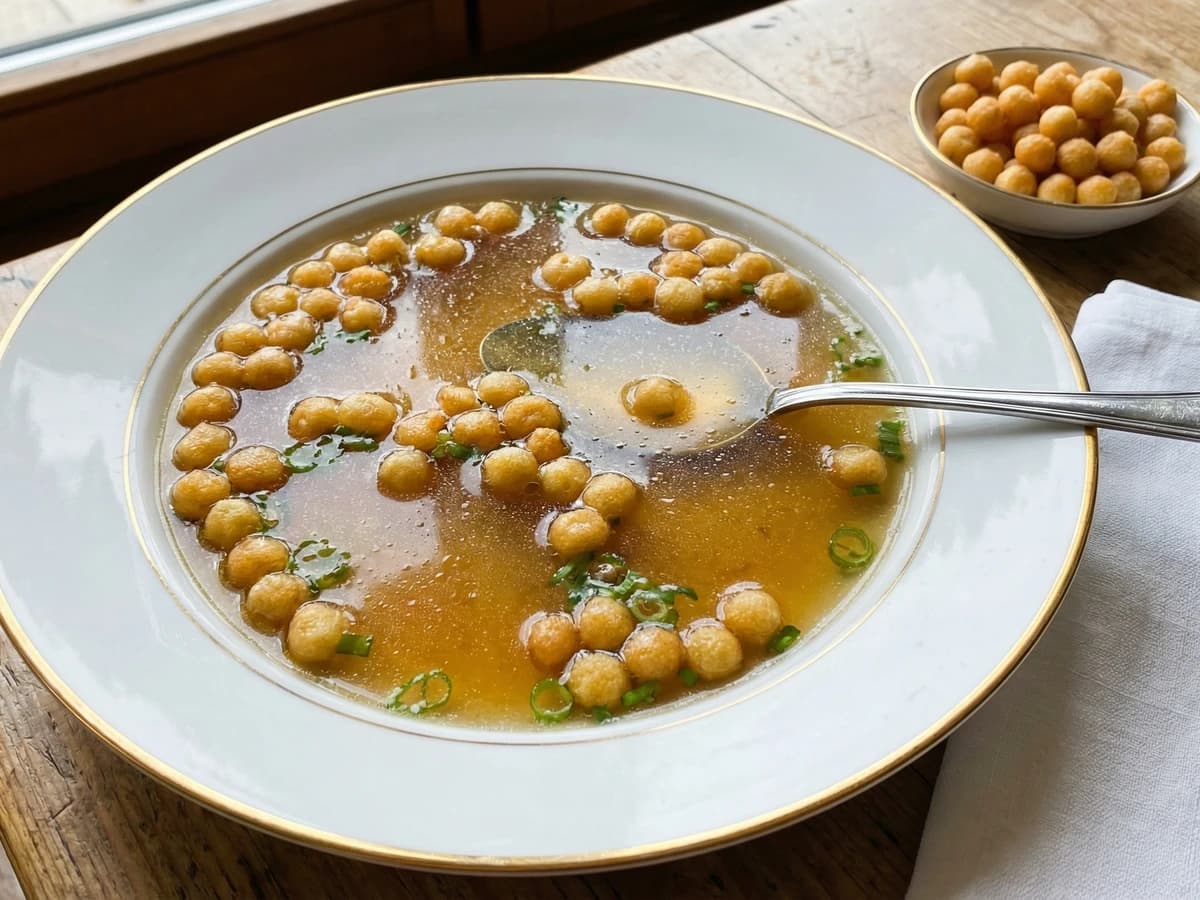
Golden fried batter pearls dropped into clear, honest Rindssuppe, where they bob on the surface before slowly drinking up the broth. The soup that Austrian children ask for by name.
Chef Elsa
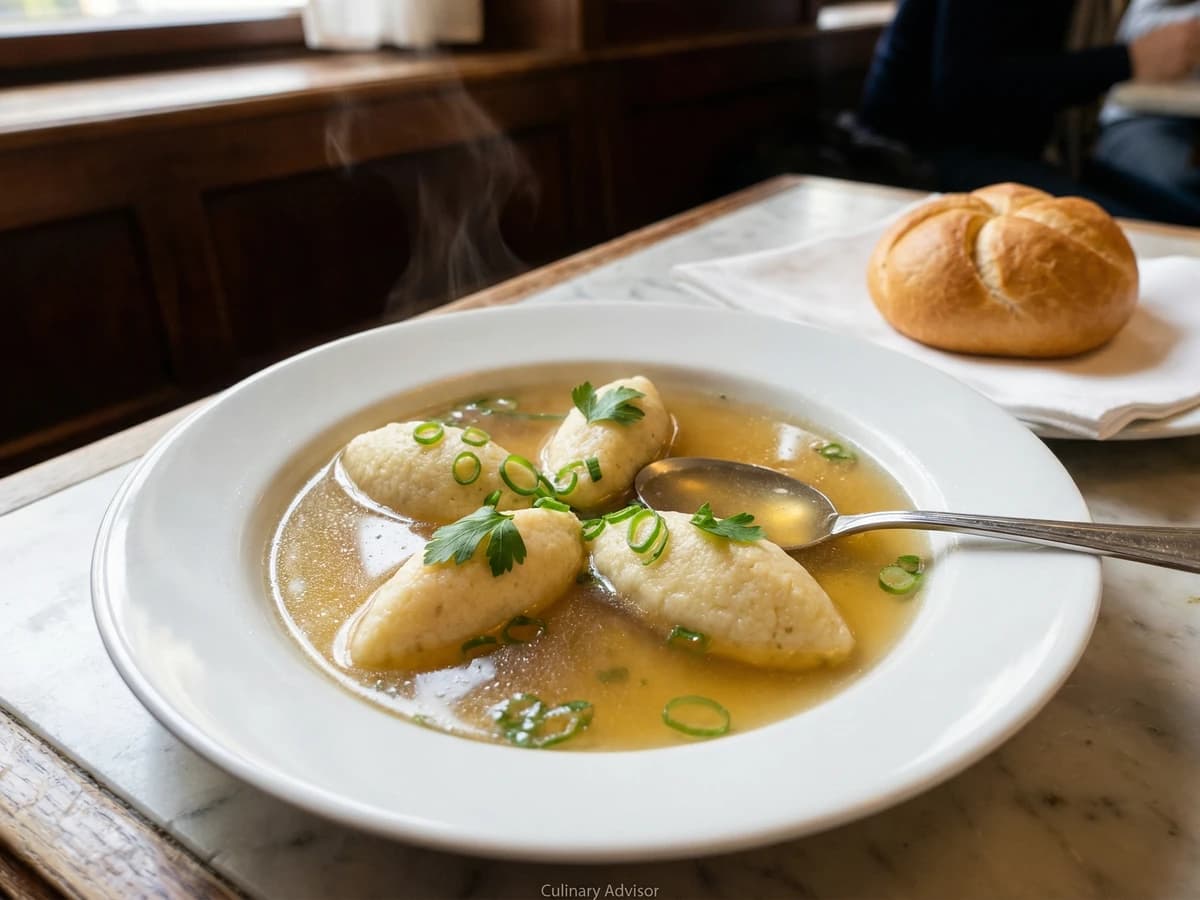
Impossibly light butter dumplings floating in clear golden Rindssuppe, the kind of Suppeneinlage that separates a good Austrian kitchen from a great one.
Chef Elsa
Flour browned slowly in lard until it smells like toasted hazelnuts, thinned with good broth, warmed with caraway. The soup Austrian grandmothers made when the cupboard was nearly bare and the family still needed feeding.