
Chef Lupita
Arroz a la Oaxaqueña
Oaxaca's red rice, stained with tomato and fried in lard, steamed with carrots, ejotes, black beans, and epazote. The side that anchors a Oaxacan family meal and earns its place beside the main.
A cooking platform built around craft, culture, and the stories behind what we eat.
Created by
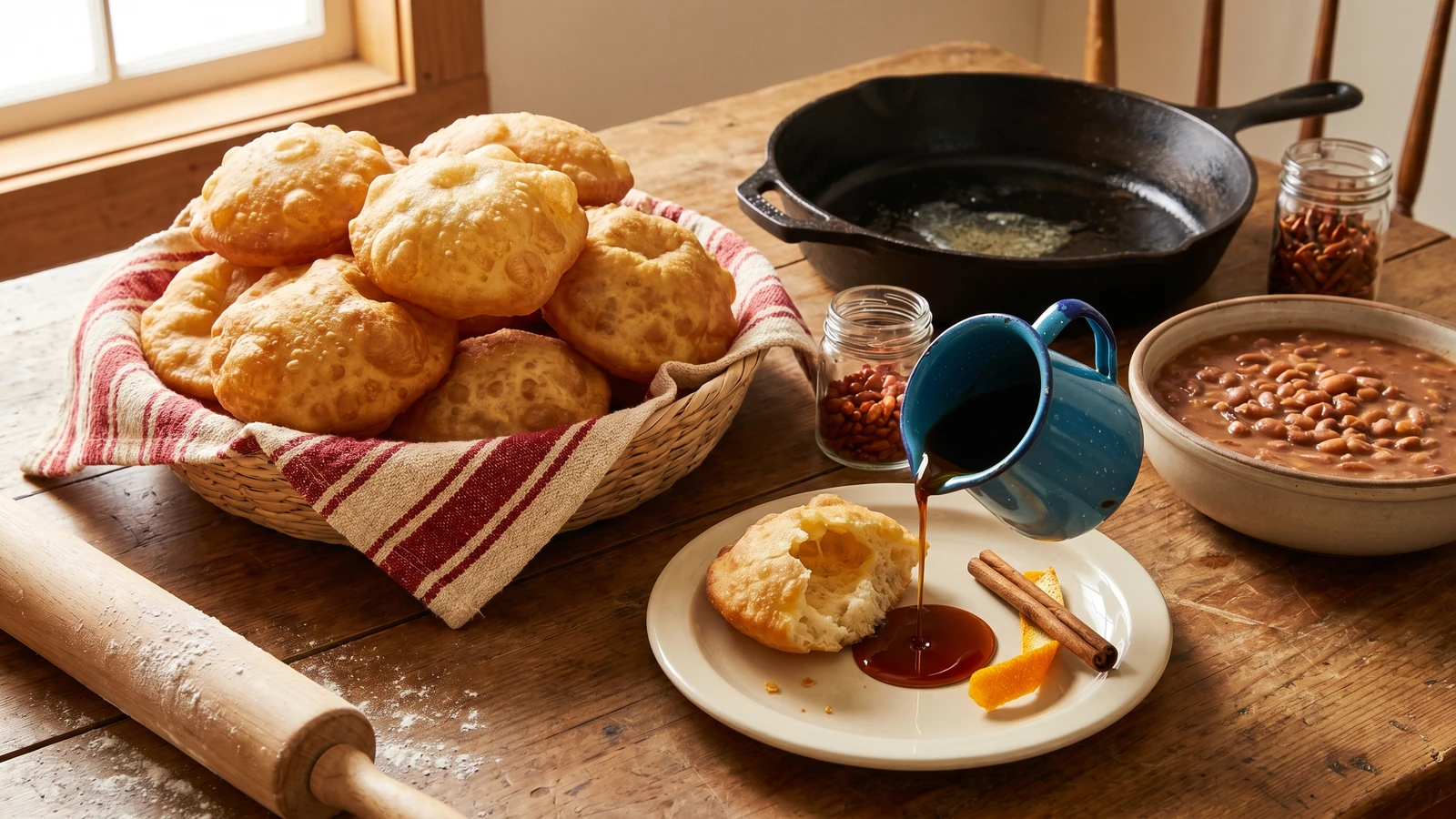
Northern Mexico's hollow fried bread from Chihuahua and Coahuila, leavened wheat dough cut into triangles and fried in lard until they puff like pillows. Torn open at the table to mop up stew or drizzled with piloncillo syrup.
Sopaipillas are from the north. Chihuahua, Coahuila, Nuevo Leon, the high plains where wheat grows and cattle are raised and the kitchen smells like flour and manteca, not corn and chile. If you grew up in central or southern Mexico, you may have never seen one. That is the point. This is a 32-state cuisine, and the north has its own bread.
A sopaipilla is leavened wheat dough cut into triangles, fried in hot lard until it balloons hollow. The puff is the dish. A flat sopaipilla is a failure. Two things make the puff happen: dough rolled to exactly the right thickness, around a quarter inch, and frying fat at exactly the right temperature, 375 degrees. Miss either and you have fried bread. Hit both and you have a sopaipilla.
My mother was from Jalisco and she did not make these. I learned sopaipillas from a senora in Saltillo named Dona Cruz who has been frying them in pork lard for fifty years on a wood-burning stove. She told me the trick is to press the dough gently into the oil with the back of a spoon for the first two seconds. That little push starts the steam pocket. Without it, the sopaipilla cooks flat. With it, the inside opens up like a bag. La manteca es el sabor, and at Christmas, when she drizzles them with piloncillo syrup spiked with canela and orange peel, the whole house smells like the north in December.
Sopaipillas trace their lineage through the Spanish colonial pastry tradition to medieval Andalusian fried doughs called 'xopaipas,' which arrived in northern New Spain with Spanish settlers in the 16th and 17th centuries. The dish took root specifically in the wheat-growing regions of Chihuahua, Coahuila, and Nuevo Leon, where the colonial cattle haciendas and the absence of native corn cultivation made flour the staple grain. Northern Mexican sopaipillas are distinct from the sweeter, thicker New Mexican version that developed independently across the border in Albuquerque and Santa Fe; the norteno style is thinner, more bread-like, and historically served as the savory accompaniment to ranch stews before its sweet Christmas role was established in the 19th century.
Quantity
4 cups
plus more for rolling
Quantity
2 teaspoons
Quantity
1 1/2 teaspoons
Quantity
2 teaspoons
Quantity
1/4 cup
cold and cut into small pieces
Quantity
1 1/4 cups
warm to the touch
Quantity
1 teaspoon
Quantity
about 6 cups
Quantity
1 cone (about 8 ounces)
chopped
Quantity
1 cup
Quantity
1
Quantity
1 strip
| Ingredient | Quantity |
|---|---|
| all-purpose flourplus more for rolling | 4 cups |
| baking powder | 2 teaspoons |
| fine sea salt | 1 1/2 teaspoons |
| granulated sugar | 2 teaspoons |
| manteca de cerdo (pork lard)cold and cut into small pieces | 1/4 cup |
| whole milkwarm to the touch | 1 1/4 cups |
| active dry yeast | 1 teaspoon |
| manteca de cerdo or neutral oil for frying | about 6 cups |
| piloncillo (optional)chopped | 1 cone (about 8 ounces) |
| water (for syrup) (optional) | 1 cup |
| canela (Mexican cinnamon stick) (optional) | 1 |
| orange peel (optional) | 1 strip |
Warm the milk until it feels like bathwater on the inside of your wrist. Not hot. Hot milk kills yeast and you start over. Stir in the yeast and the sugar and let it sit for ten minutes until the surface foams and the kitchen smells faintly of bread. If it does not foam, your yeast is dead. Throw it out and use a fresh packet.
In a wide bowl, whisk together the flour, baking powder, and salt. Add the cold lard. Work it in with your fingertips until the mixture looks like coarse cornmeal with some pea-sized pieces still visible. La manteca es el sabor. This is what makes a sopaipilla puff hollow. Vegetable shortening will work and the senoras in Saltillo will not arrest you for it, but the flavor is not the same.
Pour the foamy milk and yeast into the flour. Mix with your hand until the dough comes together in a shaggy mass. Turn it out onto a lightly floured counter and knead for five to seven minutes. The dough should go from rough to smooth, soft but not sticky, with a faint elastic snap when you press it. Do not add more flour unless the dough is genuinely tacky on your hands.
Place the dough in a lightly greased bowl, cover with a clean cotton servilleta, and leave it on the counter for one to one and a half hours. It should roughly double. In a cool northern Mexican kitchen in December, this can take longer. Be patient. The rest is what gives the inside its open crumb.
While the dough rests, combine the chopped piloncillo, water, canela, and orange peel in a small saucepan. Simmer over medium-low heat until the piloncillo dissolves and the syrup thickens enough to coat the back of a spoon, about fifteen minutes. Strain out the canela and orange peel. Set aside to cool. This syrup is what northern Mexico drizzles over sopaipillas at Christmas. It is not optional if you are serving them sweet.
Turn the dough onto a lightly floured surface and divide it in half. Roll each half into a rectangle about one-quarter inch thick. Not thinner. A thin sopaipilla will fry crisp and flat like a tostada and will not puff. Cut each rectangle into triangles or squares roughly three inches across. Cover the cut pieces with a clean servilleta while you heat the oil. Do not let them dry out.
Pour enough lard or oil into a deep heavy pot or cazuela to come three inches up the sides. Heat over medium-high to 375F. Use a thermometer. If you do not have one, a small piece of dough dropped in should bubble immediately and rise to the surface within two seconds. Below 375F, the sopaipillas absorb fat and stay flat. Above 400F, the outside burns before the inside cooks. The temperature is the recipe.
Slide two or three pieces of dough into the hot fat. Do not crowd the pot. As soon as they hit the fat, press the top of each piece gently down into the oil with the back of a slotted spoon for a couple of seconds. That push forces the steam inside the dough to do its work and makes the sopaipilla puff hollow. Fry for about 30 seconds per side until they balloon up and turn deep golden. Flip with a slotted spoon. Lift them out and drain on a wire rack set over a sheet pan.
Sopaipillas are at their best in the first ten minutes off the fat. Pile them in a basket lined with a cotton servilleta. Serve them alongside a pot of frijoles charros, asado de puerco, or carne con chile colorado so the diner can tear one open and use it to mop the broth. Or set out the piloncillo syrup and let everyone drizzle their own. Asi se hace y punto.
1 serving (about 195g)
Culinary guides, cultural storytelling, and the editorial depth that makes cooking meaningful.
Discover Culinary ExplorerChef Lupita
Oaxaca's red rice, stained with tomato and fried in lard, steamed with carrots, ejotes, black beans, and epazote. The side that anchors a Oaxacan family meal and earns its place beside the main.

Chef Lupita
Sinaloa's home-cook white rice topped with cold cubes of cream cheese that soften into the warm grain, finished with crema and a sprinkle of chiltepin at the table. The trick that makes a side dish feel like a small luxury.

Chef Lupita
Sonora's white rice, toasted in butter and steamed with sweet corn and tender peas. The clean, quiet partner to a plate of carne asada, not the red rice of central Mexico.

Chef Lupita
Yucatán's white rice with sweet corn kernels, toasted in lard with garlic and onion. The quiet base that holds up against the peninsula's bold achiote-stained stews.