
Chef Jeong-sun
Albaechu-mul-kimchi (Baby Cabbage Water Kimchi)
Tender baby napa cabbage in a clear pear-garlic brine, lightly fermented until the broth turns clean and bright, the summer kimchi a beginner can make without a kimjang floor.
A cooking platform built around craft, culture, and the stories behind what we eat.
Created by
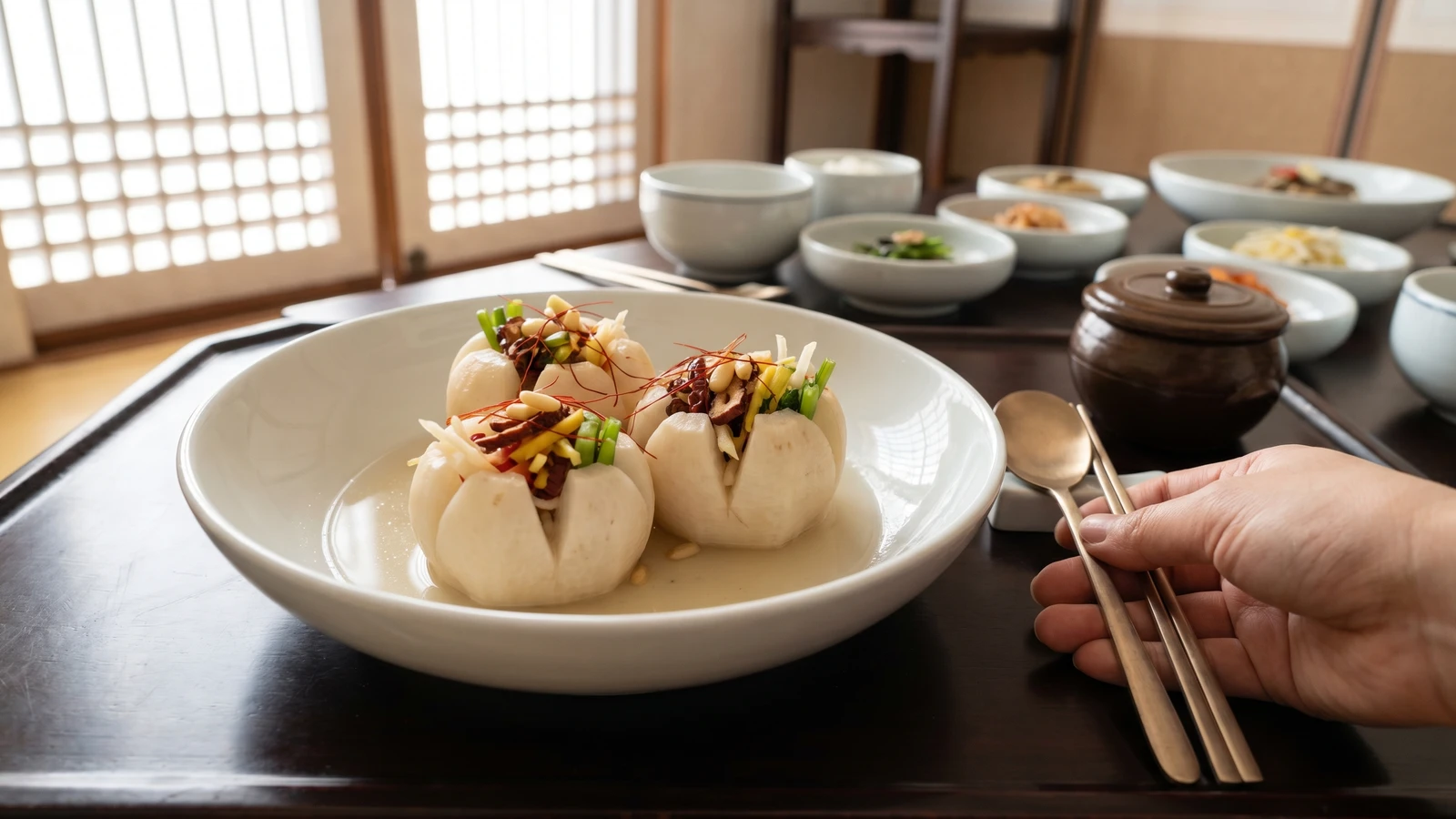
A quiet holiday kimchi from the court table: Korean radish cut to bloom like a pomegranate, stuffed with pale fruit and nuts, then rested in a clear, lightly seasoned brine.
Seokryu-kimchi lives or dies by the knife. The radish has to be cut deep enough to open like a small pomegranate, but not so deep that it falls apart in your hand. I won't tell you this is easy. It asks for a steady board, a sharp knife, and a cook who is willing to slow down.
My teacher Master Seong-nyeo made us practice the cut on scraps before she let a whole radish near us. 눈동냥, 귀동냥, borrowing with the eyes and ears. Watch the blade stop just short of the base. That uncut root is the hinge. Without it, you have chopped radish and a pile of garnish, still edible, no longer this dish.
This is a festive kimchi, mild and white, made for a table where color and restraint matter. The filling should show red jujube, pale pear, ivory chestnut, green minari, and pine nuts tucked into the radish like little jewels, but the seasoning must stay quiet. Let the radish taste like radish. Let the pear taste like pear. Not every kimchi needs to shout.
Notebook 41 says one thing in the margin: cut slowly, salt evenly, pack lightly. Too much filling splits the radish. Too much salt kills the sweetness. 손맛 is real, and I still measure it so it can be handed on.
Seokryu-kimchi belongs to the decorative white kimchi family associated with Joseon court cooking, where ingredients were cut and arranged to suggest auspicious forms, in this case the seokryu, or pomegranate. Pomegranates were valued in East Asian visual culture as a symbol of abundance because of their many seeds, and the dish borrows that image through knife work rather than relying on the fruit itself. It is closer to a special-occasion water kimchi than to a red fermented cabbage kimchi, mild, short-aged, and served for its clean taste as much as its appearance.
Quantity
1 large, about 1.2kg
straight, firm, peeled
Quantity
2 tablespoons
for salting the radish
Quantity
1/2
peeled and cut into fine matchsticks
Quantity
4
pitted and cut into fine strips
Quantity
4
cut into fine matchsticks
Quantity
2 tablespoons
tips removed
Quantity
30g
tender stems only, cut into 1-inch lengths
Quantity
1 small
seeded and cut into fine threads
Quantity
1 small piece, about 10g
peeled and cut into fine threads
Quantity
1 small clove
very thinly sliced
Quantity
4 cups
Quantity
1 tablespoon
for the brine
Quantity
1 tablespoon
Quantity
2 tablespoons
from grated pear
Quantity
1 teaspoon
from grated ginger
Quantity
1 tablespoon
for serving
| Ingredient | Quantity |
|---|---|
| Korean radish (mu)straight, firm, peeled | 1 large, about 1.2kg |
| coarse sea saltfor salting the radish | 2 tablespoons |
| Korean pearpeeled and cut into fine matchsticks | 1/2 |
| dried jujubespitted and cut into fine strips | 4 |
| peeled chestnutscut into fine matchsticks | 4 |
| pine nutstips removed | 2 tablespoons |
| minari (Korean water dropwort)tender stems only, cut into 1-inch lengths | 30g |
| red chiliseeded and cut into fine threads | 1 small |
| gingerpeeled and cut into fine threads | 1 small piece, about 10g |
| garlicvery thinly sliced | 1 small clove |
| water | 4 cups |
| coarse sea saltfor the brine | 1 tablespoon |
| sugar | 1 tablespoon |
| Korean pear juicefrom grated pear | 2 tablespoons |
| ginger juicefrom grated ginger | 1 teaspoon |
| pomegranate arils (optional)for serving | 1 tablespoon |
Peel the radish and cut it into 6 to 8 squat pieces, each about 5cm tall. Trim the sides lightly so each piece can stand flat. Set one piece upright and cut down in a cross, stopping 1cm before the base, then cut each quarter once more if the radish is wide. The base must stay joined, because that hinge is what lets the radish open like a pomegranate without breaking.
Sprinkle the 2 tablespoons coarse sea salt between the cuts and over the outside of the radish pieces. Set them in a shallow bowl for 45 minutes, turning once. They should bend slightly at the cuts but still feel crisp. Rinse quickly under cold water and drain cut side down for 15 minutes. Too much salt makes this delicate kimchi taste flat, so do not leave it longer.
Cut the pear, jujube, chestnut, minari, red chili, ginger, and garlic into fine pieces no thicker than a matchstick. Keep each ingredient separate until the cutting is done, because they bruise and stain at different speeds. The filling is small on purpose: large pieces split the radish and make the finished kimchi look clumsy.
In a small bowl, toss the pear, jujube, chestnut, pine nuts, minari, red chili, ginger threads, and garlic with your fingertips. Do not crush it. You are distributing color, not making a paste. Taste one strand of pear with one strand of ginger; the ginger should lift the sweetness, not take over.
Open each salted radish gently with your fingers and tuck in 1 to 1 1/2 tablespoons filling. Pack lightly. If you force in more, the radish will tear during resting and all that careful cutting will be wasted. Set the stuffed radishes close together in a clean glass or ceramic container so they support one another.
Stir 4 cups water with 1 tablespoon coarse sea salt, 1 tablespoon sugar, 2 tablespoons pear juice, and 1 teaspoon ginger juice until dissolved. Taste it before it touches the radish. It should be lightly salty and faintly sweet, cleaner than a soup and gentler than pickle brine, because the radish has already been salted.
Pour the brine gently down the side of the container so it covers the stuffed radishes without knocking out the filling. Cover and leave at cool room temperature for 6 to 8 hours, then refrigerate at least 4 hours before serving. This is a short-aged kimchi. It should taste crisp, mild, and settled, not sour.
Lift each radish with a spoon, not chopsticks, and set it in a shallow bowl with a little brine. Open the cuts just enough to show the filling. Add a few pomegranate arils only if you want to make the name visible at the table; the older point of the dish is the shape, not the fruit.
1 serving (about 340g)
Culinary guides, cultural storytelling, and the editorial depth that makes cooking meaningful.
Discover Culinary ExplorerChef Jeong-sun
Tender baby napa cabbage in a clear pear-garlic brine, lightly fermented until the broth turns clean and bright, the summer kimchi a beginner can make without a kimjang floor.

Chef Jeong-sun
The kimchi from before chili, salted napa cabbage packed with radish, pear, jujube, and pine nuts in a clear brine that turns quietly tart in the jar.

Chef Jeong-sun
A pale summer cucumber kimchi, split and stuffed with radish and chives, then held in a cool pear brine so the cucumber stays clean, crunchy, and plainly itself.

Chef Jeong-sun
Flat spring bomdong cabbage, lightly brined and tucked into a clear pear-radish kimchi broth, made without chili and eaten young while the leaves still taste like spring.