
Chef Jeong-sun
Albaechu-mul-kimchi (Baby Cabbage Water Kimchi)
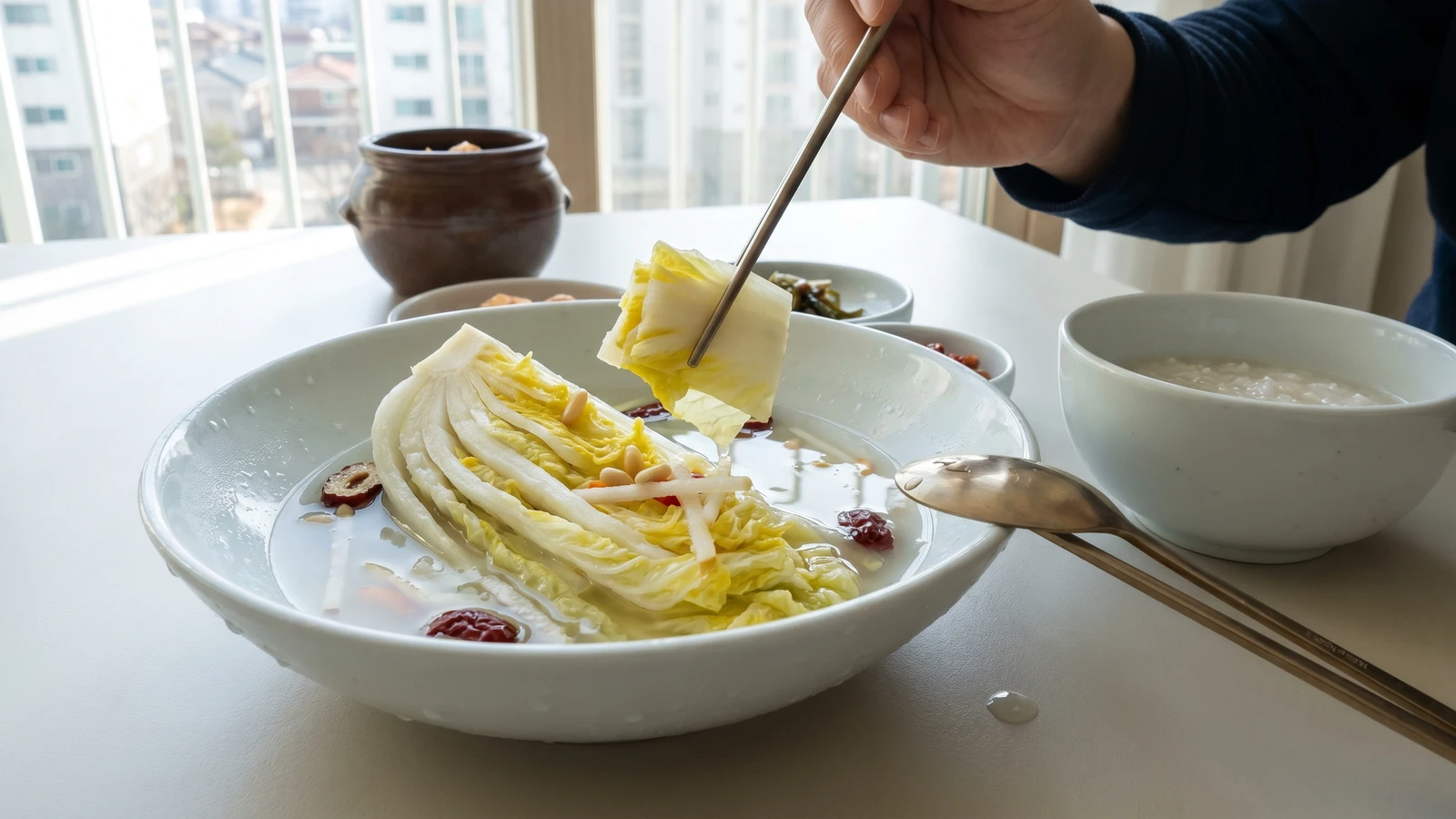
Tender baby napa cabbage in a clear pear-garlic brine, lightly fermented until the broth turns clean and bright, the summer kimchi a beginner can make without a kimjang floor.
A cooking platform built around craft, culture, and the stories behind what we eat.
Created by
The kimchi from before chili, salted napa cabbage packed with radish, pear, jujube, and pine nuts in a clear brine that turns quietly tart in the jar.
Baek-kimchi lives or dies by salting. People look at the pale brine and think it is the gentle kimchi, and it is, but gentle does not mean careless. Salt the cabbage too little and it ferments weakly. Salt it too much and the brine tastes flat before it ever has a chance to sour.
My teacher, Master Seong-nyeo, made me bend the cabbage leaf at the thick white rib, not at the green edge. The rib tells the truth. When it bends without snapping and still tastes pleasantly salty, the cabbage is ready to rinse and pack. That one test matters more than the clock, but I still give you the clock, because 손맛 is real. I measure it anyway.
This is white kimchi, 백김치: napa cabbage, Korean radish, pear, garlic, ginger, and a clear seasoned brine, with no gochugaru to hide behind. It belongs on the table when there are children, elders, grilled meat, rice porridge, or a stomach that wants quiet. The work tonight is knife work, salting, rinsing, and packing cleanly. After that, the jar does the slow part.
Baek-kimchi preserves the older branch of kimchi that existed before chili peppers reached Korea from the Americas in the late sixteenth to seventeenth century. White and watery kimchi styles remained especially important in the northern regions, including Pyongan, where milder seasoning, cold winters, and dongchimi-like brines shaped the table. Modern red kimchi is now more famous, but baek-kimchi keeps the clear brined tradition visible and edible.
Quantity
1 large, about 1.5kg
quartered lengthwise through the core
Quantity
1/2 cup
for salting
Quantity
6 cups
divided
Quantity
200g
peeled and julienned
Quantity
1/2
peeled and julienned
Quantity
3
cut into 2-inch lengths
Quantity
1 small
julienned
Quantity
3
pitted and thinly sliced
Quantity
1 tablespoon
Quantity
6 cloves
sliced
Quantity
20g
sliced
Quantity
1/2 small
sliced
Quantity
1/2
grated or blended for brine
Quantity
2 tablespoons
Quantity
1 tablespoon
Quantity
1 tablespoon
Quantity
1/2 cup
Quantity
1 1/2 teaspoons, plus more as needed
| Ingredient | Quantity |
|---|---|
| napa cabbagequartered lengthwise through the core | 1 large, about 1.5kg |
| coarse sea saltfor salting | 1/2 cup |
| waterdivided | 6 cups |
| Korean radishpeeled and julienned | 200g |
| Korean pearpeeled and julienned | 1/2 |
| scallionscut into 2-inch lengths | 3 |
| carrot (optional)julienned | 1 small |
| dried jujubes (optional)pitted and thinly sliced | 3 |
| pine nuts (optional) | 1 tablespoon |
| garlicsliced | 6 cloves |
| fresh gingersliced | 20g |
| onionsliced | 1/2 small |
| Korean peargrated or blended for brine | 1/2 |
| fish sauce or soup soy sauce | 2 tablespoons |
| sugar | 1 tablespoon |
| sweet rice flour | 1 tablespoon |
| water for paste | 1/2 cup |
| fine sea salt | 1 1/2 teaspoons, plus more as needed |
Trim only the browned base of the cabbage, keeping enough core to hold each quarter together. Cut a short slit through the core, then pull the cabbage apart with your hands so the leaves tear naturally instead of being crushed by the knife. Rinse lightly and shake off excess water.
Dissolve 1/4 cup coarse sea salt in 4 cups water in a large basin. Dip each cabbage quarter in the brine, then lift it out and sprinkle the remaining 1/4 cup coarse salt between the leaves, using more at the thick white ribs and less at the green tips. Set the quarters cut side up in the basin and let them salt for 3 to 4 hours, turning once halfway.
Whisk the sweet rice flour with 1/2 cup water in a small pot until smooth. Cook over medium-low heat, stirring, until it turns glossy and lightly thickened, about 3 minutes. Cool completely. This paste gives the brine a little body and food for fermentation, not sweetness for its own sake.
Blend or grate the pear with the garlic, ginger, onion, fish sauce or soup soy sauce, sugar, fine sea salt, cooled rice paste, and 2 cups water. Strain through a fine sieve or clean cloth into a bowl, pressing gently. The brine should be clear enough to see the pale cabbage through it, and it should taste slightly saltier than soup because the cabbage and vegetables will dilute it.
Rinse the salted cabbage under cool running water 2 to 3 times, lifting between the leaves to remove excess salt. Taste a piece from the thick rib. It should be seasoned all the way through, not raw-salty on the outside and watery inside. Drain cut side down for 30 minutes so the finished kimchi is crisp instead of waterlogged.
In a bowl, combine the julienned radish, julienned pear, scallions, carrot if using, sliced jujubes, and pine nuts. Add 1/2 cup of the strained brine and toss gently by hand. Do not bruise the pear. Baek-kimchi has no chili to cover rough handling, so the cut vegetables should stay clean and distinct.
Lay one cabbage quarter open in your palm and tuck small amounts of filling between the leaves, especially near the base. Use about 1/4 of the filling for each quarter. Fold the outer leaf around the bundle to hold it together. Pack each bundle into a clean 2-liter jar or lidded container, cut side up, without crushing it.
Pour the remaining strained brine over the packed cabbage until it is just covered. Press down gently with clean hands or a fermentation weight so no dry leaves sit above the liquid. Leave at least 1 inch of headspace, because fermentation pushes the brine upward. Cover with a lid, but do not tighten it hard for the first day.
Leave the jar at cool room temperature, about 18 to 21 C, for 24 to 48 hours. Open once a day over the sink to release pressure and press the cabbage back under the brine with a clean utensil. When the brine smells cleanly sour and tastes lightly tart, refrigerate it. It is good after 3 days cold and best from day 5 to day 14.
Cut only what you will serve, using clean scissors or a clean knife, and return the rest to the brine. Serve cold, with a spoonful of the clear brine. That brine is part of the dish, especially beside rice, grilled meat, mandu, or juk (rice porridge).
1 serving (about 100g)
Culinary guides, cultural storytelling, and the editorial depth that makes cooking meaningful.
Discover Culinary ExplorerChef Jeong-sun
Tender baby napa cabbage in a clear pear-garlic brine, lightly fermented until the broth turns clean and bright, the summer kimchi a beginner can make without a kimjang floor.

Chef Jeong-sun
A pale summer cucumber kimchi, split and stuffed with radish and chives, then held in a cool pear brine so the cucumber stays clean, crunchy, and plainly itself.

Chef Jeong-sun
Flat spring bomdong cabbage, lightly brined and tucked into a clear pear-radish kimchi broth, made without chili and eaten young while the leaves still taste like spring.
Chef Jeong-sun
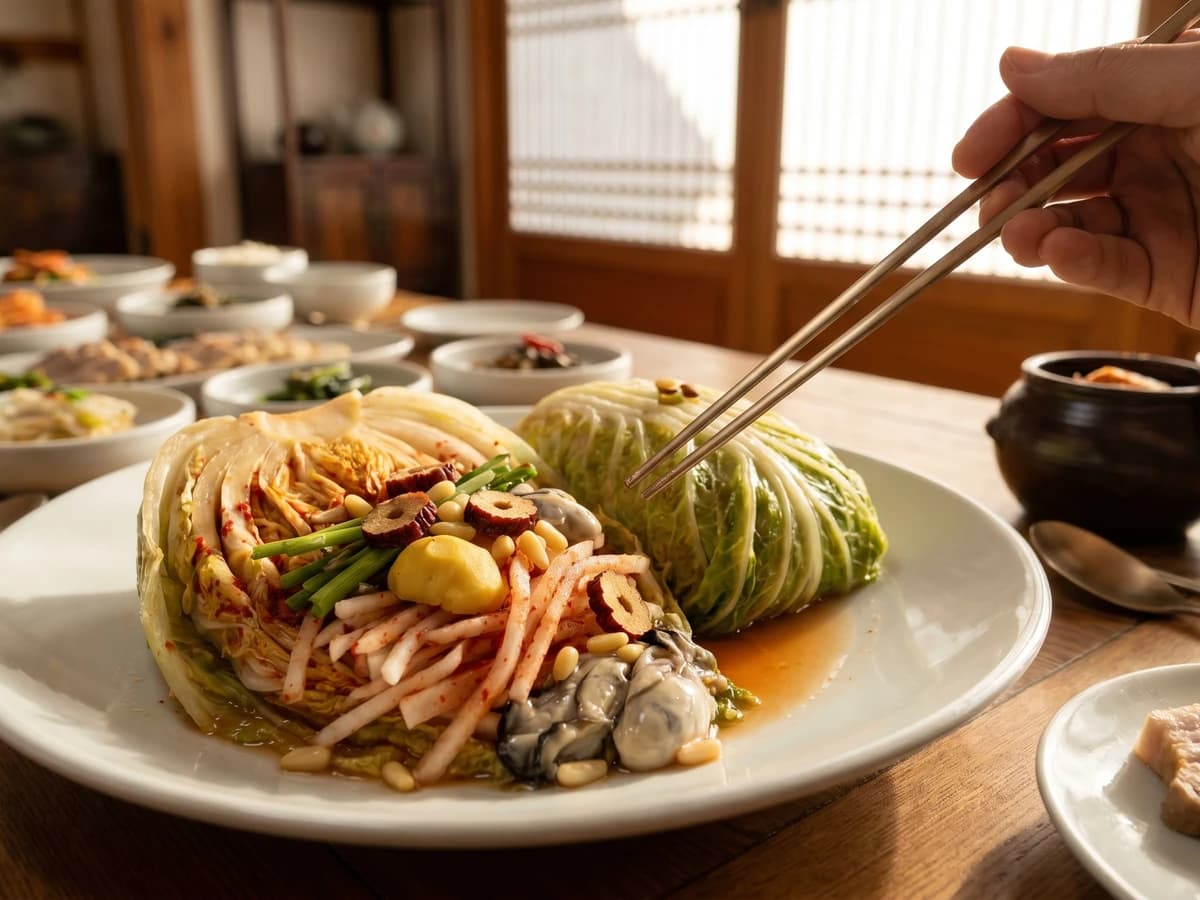
A festive Gaeseong kimchi parcel, packed with crisp radish, pear, chestnut, jujube, pine nuts, and oyster, then opened at the table like a gift made to be shared.