
Chef Klaus
Apfelmus
The apple-harvest preserve of the German kitchen, cooked low until the fruit collapses, then kept smooth, tart, and ready for potato pancakes or warm Mehlspeisen.
A cooking platform built around craft, culture, and the stories behind what we eat.
Created by
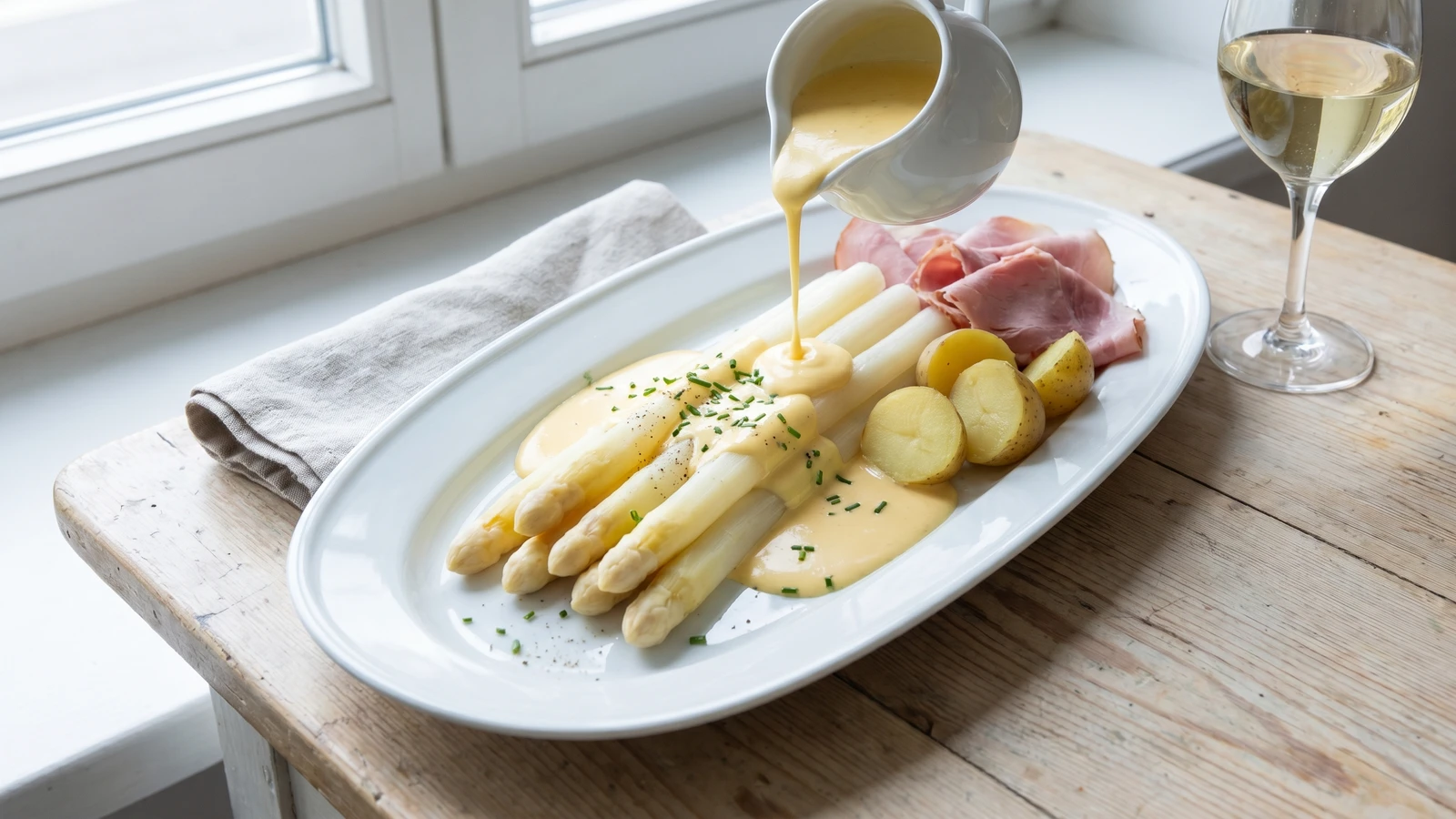
Spargelzeit has two arguments: melted butter or Hollandaise. If you choose the sauce, keep the heat gentle, add the butter slowly, and don't let it boil.
Sauce Hollandaise sits on the German table in spring, when white Spargel, asparagus, comes in and the country starts behaving as if no other vegetable exists. Easter tables, May Sundays, a quiet dinner for two: pale asparagus, new potatoes, ham, and this warm yellow sauce. Not from a packet. Nicht aus dem Glas.
The regions argue in the usual useful way. Baden and the southwest will put Spargel beside Kratzete, torn pancake, with ham and plenty of sauce. Lower Saxony and the north often keep it plainer with new potatoes, Katenschinken, and melted butter. Some cooks say butter alone is cleaner. They're not wrong. But if you make Hollandaise, make it properly.
The whole dish is one technique: yolk and butter must meet warm, not hot. The yolks thicken because gentle heat unwinds their proteins slowly, and the whisk breaks warm butter into tiny droplets that the yolk can hold. Boil it and the proteins seize, the butter runs out, and you've got scrambled egg with expensive butter around it. Runter mit der Temperatur.
I build it over a bain-marie, a bowl over barely trembling water, and I watch the bottom of the bowl more than the clock. When the whisk leaves a trail, the yolk is ready. Butter goes in slowly at first, then steadier once the sauce has taken hold. Lemon and salt at the end. Würzen, Fett, Salz zum Schluss.
Sauce Hollandaise is French in origin, but it became fixed in German cooking through Spargelzeit, the asparagus season that took strong hold around court and market-garden regions such as Schwetzingen in Baden from the eighteenth century onward. Auguste Escoffier codified Hollandaise among the great sauces in Le Guide Culinaire in 1903, and German hotel, restaurant, and home cooking adopted it as the warm butter sauce for white asparagus. The regional dispute remains practical rather than grand: much of the north and west is happy with melted butter, while Baden, the Rhineland, and restaurant tables often choose Hollandaise.
Quantity
3
very fresh
Quantity
1 tablespoon
Quantity
1 tablespoon
Quantity
200g
melted and kept warm
Quantity
1 tablespoon
plus more to taste
Quantity
1 small pinch
Quantity
1 pinch
Quantity
1 pinch
| Ingredient | Quantity |
|---|---|
| large egg yolksvery fresh | 3 |
| cold water | 1 tablespoon |
| dry white wine or white wine vinegar | 1 tablespoon |
| unsalted buttermelted and kept warm | 200g |
| fresh lemon juiceplus more to taste | 1 tablespoon |
| fine salt | 1 small pinch |
| white pepper | 1 pinch |
| cayenne pepper (optional) | 1 pinch |
Melt the butter gently and keep it warm, not hot. If it spits or browns, you've gone too far for Hollandaise; the yolks need warm butter they can hold, not angry fat that cooks them on contact. Skim off the foam if you want a cleaner sauce, or leave the milk solids in for a fuller home-kitchen flavour.
Bring 3cm of water to a bare tremble in a small saucepan, then set a heatproof bowl over it without letting the bowl touch the water. Touching water gives direct heat, and direct heat turns yolk to curd before your whisk can save it. Runter mit der Temperatur: this sauce is made by patience, not force.
Whisk the egg yolks with the cold water and wine or vinegar in the bowl until they turn pale, foamy, and thick enough for the whisk to leave a ribbon for a second. The water gives the yolks room to heat without scrambling, and the acid helps them stay smooth while they thicken.
Take the bowl off the heat and whisk in the warm butter drop by drop at first. Once the sauce turns glossy and starts to thicken, pour in a thin steady stream, whisking all the time. The first spoonfuls build the emulsion; rush them and the butter has nowhere to go except out of the sauce.
Whisk in the lemon juice, salt, white pepper, and cayenne if you're using it, then taste. Lemon goes at the end because heat dulls its sharpness, and salt at the end keeps you from overcorrecting before the butter is in. Würzen, Fett, Salz zum Schluss.
Serve the Hollandaise straight away over white Spargel, new potatoes, or poached fish. Keep it warm over a pan of warm water off the heat for no more than 30 minutes, whisking now and then. Don't boil it, don't chill and reheat it hard, and don't leave egg sauce sitting around all afternoon. Schön ist, was schmeckt.
1 serving (about 75g)
Culinary guides, cultural storytelling, and the editorial depth that makes cooking meaningful.
Discover Culinary ExplorerChef Klaus
The apple-harvest preserve of the German kitchen, cooked low until the fruit collapses, then kept smooth, tart, and ready for potato pancakes or warm Mehlspeisen.

Chef Klaus
The northern marinated herring that belongs to the cold larder: salt fish, vinegar, onion, and time doing the work before bread or potatoes ever reach the table.

Chef Klaus
A proper Bratensoße begins with the brown bits in the pan, not a packet: bones roasted dark, wine scraped clean, stock reduced until it coats the spoon.

Chef Klaus
Plain mushrooms browned hard, then loosened with stock and cream. The sauce is mild, pale, quick, and honest, made for Schnitzel, Spätzle, or a weeknight pork cutlet.