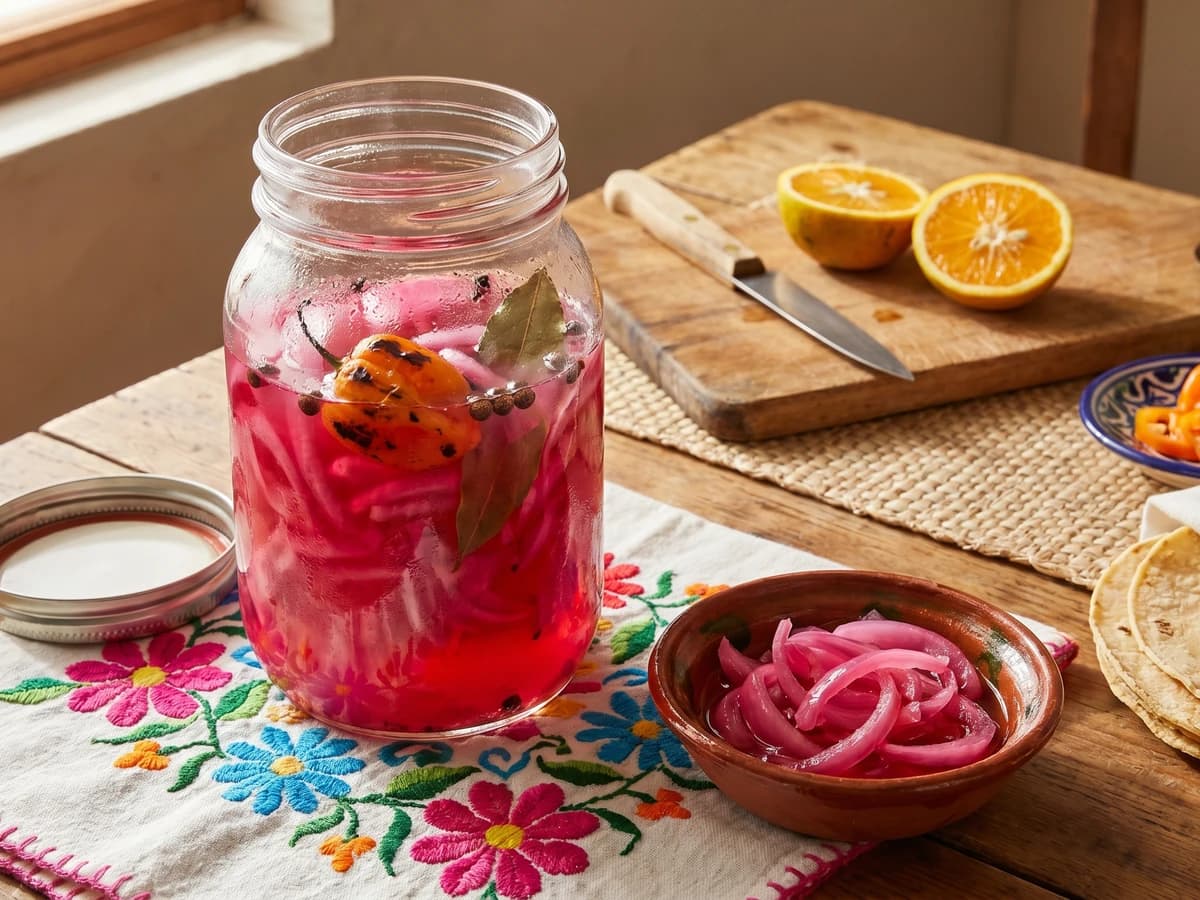
Yucatán's sharp radish cut, finely diced rabanitos with cilantro, cured purple onion, and naranja agria. The bright counterweight that makes frijol con puerco and cochinita work on the plate.
Salads
Mexican
Weeknight
Comfort Food
Budget Friendly
20 min
Active Time
0 min cook•20 min total
Yield6 servings
This is from Yucatán. Not from a Mexico-City notion of Mexican food, not a generic radish salad with vinaigrette, but from the courtyard kitchens of Mérida, Valladolid, and Tizimín, where a small clay bowl of salpicón de rabanitos sits next to the heavy plate on Monday because Monday is frijol con puerco and frijol con puerco without the salpicón is a meal missing its mouth.
The word salpicón means a fine dice. That is the technique and that is the law. Tiny cubes of radish, tiny cubes of cebolla morada cured in sour orange, finely chopped cilantro, a minced habanero for the cooks who like a bite, and naranja agria. No oil. No vinegar. No lettuce. Yucatecan salads are not lettuce-and-dressing affairs. They are built on jícama, cabbage, beet, citrus, radish. The peninsula has its own grammar and the salpicón is one of its smallest, sharpest words.
Naranja agria is the ingredient outsiders try to replace and usually ruin. It is not lime. It is not sweet orange. It is the Seville sour orange the Spanish brought to the peninsula in the 16th century and the Maya cooks adopted as the acid of choice. If you cannot find it, mix lime with a little fresh sweet orange juice. It is a compromise, not an upgrade. Pregúntale a las señoras del mercado de Santiago en Mérida. They will tell you the same thing.
My mother did not cook Yucatecan food. She was from Jalisco. But the first time I sat at a table in Mérida and watched a señora set down a bowl of frijol con puerco with a smaller bowl of salpicón beside it, I understood that the salad was not garnish. It was function. The radish cuts the fat. The sour orange wakes up the beans. The cilantro lifts the pork. Cada estado, su propia cocina, and the Yucatán knows what its plate needs.
Salpicón, from the Spanish verb 'salpicar' (to sprinkle or splash), refers across the Spanish-speaking world to any preparation built on fine dicing, with regional fillings ranging from meat to seafood to vegetables; the Yucatecan radish version is a peninsular adaptation that took hold in the 19th century as a cooling counterpoint to the heavy, lard-rich plates of the region's mestizo cuisine. Naranja agria (Citrus × aurantium), the Seville sour orange that defines the dish's acid, was introduced to the Yucatán by Spanish colonists in the 16th century and was rapidly absorbed into Maya cooking, where it replaced the indigenous practice of souring food with the juice of native chaya stems and bitter wild fruits. The Monday tradition of pairing salpicón with frijol con puerco is so codified in Mérida that families plan the week's marketing around it, and a Yucatecan cook who serves frijol con puerco without salpicón will be quietly judged.
The technique, the tradition, and the story behind every dish.
fresh-squeezed, or substitute 3 tablespoons lime juice mixed with 1 tablespoon sweet orange juice
fresh chile habanero (optional)
Quantity
1
stemmed and very finely minced
kosher salt
Quantity
3/4 teaspoon, plus more to taste
fresh sour orange juice or lime juice (for the onion bath)
Quantity
1 tablespoon
dried Yucatecan oregano (oregano yucateco)
Quantity
a pinch
crumbled between the fingers
Ingredient
Quantity
red radishes (rabanitos)tops trimmed and cleaned
2 bunches (24 to 30 small)
small purple onion (cebolla morada)very finely diced
1/2
fresh cilantro leaves and tender stemsfinely chopped
1/2 cup
naranja agria juicefresh-squeezed, or substitute 3 tablespoons lime juice mixed with 1 tablespoon sweet orange juice
1/4 cup
fresh chile habanero (optional)stemmed and very finely minced
1
kosher salt
3/4 teaspoon, plus more to taste
fresh sour orange juice or lime juice (for the onion bath)
1 tablespoon
dried Yucatecan oregano (oregano yucateco)crumbled between the fingers
a pinch
Equipment Needed
•Sharp 6-inch chef's knife for the fine dice
•Small wooden cutting board reserved for chile work
•Small clay or talavera bowl for serving
•Citrus reamer or hand juicer for the sour orange
Instructions
1
Tame the onion
Put the finely diced purple onion in a small bowl with the tablespoon of sour orange juice or lime and a pinch of salt. Toss with your fingers and leave it for ten minutes. The acid pulls the raw sting out of the onion and the color turns from purple to pink. This is the Yucatecan move. Raw onion in a salpicón is harsh. Cured onion is alive. Do not skip this.
If you are using true cebolla morada from the Yucatán mercado, the color shift to pink is dramatic and fast. With supermarket red onion it is more subtle, but the chemistry is the same.
2
Chop the radishes
Trim the radish tops and the little root tail. Wash them well. Cut each radish into very small dice, about three millimeters per side. Not slices. Not matchsticks. Small, even cubes the size of pomegranate seeds. This is the cut a señora in a Mérida courtyard will check first. A salpicón is named for the chop. If you slice the radishes you have made something else.
3
Mince the habanero, if using
If you want the bite, stem the habanero and mince it as finely as you can. Do not seed it. The seeds and the white ribs are where the perfume lives, and the habanero in Yucatán is not a flat heat. It is fruity, floral, and sharp. A whole minced chile in a bowl this size is for those who grew up eating habanero. Half a chile for everyone else. Wash your hands and your knife when you are done. Do not touch your eyes for the rest of the day.
4
Combine the salad
In a wide bowl, combine the diced radishes, the chopped cilantro, the cured onion (with whatever liquid is left in its bowl), and the habanero if using. Pour in the naranja agria juice. Add the salt and crumble the oregano yucateco between your fingers over the bowl as you would over a plate of cochinita. Toss gently with a spoon.
Naranja agria does the work of vinegar here. Lime alone is too one-note. If you cannot find true sour orange, the lime-and-sweet-orange blend gets you close. Plain lime is a last resort.
5
Rest and taste
Let the salpicón sit for ten minutes at room temperature. The radishes release a little water, the cilantro perfumes the bowl, and the salt and citrus settle into the vegetables. Taste it. It should be bright, sharp, salty, with a green snap from the radish. Adjust the salt. Adjust the sour orange. Do not add oil. There is no oil in a Yucatecan salpicón. Así se hace y punto.
6
Serve beside the main dish
Spoon the salpicón into a small clay bowl or a glazed talavera dish and set it on the table next to the frijol con puerco, the cochinita pibil, the puchero, or whatever heavy plate the Monday or Sunday meal calls for. This is the sharp cut that resets the palate between bites of pork and beans. It is not a side salad. It is a tool the cook hands the eater so the meal works.
Chef Tips
•The cut is the dish. A salpicón is defined by the fine dice, not the ingredients. If you are tempted to slice or shred the radishes to save time, make a different salad. No me vengas con atajos.
•True naranja agria is hard to find outside Mexico, Florida, and a handful of Caribbean markets. Look for Seville oranges in winter, or Goya bottled sour orange marinade as an emergency substitute. The lime-and-sweet-orange blend in the recipe is the home cook's workaround when nothing else is available.
•Do not refrigerate the salpicón before serving. Cold dulls the chile and tightens the radish. Make it twenty minutes before the meal and let it sit on the counter. The textures stay alive that way.
•If you serve this with cochinita pibil instead of frijol con puerco, leave out the habanero in the salpicón. The salsa de cebolla morada con habanero is already on the table for the cochinita, and two habanero hits will flatten the meal.
Advance Preparation
•The radishes can be washed, trimmed, and diced up to four hours ahead and held covered in the refrigerator on a slightly damp paper towel.
•The onion can be diced and started in its sour-orange bath up to one hour before serving. Past that the onion goes too soft.
•Combine the full salpicón no more than thirty minutes before the meal. It does not keep overnight. The radishes weep, the cilantro darkens, the texture collapses.
Frequently Asked Questions
Nutrition Information
1 serving (about 73g)
Calories
20 calories
Total Fat
0 g
Saturated Fat
0 g
Trans Fat
0 g
Unsaturated Fat
0 g
Cholesterol
0 mg
Sodium
185 mg
Total Carbohydrates
4 g
Dietary Fiber
1 g
Sugars
2 g
Protein
1 g
Where cooking meets culture.
Culinary guides, cultural storytelling, and the editorial depth that makes cooking meaningful.