
Chef Lupita
Acúmara Tatemada al Comal
Michoacán's Lake Pátzcuaro acúmara, a whole kurucha from the lago tatemada on a comal de leña and served with chile perón atápakua, corn tortillas, and P'urhépecha discipline.
A cooking platform built around craft, culture, and the stories behind what we eat.
Created by
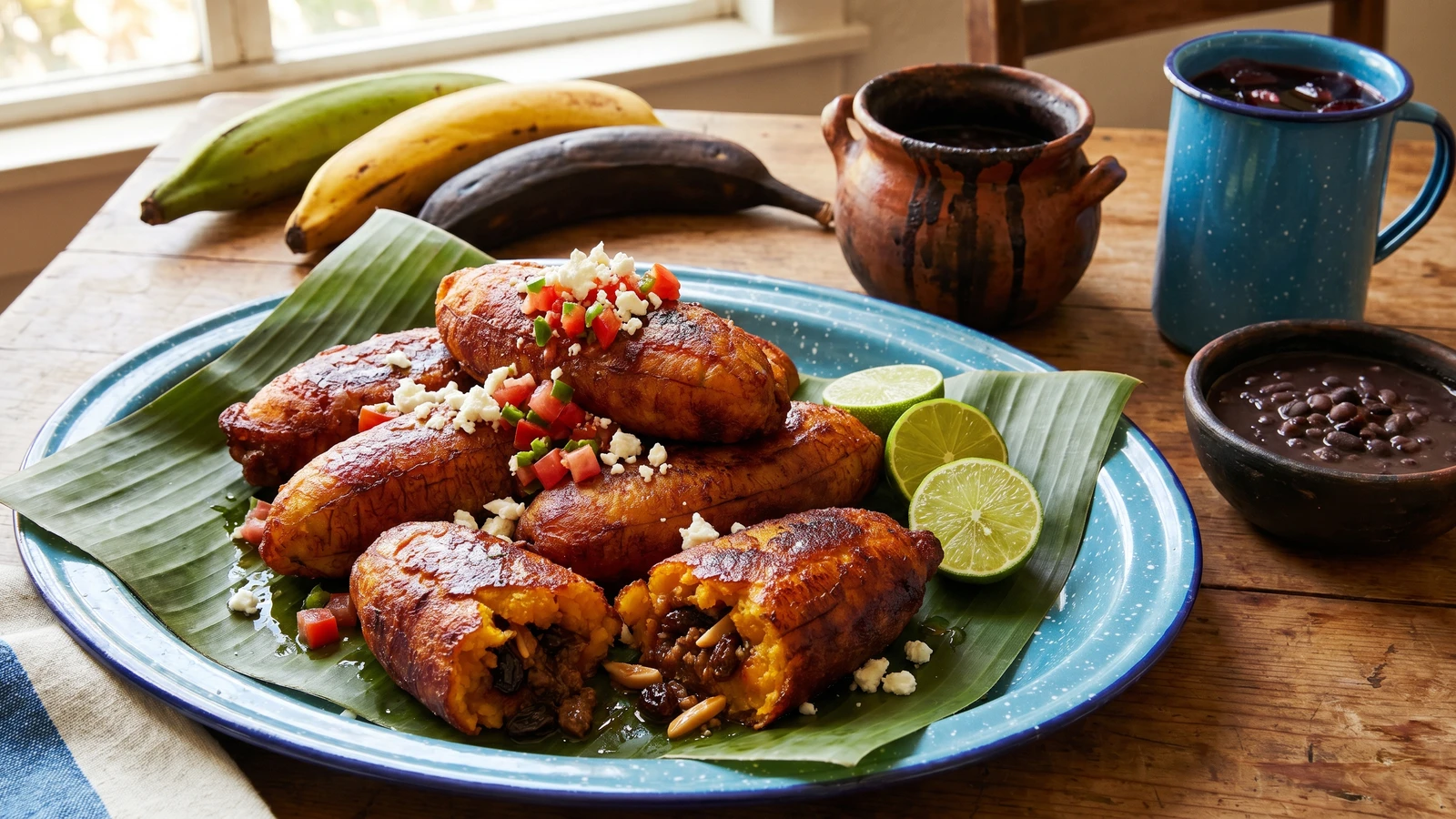
From the Sotavento coast of Veracruz, ripe plátano macho pounded into a sweet dough, wrapped around a sweet-savory beef picadillo of raisins, almonds, olives, and capers, then fried in lard until the shell turns deep gold.
This is jarocho food. It comes from the Sotavento, the low coastal plain of Veracruz where the Papaloapan River runs out to the Gulf, from towns like Tlacotalpan and Boca del Río where the son jarocho is played on an arpa and a jarana and the kitchen smells of ripe plátano frying in lard. The plantain at the center of this dish did not grow here first. It crossed the Atlantic with the African diaspora and came ashore through the port of Veracruz, the same port where enslaved Africans were forced into New Spain for three centuries. La tercera raíz no es nota al pie. Es plato principal.
Look at what goes into one of these. The plátano macho, ripe to the point the skin turns black, mashed into a sweet dough: that is the African hand. The picadillo inside, beef cooked down with raisins, almonds, green olives, capers, canela, and clove: that is the Spanish and the Moorish kitchen that came before it. The tomato and the chile jalapeño that bind it: that is the Indigenous ground all of it landed on. Three roots in one bite, fried in pork lard the way the cooks of the Gulf coast have always fried. La manteca es el sabor, and here it is also history.
I learned to make these from a woman who ran a fonda two streets back from the malecón in Boca del Río. She did not measure anything. She mashed the plantain hot, sealed the picadillo inside with her thumbs, and dropped them into a cazuela of lard so old it had gone nearly black. The first ones I made fell apart in the fat because I rushed the sealing. She told me to slow down and close every crack. She was right. No me vengas con atajos.
Understand the dish before you touch it. The shell has to be sweet and the filling has to be savory, and the contrast between them is the whole point. The picadillo has to be cooked nearly dry or it bursts the shell in the fryer. The plantain has to be ripe or there is no sweetness to play against the meat. Get those two things right and the rest is just careful hands. Cada estado, su propia cocina, and this one belongs to the Black coast of Veracruz.
The plantain is not native to the Americas; it traveled from Southeast Asia through Africa before reaching the Gulf coast in the sixteenth century, where its cultivation became bound to the African diaspora that entered New Spain through Veracruz, the colony's principal port of arrival for enslaved Africans. The anthropologist Gonzalo Aguirre Beltrán documented this African presence in mid-twentieth-century studies of towns such as Cuajinicuilapa, laying the groundwork for the concept of la tercera raíz, the 'third root' of Mexican identity beside the Indigenous and the Spanish. Afro-Mexicans were nonetheless absent from the federal constitution until a reform took effect in 2019, and the 2020 national census was the first to count them, recording some two and a half million people.
Quantity
5 large
skins blackened
Quantity
1/2 cup, plus more for shaping
Quantity
1 teaspoon
Quantity
3 tablespoons
Quantity
1 pound
Quantity
1 small
finely diced
Quantity
4 cloves
minced
Quantity
3
blended into a puree
Quantity
2
seeded and finely chopped
Quantity
1/3 cup
Quantity
1/3 cup
Quantity
1/4 cup
pitted and chopped
Quantity
2 tablespoons
drained and rinsed
Quantity
1 stick (3-inch)
Quantity
3
Quantity
1
Quantity
1/2 teaspoon
Quantity
1/2 teaspoon
Quantity
1/4 teaspoon
Quantity
1 teaspoon, or to taste
Quantity
about 3 cups
Quantity
for serving
Quantity
for serving
Quantity
for serving
Quantity
for serving
| Ingredient | Quantity |
|---|---|
| very ripe plátano macho (plantains)skins blackened | 5 large |
| all-purpose flour | 1/2 cup, plus more for shaping |
| kosher salt | 1 teaspoon |
| manteca de cerdo (pork lard), for the picadillo | 3 tablespoons |
| ground beef | 1 pound |
| white onionfinely diced | 1 small |
| garlicminced | 4 cloves |
| ripe plum tomatoes (jitomate)blended into a puree | 3 |
| chile jalapeñoseeded and finely chopped | 2 |
| raisins (pasas) | 1/3 cup |
| slivered almonds (almendras) | 1/3 cup |
| green olivespitted and chopped | 1/4 cup |
| capers (alcaparras)drained and rinsed | 2 tablespoons |
| Mexican cinnamon (canela) | 1 stick (3-inch) |
| whole cloves (clavo) | 3 |
| bay leaf (hoja de laurel) | 1 |
| dried thyme (tomillo) | 1/2 teaspoon |
| dried marjoram (mejorana) | 1/2 teaspoon |
| freshly ground black pepper | 1/4 teaspoon |
| kosher salt, for the picadillo | 1 teaspoon, or to taste |
| manteca de cerdo (pork lard), for frying | about 3 cups |
| crumbled queso fresco (optional) | for serving |
| fresh tomato and jalapeño salsa (optional) | for serving |
| refried black beans (frijoles negros) (optional) | for serving |
| lime halves (optional) | for serving |
You want plátano macho so ripe the skins have gone black, because ripe means sweet and the sweetness is half the dish. Slit each plantain down its length, peel it, and cut into two-inch chunks. Drop them into a pot of salted boiling water and cook until a fork slides through with no resistance, about eighteen to twenty minutes. Drain well and let them sit five minutes to dry off. A waterlogged plantain makes a slack dough that will not hold the filling.
While the plantain is still hot, mash it smooth with a potato masher or in a molcajete. Work in the flour and salt a little at a time, kneading right in the bowl, until you have a soft, pliable dough that holds its shape and no longer sticks to your hands. If it stays tacky, add a spoonful more flour. If it cracks and feels dry, wet your hands and knead the moisture back in. Cover it and set it aside.
Melt three tablespoons of manteca de cerdo in a wide skillet over medium heat. Add the onion and cook until soft and translucent, about five minutes, then stir in the garlic for one minute more, just until you smell it. Add the ground beef, break it up with a wooden spoon, and cook until it loses its pink and any water it gives off has cooked away, about eight minutes. The beef should be frying in the fat, not boiling in its own liquid. La manteca es el sabor.
Pour in the tomato puree and add the chile jalapeño, raisins, almonds, olives, and capers. Tuck in the cinnamon stick, cloves, bay leaf, thyme, marjoram, black pepper, and salt. Lower the heat and simmer uncovered, stirring now and then, until the mixture turns thick, glossy, and nearly dry, fifteen to twenty minutes. This is the agridulce, the sweet and the savory in one pan, the Spanish pantry meeting the Gulf coast. Fish out the cinnamon stick, cloves, and bay leaf, spread the picadillo on a plate, and cool it completely.
With lightly floured or wet hands, take about a quarter cup of dough and flatten it into a disc a little under half an inch thick. Spoon a heaping tablespoon of cooled picadillo into the center. Fold the dough up and around the filling and work it closed into an oval the shape of a small football, smoothing every seam and crack with a wet fingertip. Set each one on a floured tray. You should get twelve to fourteen. No me vengas con atajos: a single open seam lets the lard rush in and the filling out.
Chill the shaped rellenos for fifteen to twenty minutes to firm up; they hold together far better cold. Meanwhile, heat about an inch and a half of manteca de cerdo in a deep heavy skillet or clay cazuela to 350°F (175°C). If you do not have a thermometer, drop in a pinch of dough. It should sizzle steadily on contact, not sink quietly and not spit violently.
Lower the rellenos into the lard a few at a time, never crowding the pan, and fry, turning once or twice, until the shells are deep golden brown and crisp all over, three to four minutes. The crust firms up and takes on mahogany edges where the sugars in the ripe plantain caramelize. Lift them out with a spider and drain on a wire rack, not paper, so the bottoms stay crisp.
Eat them hot, while the shell still crackles against the soft sweet plantain and the savory picadillo inside. Pile them on a platter lined with banana leaf, crumble queso fresco over the top, and serve with frijoles negros, a fresh tomato and jalapeño salsa, and lime. Así se hace y punto.
1 serving (about 430g)
Culinary guides, cultural storytelling, and the editorial depth that makes cooking meaningful.
Discover Culinary ExplorerChef Lupita
Michoacán's Lake Pátzcuaro acúmara, a whole kurucha from the lago tatemada on a comal de leña and served with chile perón atápakua, corn tortillas, and P'urhépecha discipline.

Chef Lupita
Puebla's weekday adobo of pork shoulder braised in a thick guajillo and ancho sauce sharpened with vinegar, cumin, and clove. The deep red of a market spice stall, the dish a poblana cooks without thinking.

Chef Lupita
Loreto's pit-roasted clams, planted hinge-up in beach sand and tatemadas under a fast fire of dried romerillo brush, the resinous Baja desert shrub that gives this dish its smoke.

Chef Lupita
Oaxaca's eighth mole, the silky, almond-and-cinnamon almendrado, served over poached chicken. Mild, sweet, restrained, and a quiet rebuttal to anyone who thinks Mexican food has to be hot to be Mexican.