
Chef Lupita
Acúmara Tatemada al Comal
Michoacán's Lake Pátzcuaro acúmara, a whole kurucha from the lago tatemada on a comal de leña and served with chile perón atápakua, corn tortillas, and P'urhépecha discipline.
A cooking platform built around craft, culture, and the stories behind what we eat.
Created by
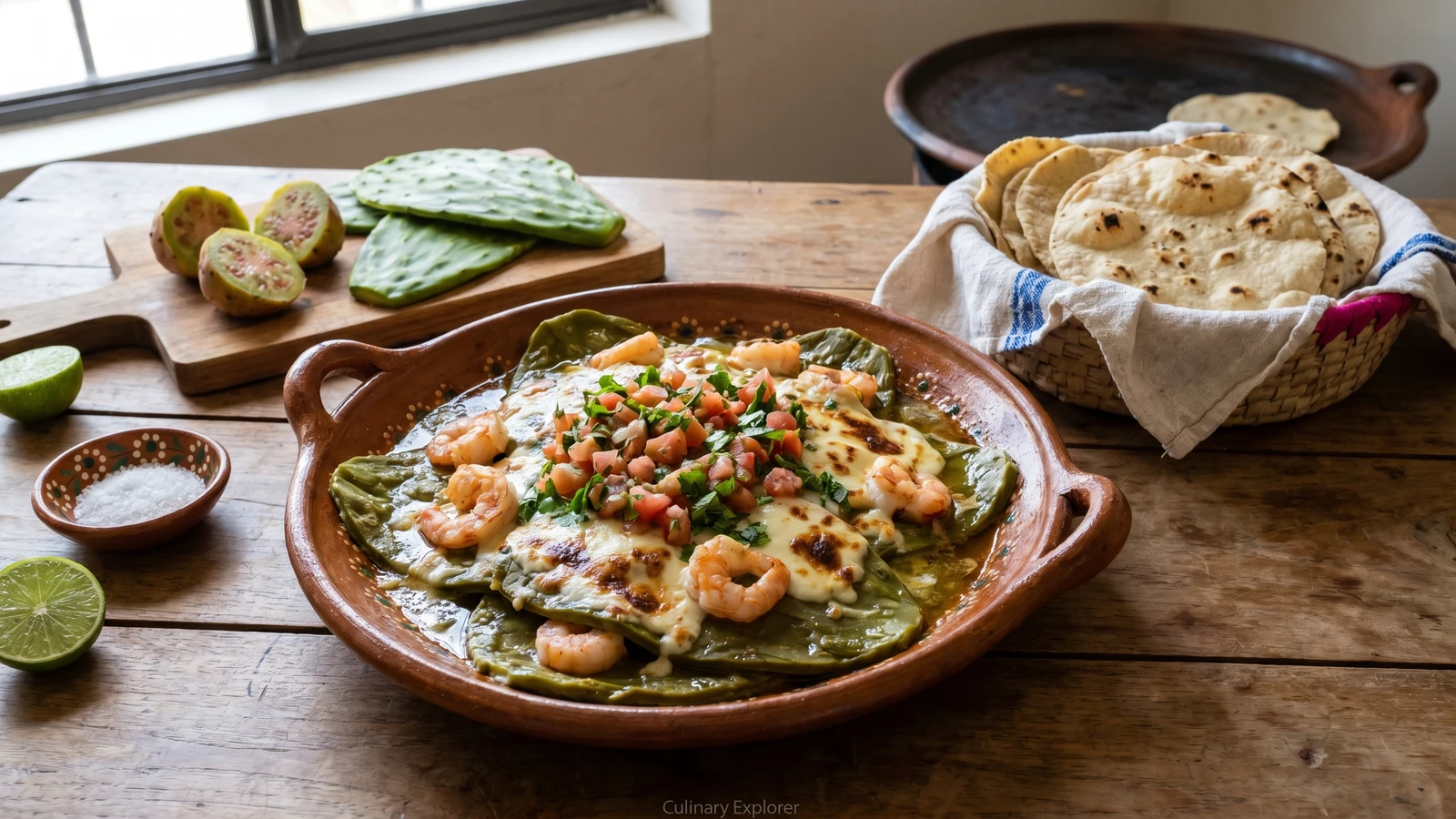
Querétaro's semidesert nopal dish, whole cactus paddles layered with xoconostle pico de gallo, barely cooked shrimp, and queso ranchero, then browned in the hard heat of a stone oven.
Querétaro's semidesierto, the dry country around Cadereyta de Montes, Tolimán, and Peñamiller, is where Nopales en su Madre belongs. Not the plaza version for visitors. The rancho version. Nopal, xoconostle, epazote, shrimp from the market, queso ranchero, and a horno de piedra that browns the top before the cactus loses its bite.
En su madre is literal. The tender nopalitos go back onto the larger penca, the mother pad, then into a barro cazuela with xoconostle pico de gallo, camarones, and cheese. The shrimp does not mean Querétaro has a coast. Please. It means the Bajío knows trade, feast days, and market discipline. A landlocked kitchen is not a poor kitchen.
The women who showed me this in Cadereyta worked the cactus like cloth: scrape the spines, score the paddles, cook off the baba, and never drown the nopal in tomato. The chile is fresh serrano. The herb for the cactus is epazote. The sour edge is xoconostle, and xoconostle is not regular tuna. Tuna is sweet. Xoconostle bites back.
Use a stone oven if you have one. If you don't, heat a baking stone hard and set a wide cazuela de barro over it. This dish needs fierce bottom heat, a little manteca de cerdo, and restraint. Cada estado, su propia cocina.
The semidesierto of Querétaro, especially Tolimán, Cadereyta de Montes, and Peñamiller, is part of the Otomí-Chichimeca sacred territory around Peña de Bernal, recognized by UNESCO in 2009 as a living tradition tied to pilgrimage routes, water, and desert plants. Nopal and xoconostle were used in central Mexico long before the conquest, while queso ranchero and shrimp entered the dish after colonial ranching and market trade connected the Bajío to coastal supplies. The name 'Nopales en su Madre' preserves the older technique of returning chopped tender nopales to the larger penca, using the plant itself as the first cooking vessel before a barro cazuela made the table version easier.
Quantity
6
thorns removed and edges trimmed
Quantity
4
thorns removed and diced into 1/2-inch pieces
Quantity
1/2 medium
quartered
Quantity
2 sprigs
Quantity
2 teaspoons, divided, plus more to taste
Quantity
3
diced
Quantity
2
peeled, seeded, and diced small
Quantity
1/2 cup
finely diced
Quantity
1 to 2
finely chopped
Quantity
1/2 cup, plus more for finishing
chopped
Quantity
1 tablespoon
Quantity
1 pound
peeled, deveined, tails removed, and patted dry
Quantity
2 tablespoons, plus more for the cazuela
Quantity
2
minced
Quantity
1/4 teaspoon
Quantity
10 ounces
crumbled in large pieces
Quantity
for serving
Quantity
for serving
warmed
| Ingredient | Quantity |
|---|---|
| large fresh nopal paddlesthorns removed and edges trimmed | 6 |
| young fresh nopal paddlesthorns removed and diced into 1/2-inch pieces | 4 |
| white onionquartered | 1/2 medium |
| fresh epazote | 2 sprigs |
| sal de grano or kosher salt | 2 teaspoons, divided, plus more to taste |
| ripe jitomate guaje or Roma tomatoesdiced | 3 |
| xoconostlespeeled, seeded, and diced small | 2 |
| white onionfinely diced | 1/2 cup |
| fresh chile serranofinely chopped | 1 to 2 |
| fresh cilantro leaves and tender stemschopped | 1/2 cup, plus more for finishing |
| fresh lime juice | 1 tablespoon |
| medium raw shrimppeeled, deveined, tails removed, and patted dry | 1 pound |
| pork lard (manteca de cerdo) | 2 tablespoons, plus more for the cazuela |
| garlic clovesminced | 2 |
| freshly ground black pepper | 1/4 teaspoon |
| queso rancherocrumbled in large pieces | 10 ounces |
| lime halves (optional) | for serving |
| hand-pressed corn tortillas (optional)warmed | for serving |
Heat a horno de piedra to strong baking heat, about 475F to 500F if you use a thermometer. For a home oven, set a baking stone or heavy sheet pan on the lowest rack and heat to 475F for at least 30 minutes. A cold oven gives you watery nopales. The stone heat tightens the cactus juices and browns the cheese.
Check every nopal paddle, even if the market vendor cleaned them. Hold each paddle with a towel and scrape away any remaining thorns with the back of a knife. Trim the dry rim. Score the 6 whole paddles in a shallow crosshatch, not all the way through. The scoring lets salt and comal heat reach the flesh while the paddle still holds its shape.
Bring a pot of water to a simmer with the quartered onion, epazote, and 1 teaspoon salt. Add the diced nopales and cook uncovered for 10 to 12 minutes, until they turn olive green and release their baba. Drain and rinse briefly with warm water. Do not soak them. Water steals flavor.
Heat a dry comal over medium-high. Lay the 6 whole nopales on the comal and cook 3 to 4 minutes per side, until they turn deep green, soften, and show dark freckles where the surface touched the clay or iron. Sprinkle with a pinch of salt. These paddles are the madre, the base that carries the rest of the dish.
In a bowl, combine the tomatoes, diced xoconostle, finely diced onion, chile serrano, cilantro, lime juice, and 1/2 teaspoon salt. Let it sit for 10 minutes, then drain off the excess liquid. The xoconostle should taste sharp enough to cut through the cheese. If all you have is sweet tuna, do not use it. That is another fruit.
Pat the shrimp dry again. Melt the manteca de cerdo in a skillet over medium-high heat. Add the garlic and stir for 15 seconds, just until fragrant. Add the shrimp, black pepper, and 1/2 teaspoon salt. Cook 60 to 90 seconds, until the edges turn pink but the centers still look slightly glossy. They finish in the oven. Overcooked shrimp bounce. We're cooking dinner, not rubber.
Rub a wide cazuela de barro with a thin coat of manteca. Lay the griddled whole nopales across the bottom, overlapping slightly. Spoon the cooked diced nopales over them. Add the drained xoconostle pico, then the shrimp with its garlicky lard. Scatter the queso ranchero over the top in rough pieces, leaving some cactus edges visible. La cocina no es decoración, es trabajo.
Set the cazuela on the hot stone and bake 10 to 14 minutes, until the queso ranchero softens, browns in spots, the juices bubble at the edges, and the shrimp are opaque and firm. If the top needs more color, use the broiler for the last 1 to 2 minutes. Watch it. Queso ranchero goes from browned to dry fast.
Let the cazuela rest for 5 minutes so the cactus juices settle. Scatter a little fresh cilantro over the top. Serve from the cazuela with lime halves and warm hand-pressed corn tortillas. Each tortilla gets a piece of the mother nopal, some shrimp, pico, and browned queso. The juices at the bottom are for dragging tortillas. Recetas probadas y garantizadas.
1 serving (about 380g)
Culinary guides, cultural storytelling, and the editorial depth that makes cooking meaningful.
Discover Culinary ExplorerChef Lupita
Michoacán's Lake Pátzcuaro acúmara, a whole kurucha from the lago tatemada on a comal de leña and served with chile perón atápakua, corn tortillas, and P'urhépecha discipline.

Chef Lupita
Puebla's weekday adobo of pork shoulder braised in a thick guajillo and ancho sauce sharpened with vinegar, cumin, and clove. The deep red of a market spice stall, the dish a poblana cooks without thinking.

Chef Lupita
Loreto's pit-roasted clams, planted hinge-up in beach sand and tatemadas under a fast fire of dried romerillo brush, the resinous Baja desert shrub that gives this dish its smoke.

Chef Lupita
Oaxaca's eighth mole, the silky, almond-and-cinnamon almendrado, served over poached chicken. Mild, sweet, restrained, and a quiet rebuttal to anyone who thinks Mexican food has to be hot to be Mexican.