
Chef Fai
Crispy Rice with Coconut Dip (Khao Tang Na Tang)
The kreung tam doesn't rest, not even for a snack. Pounded paste cracked into coconut cream, spooned over golden rice that shatters on contact. Four pillars in every bite.
A cooking platform built around craft, culture, and the stories behind what we eat.

Created by
Four pillars threaded onto a bamboo skewer, kissed by charcoal smoke. The Isan grill paste governs this marinade: garlic, cilantro root, white pepper, nam pla. Sticky rice. Jaew. That's breakfast.
Moo ping is the simplest proof that Thai food is a system. A stick of pork. A charcoal grill. A marinade built on the same governing formula that drives every grilled dish in Isan.
Ajarn always said you don't need a kreung tam for every dish, but you always need a governing formula. For the Isan grill, that formula is: garlic, cilantro root (rak phak chi), white peppercorns, and fish sauce. Four ingredients. That's the Isan grill paste, and it appears in gai yang, kor moo yang, and moo ping without exception. It's simpler than a full kreung tam, but it's just as principled. You pound it in the krok, you don't mince it on a cutting board. The mortar breaks cell walls. The garlic and cilantro root release oils that penetrate the pork. Mincing gives you a coating. Pounding gives you a marinade that works from the inside out.
Then the four pillars show up in the liquid portion: nam pla for salt, nam tan pip (palm sugar) for sweetness, and coconut milk for body and caramelization. The sweetness matters here more than in most Thai dishes. When palm sugar hits charcoal heat, it caramelizes on the surface of the pork, creating that sticky, lacquered glaze you can smell from three stalls away. That's not an accident. That's the system at work.
I grew up eating moo ping from the vendor outside Khlong Toei market at six in the morning. She'd been grilling since four. The smoke would hang over the street, mixing with exhaust fumes and jasmine garlands. Two sticks, a bag of sticky rice, five baht change. That was breakfast on the way to school. Her marinade was always the same. She never wrote it down. She didn't need to. Garlic, cilantro root, pepper, nam pla, palm sugar, coconut milk. Principles, not recipes.
Moo ping is one of the oldest street foods in Thailand, rooted in the Isan and Lao tradition of grilling marinated proteins over low charcoal. The word "ping" (ปิ้ง) simply means "to grill," and the technique predates the modern street food economy by centuries. Moo ping became a staple of Bangkok's morning markets in the late 20th century as Isan migrants brought their food traditions to the capital, transforming it from a regional preparation into arguably Thailand's most ubiquitous grab-and-go protein.
Quantity
500g
sliced into strips about 3 inches long and 1/4 inch thick
Quantity
4 cloves
Quantity
2
scraped clean
Quantity
1 teaspoon
Quantity
2 tablespoons
Quantity
2 tablespoons
shaved or chopped
Quantity
1 tablespoon
Quantity
80ml
Quantity
1 tablespoon
Quantity
20
soaked in water for 1 hour
Quantity
for serving
Quantity
for serving
| Ingredient | Quantity |
|---|---|
| pork shoulder or pork collar (kor moo)sliced into strips about 3 inches long and 1/4 inch thick | 500g |
| garlic | 4 cloves |
| cilantro roots (rak phak chi)scraped clean | 2 |
| white peppercorns (prik thai khao) | 1 teaspoon |
| fish sauce (nam pla) | 2 tablespoons |
| palm sugar (nam tan pip)shaved or chopped | 2 tablespoons |
| oyster sauce | 1 tablespoon |
| coconut milk (hua kathi) | 80ml |
| vegetable oil | 1 tablespoon |
| bamboo skewerssoaked in water for 1 hour | 20 |
| sticky rice (khao niew) | for serving |
| jaew dipping sauce | for serving |
In your granite mortar (krok hin), pound the garlic, cilantro roots, and white peppercorns into a rough paste. Not powder. You want a coarse, fragrant mash where you can still see texture. The aroma should hit you the moment the cilantro root cracks open: earthy, peppery, sharp. That's the Isan grill paste. Three ingredients doing the structural work of the entire marinade.
Scrape the paste into a mixing bowl. Add the fish sauce, palm sugar, oyster sauce, coconut milk, and vegetable oil. Stir until the palm sugar dissolves completely. Taste. It should be sweet, salty, and aromatic. Heavier on sweet than you'd expect. That sweetness is going to caramelize on the grill. It's designed to transform under heat.
Add the pork strips to the marinade. Use your hands. Work the paste and liquid into every piece, making sure each strip is coated. Cover and refrigerate for a minimum of four hours. Overnight is better. The fish sauce and the pounded paste need time to penetrate the pork. Thirty minutes won't cut it. The coconut milk tenderizes the meat while carrying the garlic and pepper deep into the protein. This is not a quick soak. This is a slow transformation.
Thread one or two pork strips onto each soaked bamboo skewer, weaving the skewer through the meat in an S-pattern so it holds flat. Don't bunch it into a ball. You want the pork to lay flat with maximum surface area exposed to the heat. Flat means more char. More char means more flavor. Leave the bottom third of the skewer bare for handling.
Light your charcoal and wait until the coals are white-hot and glowing with no active flame. This is critical. Flame burns the sugar and gives you bitter, blackened pork. White coals give you controlled, radiant heat that caramelizes the palm sugar into a dark, sticky glaze. Lay the skewers across the grill, keeping the exposed bamboo handles off the coals. Grill for about 3 to 4 minutes per side, brushing with the leftover marinade or a mix of coconut milk and palm sugar every time you flip. You want color. Deep amber, lacquered, with spots of char where the sugar caught. The fat should be rendered and the edges slightly crispy.
Pull the skewers off the grill when the glaze is dark and sticky, the pork is cooked through but still juicy, and the edges have that charcoal kiss. Serve immediately with sticky rice (khao niew) and jaew (roasted chili dipping sauce). Tear off a pinch of sticky rice, wrap it around a piece of pork pulled from the skewer, dip in jaew. That's a bite. The sticky rice is structural: it's the vehicle for the pork and the sauce. Without it, you're eating half a dish. Jaew adds the sour and spicy dimension that the sweet-salty pork needs for balance. It's not a condiment. It's the other half of the equation.
1 serving (about 130g)
Culinary guides, cultural storytelling, and the editorial depth that makes cooking meaningful.
Discover Culinary ExplorerChef Fai
The kreung tam doesn't rest, not even for a snack. Pounded paste cracked into coconut cream, spooned over golden rice that shatters on contact. Four pillars in every bite.
Chef Fai
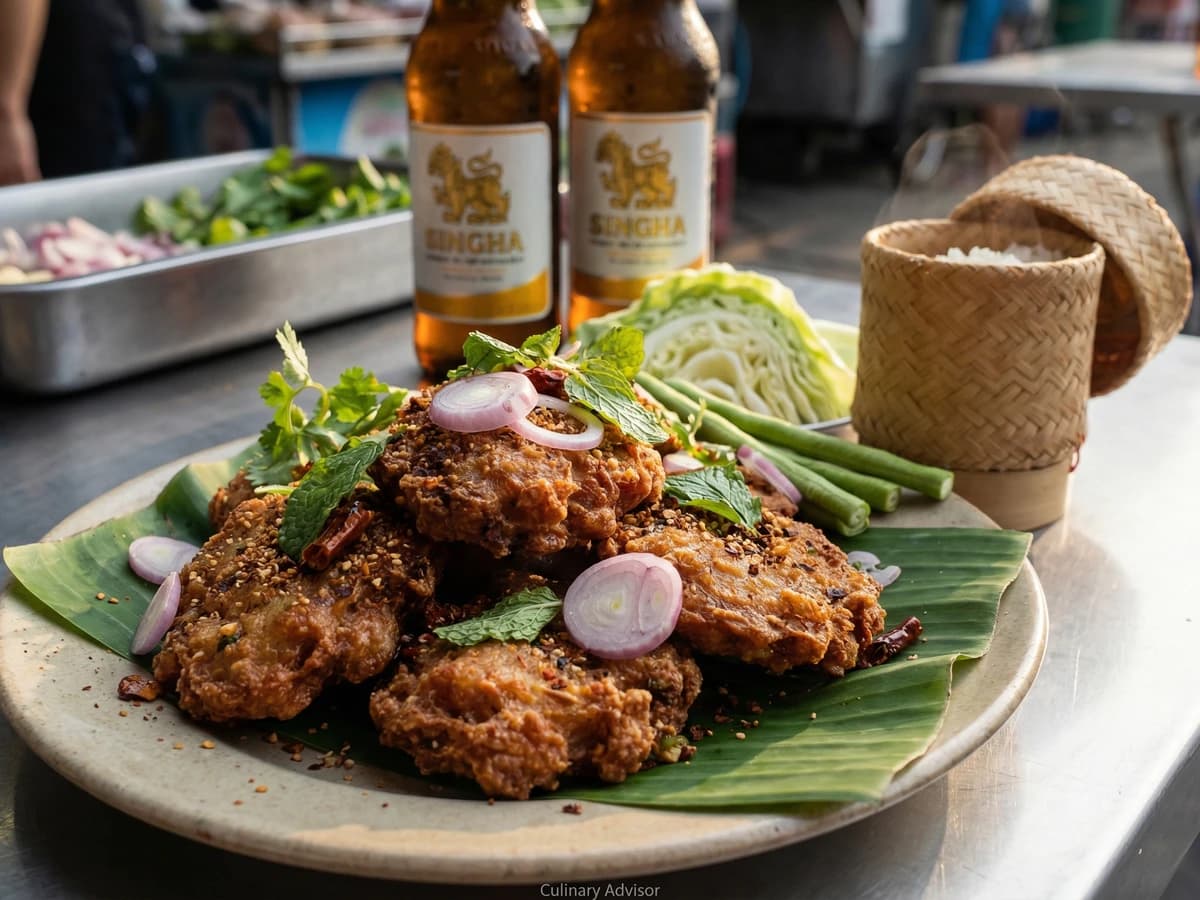
Isan's larb principles pressed into patties and fried golden: fish sauce for salt, lime for sour, khao khua for structure and crunch, prik pon for heat. No sugar. That's the rule that separates Isan from everything else.

Chef Fai
A kreung tam pounded in the krok, dissolved into cracked coconut cream, sweet crab folded through at the end. All four pillars balanced in a dip so silky you'll forget it started in a granite mortar. Central Thai home cooking at its most principled.

Chef Fai
Twenty-four meatballs, eight bamboo skewers, a charcoal grill the size of a shoebox, and one pot of nam jim built on the four pillars. The simplest vendor setup in Thailand proves the system works everywhere.