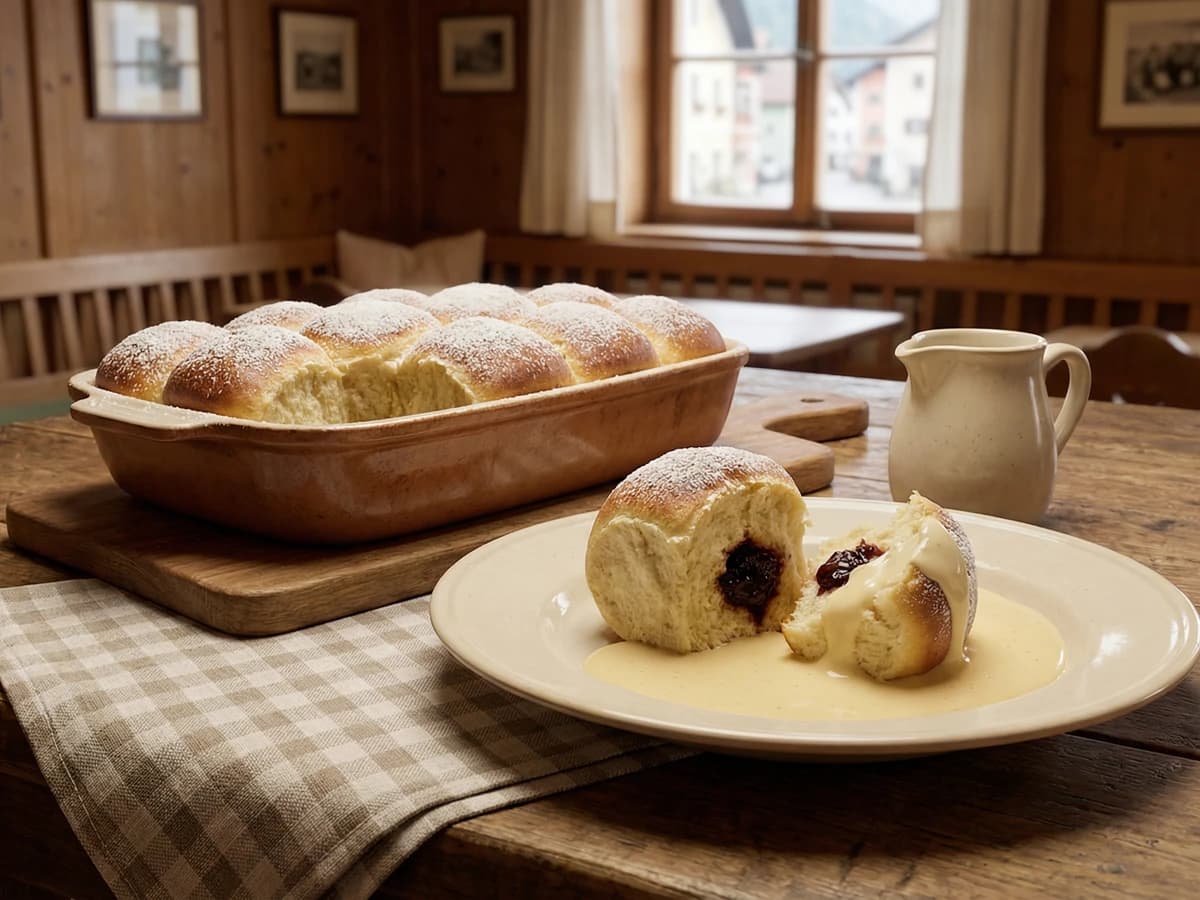
Real sweet violets painted with egg white and dusted in sugar, one petal at a time, until they become the fragile, sparkling confections that Demel has been selling from glass cases in Vienna for two hundred years.
Desserts
Austrian
Special Occasion
Make Ahead
1 hr
Active Time
0 min cook•25 hr total
Yieldapproximately 40 candied violets
The first time I saw kandierte Veilchen at Demel, I was eight years old. Gretel had taken me and my grandmother Eva on our usual spring trip to Vienna, and there they were behind the glass: tiny purple violets coated in crystallized sugar, arranged in neat rows inside a small white box lined with tissue paper. They looked like jewels somebody had forgotten were once flowers. Gretel bought a box without hesitating and told me these were the flowers Empress Sisi loved. I ate one standing on the pavement outside. It shattered against my tongue into sugar and perfume, something so distinctly floral that I can still taste it thirty years later.
Kandierte Veilchen are one of the secrets of Viennese confectionery that most people outside Austria never encounter. They're real flowers. Fresh sweet violets, picked in spring when they're at their most fragrant, painted petal by petal with a thin brush dipped in egg white, then dusted in fine sugar and left to dry for a full day until they turn translucent and brittle. The work is slow and quiet. One violet takes two or three minutes if you're careful, and you should be careful. This is not a recipe you squeeze in between other tasks. It's a Saturday afternoon in your kitchen with music playing, the kind of repetitive, gentle work that stills your mind and gives your hands something beautiful to do.
You use them to crown a Torte, to scatter across a bowl of Schlagobers, to tuck into a gift box for someone you care about. In my restaurant in Salzburg, I make a batch every April when the violets bloom along the south-facing wall of the garden. They keep for months in an airtight tin, so a single spring afternoon's work gives you something to reach for all year. Gretel always said the Viennese understood that the smallest things could carry the most meaning. A single crystallized violet on top of a slice of cake tells you that someone took real time over what they made for you.
Demel, Vienna's most celebrated Konditorei, has been producing kandierte Veilchen by hand since the mid-19th century, crystallizing each blossom individually in a process that hasn't changed in over 150 years. Empress Elisabeth of Austria was famously devoted to violets, consuming violet ice cream, wearing violet perfume, and carrying crystallized violets as a travelling sweet. The association became so strong that after her assassination in 1898, violets became a symbol of mourning throughout the empire, and Demel's candied violets took on a sentimental weight that they carry in Viennese memory to this day.
The technique, the tradition, and the story behind every dish.
Pick your violets on a dry morning after the dew has lifted. You want fully open blossoms with strong color and no browning at the edges. Leave about two centimeters of stem attached to each one. The stem is your handle while you work, and you'll trim it off at the end. Inspect every flower for tiny insects. Lay the violets on a clean tea towel in a single layer. If they're damp from washing, let them dry completely before you start. Any moisture trapped under the sugar coating will cause the finished violets to turn dark and collapse in storage.
Only use Viola odorata, the sweet violet. These are the small, intensely fragrant wild violets, not the large pansies or African violets from the garden center. If you can't smell them from a few centimeters away, they're the wrong flower. They must be unsprayed. If you don't grow your own, ask at a farmers' market or forage from land you know hasn't been treated.
2
Prepare the egg white
Crack the egg white into a small bowl. Beat it with a fork until it's just loosened and flows easily off the tines, about fifteen seconds of gentle stirring. You don't want froth. If you whip it into anything resembling foam, the air bubbles will leave tiny pockmarks in the sugar coating and your violets will look rough instead of smooth and glassy. Think of the egg white as a thin glue, not a meringue base.
If raw egg white concerns you, use pasteurized egg whites or dissolve half a teaspoon of gum arabic powder in two tablespoons of warm water as a substitute. Gum arabic gives a slightly harder finish and the violets will keep even longer, which is why Demel uses it. For a home batch you'll eat within a few months, egg white works beautifully.
3
Paint the first coat
Hold a violet by its stem with tweezers or your fingertips. Using a small, soft-bristled paintbrush, coat every surface of every petal with a thin, even layer of egg white. Turn the flower gently as you work. Get into the folds where petals overlap. Get the back. The egg white is what the sugar grips onto, so any bare spot will show up later as a dull patch where the sugar didn't stick. Work under good light. You'll be surprised how many tiny surfaces a single violet has.
Use a brush no wider than a centimeter. Watercolor brushes from an art supply shop work perfectly. Buy a new one and dedicate it to kitchen use. The stiff brushes sold as pastry brushes are too coarse for this and will bruise the petals.
4
Dust with sugar
Hold the painted violet over a shallow bowl and spoon superfine sugar over it, turning the flower slowly so every surface catches an even coating. The sugar should cling to the egg white immediately. Tap the stem gently to shake off any excess. You want a fine, even crystalline coat, not clumps. Set the sugared violet face up on a wire rack lined with parchment paper. Repeat with each flower. This is the meditative part. Forty violets will take you the better part of an hour, and that's fine. There is no way to rush this step without ruining the result.
Pour the sugar into a wide, shallow bowl rather than trying to pinch it from a bag. Use a teaspoon to shower sugar over the violet from a few centimeters above. The fine shower coats more evenly than pressing the flower into a dish of sugar, which flattens the petals.
5
Dry until crystallized
Leave the sugared violets on the wire rack in a warm, dry room for at least 24 hours. Don't put them in the oven. Don't try to speed this up with a fan. The sugar needs to set slowly through natural evaporation. After 24 hours, touch one gently. It should feel dry, rigid, and very slightly translucent, like stained glass. If it still bends, give it another 12 hours. Once fully dry, trim off the stems with small scissors.
Humidity is the enemy. If your kitchen is damp, move the rack to the driest room in your house. A room with good air circulation and low humidity will give you the best results. Don't try this on a rainy day if your house doesn't have climate control.
6
Store carefully
Layer the finished violets between sheets of parchment paper in an airtight tin or rigid container. Don't use a plastic bag. They'll crush. Store in a cool, dry place, not in the fridge. The moisture in a refrigerator will dissolve the sugar coating within days. Properly dried and stored, your kandierte Veilchen will keep for six months or more. Use them to decorate Torten, to set on top of a spoonful of Schlagobers, to scatter across a Sachertorte, or to place in a small box as a gift that tells someone you spent a quiet afternoon thinking about them.
Chef Tips
•Violets bloom in March and April in Austria and across most of Europe. This is a spring recipe. If you try to make it in August, you won't find the right flowers, and anything forced in a greenhouse won't have the fragrance you need. Wait for spring. Austrian cooking is seasonal, and that's part of what makes it honest.
•The sugar must be superfine, what the Austrians call Feinkristallzucker and the British call caster sugar. Regular granulated sugar is too coarse and won't coat the petals smoothly. If you can't find superfine sugar, pulse granulated sugar in a food processor for thirty seconds.
•If you want to use these on a Torte, place them at the very last moment before serving. The moisture from cream or glaze will soften the sugar coating within an hour. They look most beautiful in the first few minutes after you set them down.
•Make more than you think you need. Some won't survive the drying process, and once you start decorating with them, you'll use them faster than you expect. A batch of forty gives you about thirty-five perfect ones.
Advance Preparation
•Violets should be picked the same day you plan to crystallize them. They wilt quickly once cut and lose fragrance by the hour.
•Finished kandierte Veilchen keep for up to six months in an airtight tin stored in a cool, dry place. Make them in April and you'll have them through autumn.
•The egg white wash cannot be prepared ahead. It takes fifteen seconds to make. Do it fresh.
Frequently Asked Questions
Nutrition Information
1 serving (about 4g)
Calories
10 calories
Total Fat
0 g
Saturated Fat
0 g
Trans Fat
0 g
Unsaturated Fat
0 g
Cholesterol
0 mg
Sodium
1 mg
Total Carbohydrates
3 g
Dietary Fiber
0 g
Sugars
3 g
Protein
0 g
Where cooking meets culture.
Culinary guides, cultural storytelling, and the editorial depth that makes cooking meaningful.