Chef Elsa
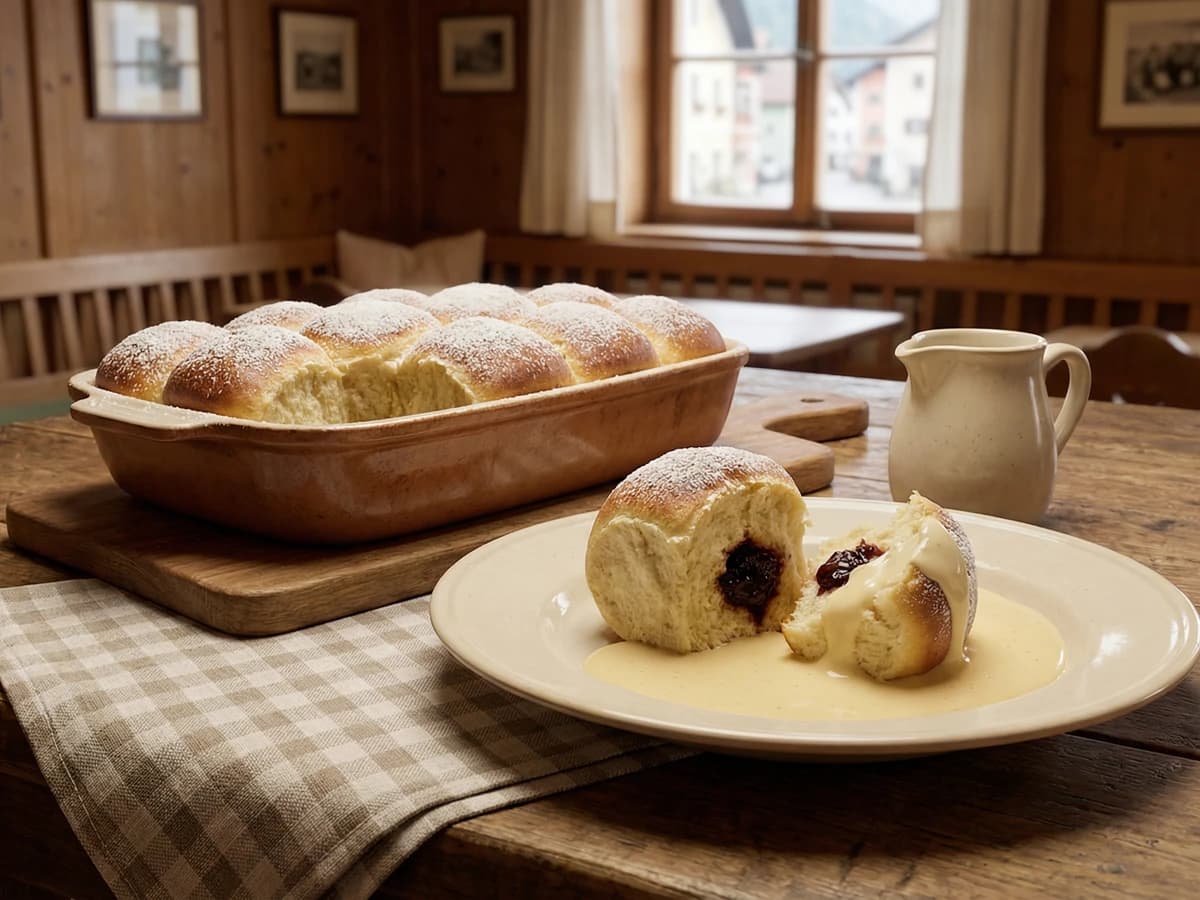
Buchteln mit Vanillesauce
Pillowy yeast buns with a hidden pocket of dark Powidl plum jam, baked together so the sides stay impossibly soft, then set swimming in a warm vanilla custard that pools into every crack when you pull them apart.
A cooking platform built around craft, culture, and the stories behind what we eat.

Created by
A light Viennese sponge loaf hiding a mosaic of dark chocolate, candied orange, cherries, raisins, and toasted almonds in every thin slice, dusted with powdered sugar and meant for a quiet afternoon with good coffee.
In my grandmother Eva's kitchen in Kent, Bischofsbrot appeared every December without fail. It sat on a board near the window, wrapped in a clean tea towel, waiting to be sliced for anyone who stopped by. Gretel always said it was the cake you made when you wanted to give someone something beautiful without making a fuss. No layers to assemble, no glaze to temper, no Konditorei precision required. Just a light sponge batter folded around the best things in your pantry: dark chocolate, candied orange peel, toasted almonds, raisins, a handful of glacé cherries for color.
The magic is in the cross-section. When you slice Bischofsbrot thin, and you must slice it thin, the cut face looks like a stained glass window. Every piece of fruit, every chunk of chocolate, every nut is suspended in the pale golden crumb like a small jewel. No two slices are the same. That's the whole pleasure of it.
The batter itself is a separated-egg sponge, the kind Austrian bakers learn before they learn almost anything else. You beat the yolks with sugar until they're thick and pale, whip the whites until they hold firm peaks, fold everything together with a light hand. The flour is minimal, just enough to hold the structure. The fruits and nuts do the rest. They're heavy, so you toss them in a little flour first to keep them from sinking to the bottom. That's not a trick, that's physics. The flour gives the batter something to grip.
Bischofsbrot keeps beautifully. Wrapped well, it improves over two or three days as the flavors settle and the crumb softens around the fruit. It's the kind of cake that rewards you for patience, which is something I've learned Austrian baking says to you over and over again.
Bischofsbrot, literally 'bishop's bread,' takes its name from the richness of its contents, a cake so full of good things it was considered worthy of a bishop's table. The recipe appears in Viennese cookbooks from the mid-19th century, when the Bürgertum, the prosperous middle class, adopted the elaborate baking traditions of the aristocracy and the Church for their own households. The cake's resemblance to a jeweled mosaic when sliced may also connect it to the ornate vestments and stained glass windows of Catholic cathedrals, though Austrians being Austrians, the more likely explanation is simply that anything this rich had to be named after someone important.
Quantity
4 large
separated
Quantity
100g
Quantity
1 packet (8g)
Quantity
pinch
Quantity
100g, plus 1 tablespoon for tossing
Quantity
80g
roughly chopped into small pieces
Quantity
50g
roughly chopped and lightly toasted
Quantity
50g
Quantity
40g
finely diced
Quantity
40g
halved
Quantity
for greasing the tin
Quantity
for dusting the tin
Quantity
for dusting
| Ingredient | Quantity |
|---|---|
| eggsseparated | 4 large |
| caster sugar | 100g |
| Vanillezucker (vanilla sugar) | 1 packet (8g) |
| salt | pinch |
| plain flour | 100g, plus 1 tablespoon for tossing |
| dark chocolate (minimum 70% cocoa)roughly chopped into small pieces | 80g |
| whole blanched almondsroughly chopped and lightly toasted | 50g |
| raisins | 50g |
| candied orange peel (Orangeat)finely diced | 40g |
| glacé cherrieshalved | 40g |
| butter | for greasing the tin |
| flour | for dusting the tin |
| powdered sugar | for dusting |
Heat your oven to 170°C (340°F). Butter a standard loaf tin, about 25cm long, and dust it with flour, tapping out the excess. Bischofsbrot batter is delicate and will cling to an ungreased tin like it's holding on for dear life. Line the bottom with a strip of baking parchment if you want extra insurance. Set the prepared tin aside.
Combine the chopped chocolate, toasted almonds, raisins, candied orange peel, and halved glacé cherries in a bowl. Sprinkle the tablespoon of flour over them and toss with your hands until every piece is lightly coated. This flour coating stops the heavy ingredients from sinking to the bottom of the batter during baking. Without it, you'll slice into your finished loaf and find all the good bits sitting in a sad pile at the base.
In a large bowl, whisk the egg yolks with the caster sugar and Vanillezucker until the mixture turns pale, thick, and falls from the whisk in a slow ribbon. This takes about four minutes with a hand mixer, longer by hand. You're dissolving the sugar and building air into the yolks. That air is your only rising agent. There's no baking powder in Bischofsbrot, so everything depends on the eggs.
In a clean, dry bowl, beat the egg whites with the pinch of salt until they hold firm, glossy peaks. Firm means when you lift the whisk, the peak stands upright and barely nods at you. If the peaks flop over, keep going. If they look grainy and dry, you've gone too far and the whites have broken. Start with fresh eggs if that happens. The whipped whites are doing all the structural work in this cake, so this step is not a place to cut corners.
Spoon about a third of the whipped whites into the yolk mixture and stir it in. This loosens the base so the rest folds in more easily. Now sift the 100g flour over the top and fold it through with a large spatula or metal spoon, using gentle movements from the bottom up. Add the remaining whites in two additions, folding each time until just combined. You'll still see a few streaks of white. That's fine. Overmixing is how you lose the air you just spent five minutes building.
Scatter the flour-coated fruits, nuts, and chocolate over the batter. Fold them through with three or four broad strokes of your spatula. You want them distributed but you don't want to deflate the batter by overworking it. Stop the moment you don't see any filling sitting on top. The distribution doesn't need to be perfect. Every slice will be different and that's the beauty of Bischofsbrot.
Pour the batter gently into the prepared tin. Smooth the top with a spatula, making a very slight valley down the center so the cake rises evenly. Bake at 170°C for 45 to 50 minutes. The loaf is done when the top is golden brown and firm to a gentle touch, and a skewer pushed into the center comes out clean, or with just a smear of melted chocolate on it. Don't mistake a chocolate streak for raw batter. They look different. Raw batter clings wet and pale. Melted chocolate smears dark and glossy.
Let the Bischofsbrot cool in the tin for ten minutes, then turn it out onto a wire rack and let it cool completely. I know. Patience. But slicing it warm will crumble the sponge and drag the chocolate into ugly smears. Once cool, dust the top generously with powdered sugar and slice it thin, no thicker than a centimeter. The thin slice is the whole point. It's how you see the mosaic. Serve with strong coffee and, if you're doing this properly, a glass of water on the side. Mahlzeit!
1 serving (about 55g)
Culinary guides, cultural storytelling, and the editorial depth that makes cooking meaningful.
Discover Culinary ExplorerChef Elsa
Pillowy yeast buns with a hidden pocket of dark Powidl plum jam, baked together so the sides stay impossibly soft, then set swimming in a warm vanilla custard that pools into every crack when you pull them apart.

Chef Elsa
Soft yeast dumplings steamed under a sealed lid until the bottoms turn into a golden caramelized crust the Austrians call Krustl, served with homemade vanilla sauce and the kind of silence that means everyone at the table is happy.

Chef Elsa
Six thin sponge layers stacked with dark chocolate buttercream and crowned by a sheet of crackable amber caramel. The cake that traveled from Budapest to Vienna and became a Konditorei legend across the Habsburg world.

Chef Elsa
Whole ripe strawberries wrapped in tender Topfen dough, simmered until soft, and rolled through golden buttered breadcrumbs. The Mehlspeise that means summer has finally arrived in Austria.