
Chef Lupita
Acúmara Tatemada al Comal
Michoacán's Lake Pátzcuaro acúmara, a whole kurucha from the lago tatemada on a comal de leña and served with chile perón atápakua, corn tortillas, and P'urhépecha discipline.
A cooking platform built around craft, culture, and the stories behind what we eat.
Created by
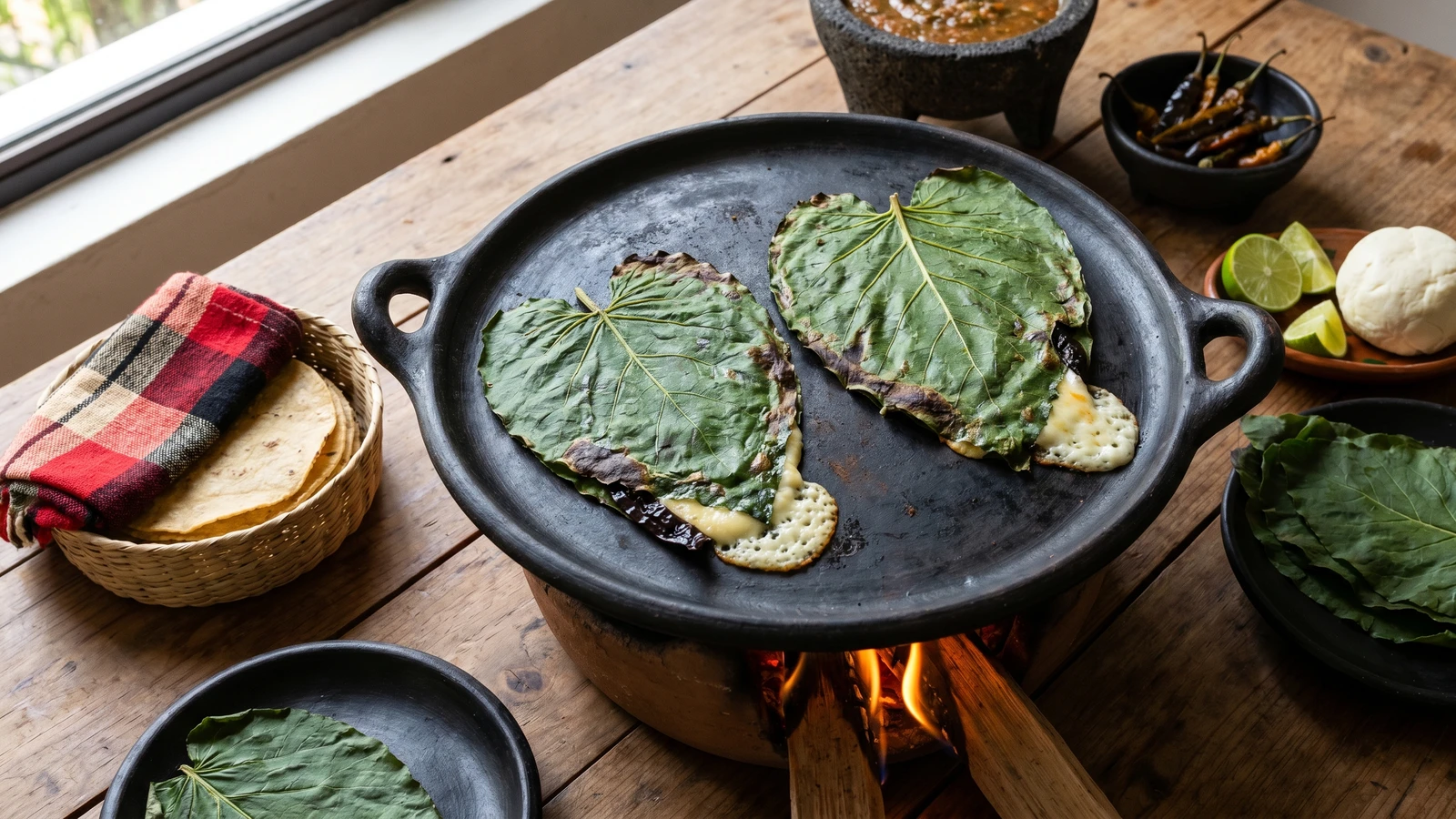
Oaxaca's heart-shaped hoja santa folded around stretched quesillo and a smoky strip of chile pasilla oaxaqueno, then warmed on the comal until the cheese melts and the leaf perfumes the whole kitchen.
Hoja santa is Oaxaca's herb. It grows in backyards across the Valles Centrales and the Sierra Norte, large heart-shaped leaves the size of your hand, with a perfume that is part anise, part root beer, part tarragon, part something nobody has named yet. Take a leaf from the plant and crush it between your fingers and you will know in three seconds why this herb anchors so much of Oaxaca's cooking.
This is a weeknight dish. A peasant dish in the best sense of the word: three ingredients that respect each other and a comal. The leaf is the wrapper, the quesillo is the filling, the chile pasilla oaxaqueno is the spine that keeps the whole thing from tasting flat. Every element is from Oaxaca. The herb from the patios of the central valleys. The cheese from Reyes Etla, where it has been pulled and wound into balls since the late nineteenth century. The chile from the Sierra Norte, where they smoke it over pine and oak fires until it tastes like a bonfire.
The technique is the comal. Not the oven, not a pan, the comal. A flat clay or cast iron disc set over a flame, the surface that has done the work of Mexican kitchens for thousands of years. The leaf chars at the edges, the cheese melts, the chile warms and releases its smoke into the cheese, and what comes off the comal is something that tastes like the sum of three places at once.
My mother did not cook with hoja santa. It was not a Jalisco herb. The first time I tasted this was at a comedor inside the Mercado 20 de Noviembre in Oaxaca de Juarez, a senora named Dona Soledad making them on a clay comal blackened by twenty years of fires. She let me watch. She did not give me the recipe because there is barely a recipe to give. Cada estado, su propia cocina, and this one belongs to Oaxaca. Saber cocinar es saber vivir.
Hoja santa, known scientifically as Piper auritum and locally also as yerba santa, hierba santa, or acuyo, was used in Mesoamerican cooking long before the conquest, with archaeological and codex evidence pointing to ritual and culinary use among the Zapotec and Mixtec peoples of what is now Oaxaca. Quesillo de Oaxaca, the stretched-curd cheese also called queso Oaxaca, originated in the town of Reyes Etla in the late 1800s when local cheesemakers, drawing on techniques brought by Italian immigrants who introduced pasta filata methods, adapted the process to local milk and climate. The chile pasilla oaxaqueno, smoked over wood fires in the Sierra Norte villages around San Juan Bautista Cuicatlan, is genetically and culturally distinct from the chile pasilla of central Mexico and has been recognized in recent years as a candidate for denomination of origin protection.
Quantity
8 large
the biggest you can find, washed and patted dry
Quantity
10 ounces
pulled into thin strands
Quantity
4
stemmed and seeded
Quantity
1
thinly sliced
Quantity
1 tablespoon, plus more for the comal
Quantity
to taste
Quantity
8
warmed
Quantity
for serving
Quantity
for serving
| Ingredient | Quantity |
|---|---|
| fresh hoja santa leavesthe biggest you can find, washed and patted dry | 8 large |
| quesillo de Oaxacapulled into thin strands | 10 ounces |
| dried chile pasilla oaxaquenostemmed and seeded | 4 |
| ripe Roma tomato (optional)thinly sliced | 1 |
| manteca de cerdo | 1 tablespoon, plus more for the comal |
| flaky sea salt | to taste |
| hand-pressed corn tortillas (optional)warmed | 8 |
| salsa de chile pasilla or salsa verde cruda (optional) | for serving |
| lime wedges (optional) | for serving |
Rinse each leaf under cold water and pat dry between two clean towels. The leaves bruise easily, so handle them like you handle good lettuce, not like you handle lechuga that has seen better days. Lay them flat on the counter, glossy side down. The matte underside is where the quesillo goes. The veins on the back are thick and woody. If a leaf has a particularly fat central vein, run a sharp paring knife along its length to shave it down. A thinner vein folds cleaner.
Heat a dry comal or heavy cast iron skillet over medium. Open each chile flat with your hands. Press them onto the hot comal for about ten seconds per side. The pasilla oaxaqueno is smoked over wood and it is already dark, so do not wait for color. Wait for the smell. The kitchen will fill with a deep, smoky perfume that is unlike any other chile in Mexico. That is the moment. Pull them off and slice each one lengthwise into thin strips. You want eight strips total, one per leaf.
Quesillo de Oaxaca comes wound in a ball. Find the loose end and pull off thin strands the way the senoras at the Mercado 20 de Noviembre pull it for their tlayudas. Do not chop it with a knife. Quesillo is a stretched-curd cheese and it melts cleaner when the strands lie flat. Divide the pulled cheese into eight portions, about an ounce and a quarter each.
Lay one hoja santa leaf flat, matte side up, with the heart-shaped point facing away from you. Place a portion of quesillo in the center, slightly toward the wide rounded end. Lay one strip of toasted chile across the cheese. Add a slice or two of tomato if you are using it. Sprinkle with a pinch of flaky salt. Fold the wide rounded sides of the leaf over the cheese first, then fold the pointed end down to make a small packet. The leaf is pliable and will hold itself closed once warmed. Repeat with the remaining seven leaves.
Wipe the comal clean of any chile dust from the toasting and set it back over medium heat. Smear about a teaspoon of manteca across the surface with a folded paper towel. Not enough to fry. Enough to keep the leaf from sticking and to help the underside crisp. La manteca es el sabor, even here, in something this simple.
Place the packets seam-side down on the warm comal. Cook for about two minutes, until the underside of the leaf darkens to a deep olive green and the edges lightly char. Flip carefully with a spatula. Cook the second side for another two minutes. You will hear a faint sizzle as the cheese starts to melt and you may see a thin trail of quesillo escape from a corner. That is the dish telling you it is ready. Press the top gently with the back of the spatula. If the wrap feels soft and yielding throughout, the cheese is melted. Pull them off the comal.
Transfer the wraps to a warm plate. Serve them whole, two per person, with a stack of warm corn tortillas, a bowl of salsa de chile pasilla, and lime wedges. The leaf is edible and you eat the whole packet. Tear a piece, lay it on a tortilla, add a spoon of salsa, fold, and eat. The hoja santa tastes of root beer and anise and tarragon all at once, the smoke of the chile cuts through the milky stretch of the cheese, and there is nothing else like it. Recetas probadas y garantizadas.
1 serving (about 200g)
Culinary guides, cultural storytelling, and the editorial depth that makes cooking meaningful.
Discover Culinary ExplorerChef Lupita
Michoacán's Lake Pátzcuaro acúmara, a whole kurucha from the lago tatemada on a comal de leña and served with chile perón atápakua, corn tortillas, and P'urhépecha discipline.

Chef Lupita
Puebla's weekday adobo of pork shoulder braised in a thick guajillo and ancho sauce sharpened with vinegar, cumin, and clove. The deep red of a market spice stall, the dish a poblana cooks without thinking.

Chef Lupita
Loreto's pit-roasted clams, planted hinge-up in beach sand and tatemadas under a fast fire of dried romerillo brush, the resinous Baja desert shrub that gives this dish its smoke.

Chef Lupita
Oaxaca's eighth mole, the silky, almond-and-cinnamon almendrado, served over poached chicken. Mild, sweet, restrained, and a quiet rebuttal to anyone who thinks Mexican food has to be hot to be Mexican.