
Chef Jeong-sun
Bokbunja-ju (Black Raspberry Wine)
Summer bokbunja steeped with sugar and strong damgeum soju until the berries give up their deep tart color, a make-ahead Korean fruit wine for small cold cups and a slow table.
A cooking platform built around craft, culture, and the stories behind what we eat.
Created by
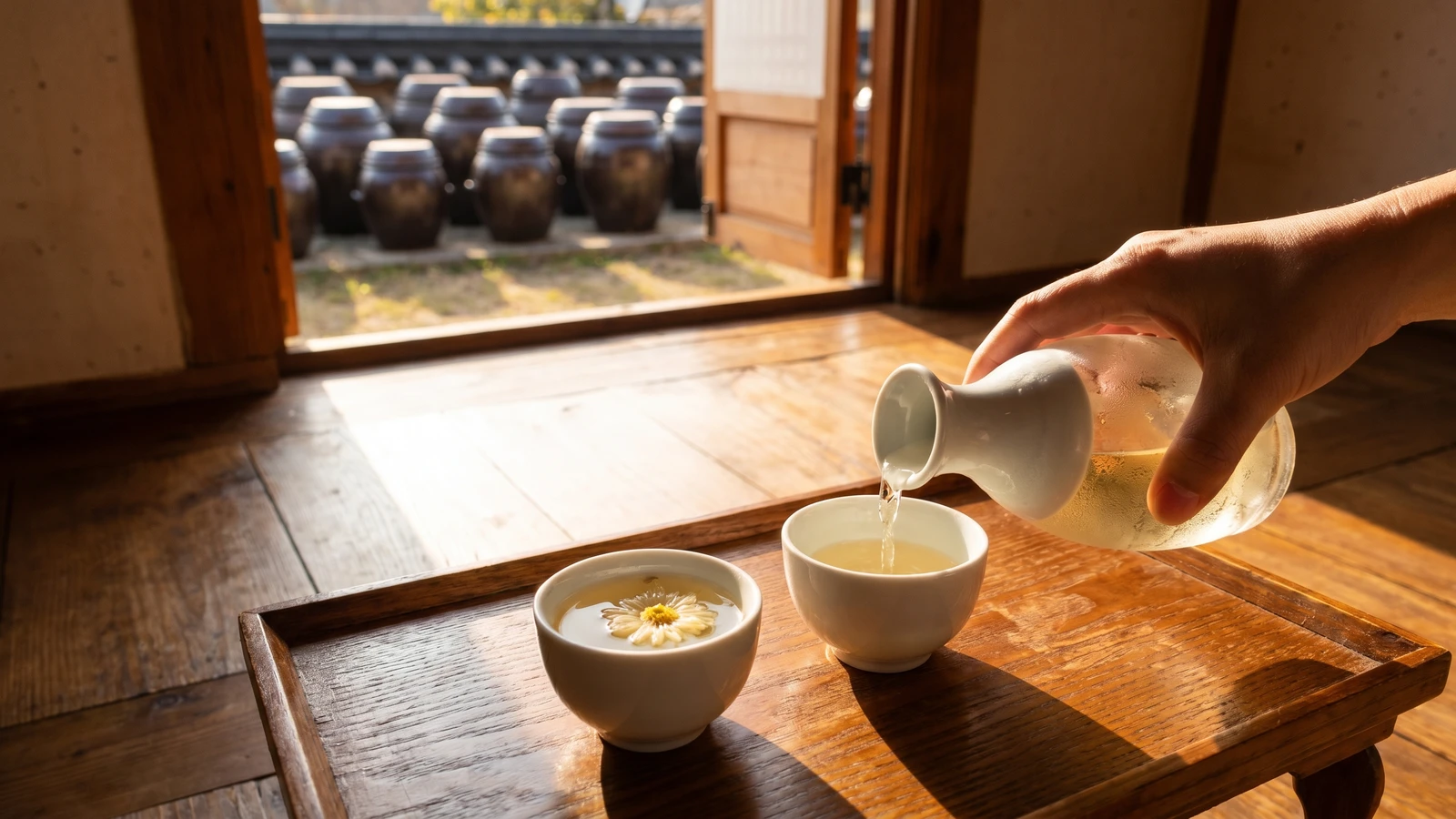
A late-autumn Korean rice wine made from hard-steamed glutinous rice, nuruk, chrysanthemum, goji, and rehmannia, fermented slowly until the cup turns pale gold and gently medicinal.
Autumn chooses this drink. When the small yellow chrysanthemums open and new glutinous rice comes into the market, gukhwaju makes sense. In midsummer it is a forced thing with tired flowers and too much hope. Cook the month you're standing in. If it isn't autumn, buy dried edible chrysanthemum from a careful herb shop and write that down too.
People misunderstand flower wine. They think the flower carries the jar. No. Rice first, clean vessel second, temperature third, flower last. The chrysanthemum is a guest, and even a good guest cannot save mushy rice or a careless jar. The rice must be steamed to godubap, firm grains for brewing, then cooled before the nuruk touches it. Hot rice kills the work before it begins.
The Hamyang version in my notebook uses chrysanthemum with gugija (goji berries) and sukjihwang (prepared rehmannia root), not enough to make the cup taste like a medicine cabinet, just enough to give it the old household-tonic character. Tonight's work is not hard, but it is exact: soak, drain, steam, cool, mix, ferment at a steady room temperature, then wait. Write it down. Memory is a borrowed bowl.
Gukhwaju belongs to Korea's family of gayangju, household-brewed liquors, and to the older seasonal custom of drinking chrysanthemum wine around Jungyangjeol, the ninth day of the ninth lunar month, when chrysanthemums were tied to long life. Korean seasonal records such as Dongguk Sesigi, compiled in the nineteenth century, describe chrysanthemum wine as part of autumn observance rather than court display. Hamyang, a mountain county near Jirisan in South Gyeongsang, is known for a medicinal style brewed with wild chrysanthemum and herbs such as goji and rehmannia.
Quantity
1 kg
rinsed, soaked 6 to 8 hours, drained 30 minutes
Quantity
1.95 liters
boiled and cooled, divided
Quantity
200 g
crumbled coarse
Quantity
15 g
divided
Quantity
25 g
rinsed
Quantity
8 g
rinsed
Quantity
1/4 teaspoon
Quantity
1 to 2
for serving
Quantity
1 teaspoon per 120 ml cup
| Ingredient | Quantity |
|---|---|
| glutinous rice (chapssal)rinsed, soaked 6 to 8 hours, drained 30 minutes | 1 kg |
| filtered waterboiled and cooled, divided | 1.95 liters |
| nuruk (Korean grain fermentation starter)crumbled coarse | 200 g |
| dried edible wild chrysanthemum flowers (gamguk)divided | 15 g |
| dried goji berries (gugija)rinsed | 25 g |
| dried prepared rehmannia root (sukjihwang)rinsed | 8 g |
| wine yeast or makgeolli yeast (optional) | 1/4 teaspoon |
| dried edible chrysanthemum blossoms (optional)for serving | 1 to 2 |
| honey syrup (optional) | 1 teaspoon per 120 ml cup |
Wash a 4-liter glass jar or small onggi, your spoon, strainer, and cloth with hot water, then sanitize them with boiling water or a no-rinse brewing sanitizer. Let everything air-dry. Gukhwaju is not a dish where you can scrub the jar lazily and ask the nuruk to forgive you.
Rinse the glutinous rice until the water runs almost clear, soak it 6 to 8 hours, then drain it for 30 minutes. Steam the drained rice over briskly boiling water for 40 to 45 minutes, until the grains are cooked through but still separate and firm. This is godubap, hard-steamed rice for brewing. Wet, soft rice makes a dull, sour mash.
While the rice cooks, put 600 ml of the boiled water in a small pot with the goji berries and rehmannia. Simmer gently for 10 minutes, turn off the heat, add 10 g of the chrysanthemum flowers, cover, and steep 5 minutes. Strain the liquid and discard the solids. Rehmannia is strong, so do not increase it. It should steady the wine, not take over the cup.
Spread the cooked rice on a clean tray and cool it to 25 C or cooler. Break up clumps with clean hands or a sanitized spoon. Crumble the nuruk until it looks like coarse meal, not powder. The coarse pieces release their enzymes steadily, which helps the rice turn sweet before it turns alcoholic.
Put the cooled rice, crumbled nuruk, cooled herb tea, 1.2 liters of the remaining cooled water, and the optional yeast into the sanitized jar. Mix thoroughly for 3 to 4 minutes, lifting from the bottom so no dry pockets of nuruk remain. The mash should be loose and thick, with visible rice grains suspended in liquid. Cover with the cloth or fit the airlock.
Keep the jar at 18 to 22 C for the first 3 days. Stir twice a day with a sanitized spoon, scraping the bottom and folding the rice cap back into the liquid. This feeds the yeast and keeps the floating rice from drying out. You should see bubbles, a gentle rise, and a smell that moves from grain to sweet-tart flowers.
On day 4, pour 150 ml boiling water over the remaining 5 g chrysanthemum flowers, steep 3 minutes, then cool completely below 25 C. Stir this late flower infusion into the jar. Adding part of the flower now keeps more fragrance in the finished wine, because the first hard bubbling carries aroma away.
Let the jar ferment 4 to 6 more days, stirring once a day for day 4 and day 5, then leaving it still. It is ready to strain when bubbling slows, the rice has softened and begun to sink, and the liquid tastes lightly sweet, tart, floral, and alcoholic with no raw flour taste. In a cool room this may take 10 days. In a warm room it may be ready in 8.
Line a strainer with clean cheesecloth and strain the mash into a clean bowl. Press gently for a cloudy, makgeolli-style gukhwaju, or let it drain without squeezing for clearer yakju-style wine. Bottle loosely and refrigerate 1 to 2 days so sediment settles. For clear wine, pour off the pale gold top and leave the cloudy lees behind.
Serve cold in small cups, 60 to 90 ml at a time. Float one edible chrysanthemum blossom in the first cup if you like, but don't make a garden of it. If the wine is sharper than your table wants, stir 1 teaspoon honey syrup into each 120 ml cup just before serving, not into the storage bottle, because sweetness can wake fermentation again.
1 serving (about 120g)
Culinary guides, cultural storytelling, and the editorial depth that makes cooking meaningful.
Discover Culinary ExplorerChef Jeong-sun
Summer bokbunja steeped with sugar and strong damgeum soju until the berries give up their deep tart color, a make-ahead Korean fruit wine for small cold cups and a slow table.

Chef Jeong-sun
A cloudy Korean rice wine brewed with sweet rice, nuruk, and water, strained just enough to drink while pale grains bob on top, the celebration cup that asks for patience more than equipment.

Chef Jeong-sun
A measured home version of Myeoncheon's spring rice wine, made from steamed glutinous rice, nuruk, and edible azalea petals cleaned one by one, then strained clear for a table that waited.

Chef Jeong-sun
A pear-blossom-season rice wine so thick it takes a spoon, fermented from steamed rice flour and rice nuruk until it turns sweet, faintly tart, and soft enough to thin with cold water.