
Chef Jeong-sun
Albaechu-mul-kimchi (Baby Cabbage Water Kimchi)
Tender baby napa cabbage in a clear pear-garlic brine, lightly fermented until the broth turns clean and bright, the summer kimchi a beginner can make without a kimjang floor.
A cooking platform built around craft, culture, and the stories behind what we eat.
Created by
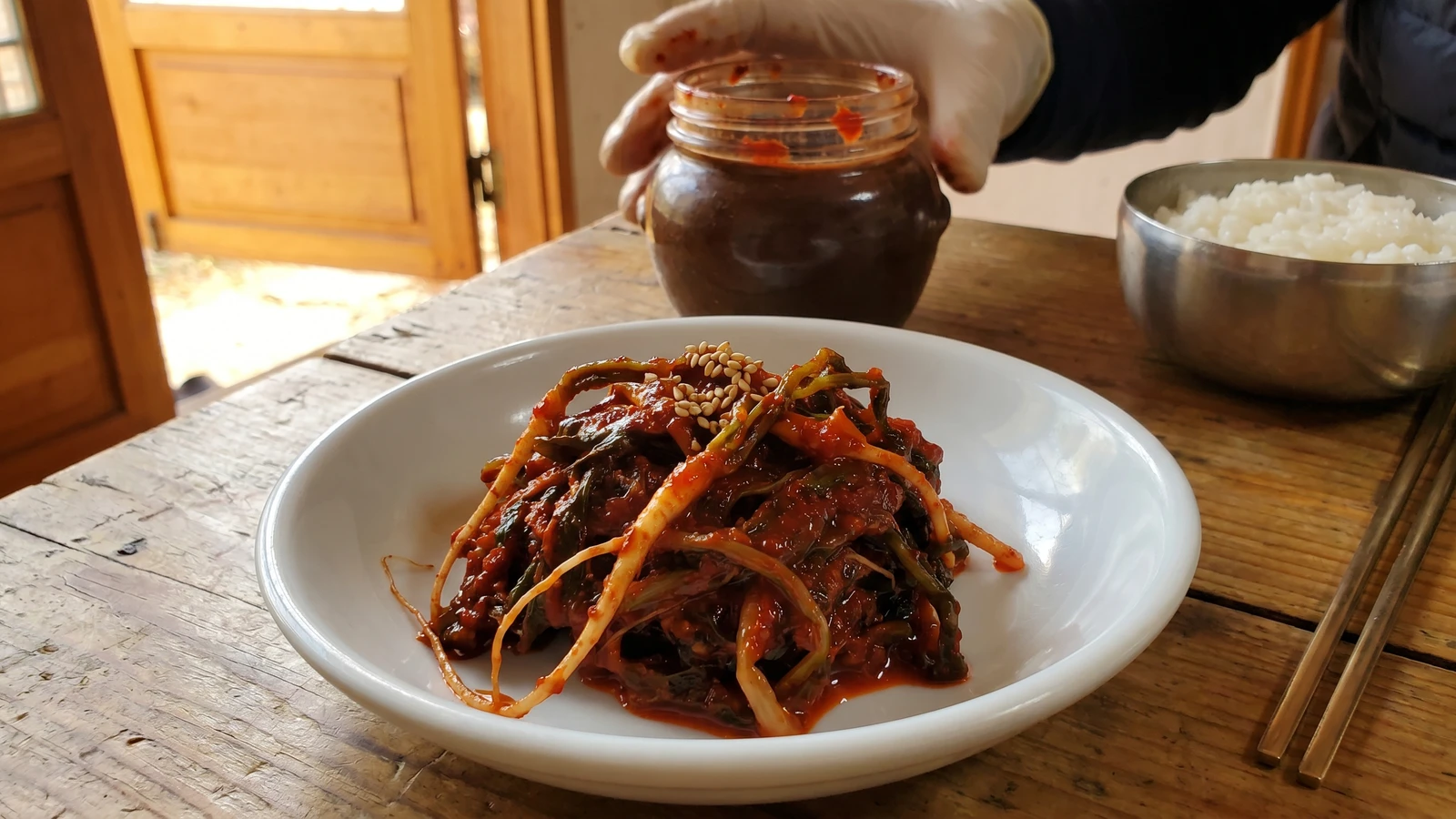
Autumn bitter greens from the Jeolla countryside, soaked until the bite becomes clean, then packed under gochugaru, anchovy jeotgal, and sweet rice paste for a kimchi that sharpens every bowl of rice.
At the late-autumn market, godeulppaegi sits in wiry bunches, roots still dirty, leaves looking too stubborn for a polite table. That is when you buy it. Cook the month you're standing in: this kimchi belongs after the first cold nights, when the roots have enough strength to stay crisp through salting and fermentation.
People hear bitter greens kimchi and think the work is to remove the bitterness. Wrong direction. You soak it in measured salt water long enough to tame the harsh edge and keep the clean bitterness that makes the dish worth eating. My teacher, Master Seong-nyeo, would have made me taste a root after one day, then after two, and say the difference out loud. 눈동냥, 귀동냥 (borrowing with the eyes and ears) was not enough here; your tongue has work.
This is a Jeolla country kimchi, sharp with anchovy jeotgal and not shy about gochugaru, but it should still taste like godeulppaegi. I won't tell you this is easy. Tonight asks for washing sand from every root, waiting through the soak, packing the greens tightly, and then leaving the jar alone until the bitterness, salt, and ferment settle into one clear bite beside rice.
Notebook 41 says 1 kilogram of greens takes 180 grams of salt across the soaking water and no more than 1 tablespoon of syrup in the paste. That number matters. Too little salt leaves the bitterness raw; too much sweetness turns a country kimchi into candy. 손맛 is real. I still measure it, so it can be handed on.
Godeulppaegi-kimchi is most strongly associated with Jeolla-do, where country kimchi often uses anchovy, hairtail, and other jeotgal more generously than the milder Seoul styles. The plant, Crepidiastrum sonchifolium, is a bitter wild green gathered or cultivated for its leaves and slender roots, and autumn roots are prized because they keep texture through winter fermentation. It belongs to local kimjang practice and rural banchan history, not court cuisine; its value is in preserving a hard-season green so rice has something sharp beside it.
Quantity
1 kg
roots and leaves attached
Quantity
6 liters
divided, for soaking
Quantity
180g
divided, for soaking
Quantity
1 cup
for sweet rice paste
Quantity
2 tablespoons
Quantity
1 cup (about 80g)
Quantity
1/2 cup
Quantity
2 tablespoons
finely minced
Quantity
1 tablespoon
minced
Quantity
8 cloves
minced
Quantity
1 tablespoon
minced
Quantity
1/2 medium
grated
Quantity
1/2
grated
Quantity
1 tablespoon
Quantity
200g
cut into thin matchsticks
Quantity
6
cut into 2-inch lengths
Quantity
60g
cut into 2-inch lengths
Quantity
1 teaspoon
for serving
| Ingredient | Quantity |
|---|---|
| fresh godeulppaegi (Korean bitter greens)roots and leaves attached | 1 kg |
| cold waterdivided, for soaking | 6 liters |
| coarse sea saltdivided, for soaking | 180g |
| waterfor sweet rice paste | 1 cup |
| glutinous rice flour (chapssal-garu) | 2 tablespoons |
| gochugaru (Korean chili flakes) | 1 cup (about 80g) |
| anchovy fish sauce (myeolchi-aekjeot) | 1/2 cup |
| salted shrimp (saeujeot)finely minced | 2 tablespoons |
| thick salted anchovy jeot (myeolchi-jeot) (optional)minced | 1 tablespoon |
| garlicminced | 8 cloves |
| fresh gingerminced | 1 tablespoon |
| oniongrated | 1/2 medium |
| Korean peargrated | 1/2 |
| maesil-cheong (green plum syrup) or rice syrup | 1 tablespoon |
| Korean radishcut into thin matchsticks | 200g |
| scallionscut into 2-inch lengths | 6 |
| buchu (Korean garlic chives) (optional)cut into 2-inch lengths | 60g |
| toasted sesame seeds (optional)for serving | 1 teaspoon |
Trim away bruised leaves, tough root tips, and any dark hair roots, but keep the main root attached to the leaf crown. Wash the godeulppaegi in several changes of cold water, rubbing gently around the root collars where sand hides. This kimchi keeps its character because root and leaf ferment together, so do not cut the bunches short now.
Dissolve 90g coarse sea salt in 3 liters cold water in a large basin. Add the cleaned godeulppaegi, weigh it down with a plate so every stem is under the brine, and soak 24 hours in a cool place. Drain, then repeat with the remaining 3 liters water and 90g salt for another 12 to 24 hours. Taste a root. It should still be bitter, but clean, not harsh at the back of the throat. You are not washing the bitterness away. You are teaching it manners.
Rinse the soaked greens twice in clean cold water, lifting them rather than crushing them. Drain in a colander for 1 hour, roots facing downward if you can manage it. Do not squeeze them dry. Squeezing bruises the leaves, but leaving them dripping will thin the kimchi paste and weaken the ferment.
Whisk 1 cup water with the glutinous rice flour in a small saucepan. Cook over medium heat, stirring, until it turns glossy and lightly thickened, 3 to 5 minutes. Cool it completely. This paste helps the seasoning cling to the long leaves and feeds fermentation gently, which is why a spoonful matters more here than extra sugar.
In a wide bowl, stir the cooled rice paste with the gochugaru, anchovy fish sauce, minced salted shrimp, optional thick anchovy jeot, garlic, ginger, grated onion, grated pear, and maesil-cheong. Let it sit 20 minutes so the gochugaru blooms and softens. Taste a fingertip of the paste. It should be salty and strong because the greens are unsalted at the center, but it should not taste sweet. Let the godeulppaegi still speak.
Add the radish, scallions, and buchu to the seasoning and fold them through first. Wearing gloves, take small handfuls of godeulppaegi and work the paste into the roots, crowns, and leaf bases, where plain tossing will miss. Keep the bunches mostly aligned as you season them. This sounds fussy until you eat a bite with an unseasoned root, then you will understand why Master Seong-nyeo made us do it twice.
Pack the seasoned greens into a clean 2-liter glass jar or small onggi, folding the long leaves down as you go. Press firmly after each layer to remove air pockets, but do not pound. Leave about 2.5 cm headspace, scrape any remaining paste over the top, and wipe the rim clean. Set the jar on a plate because active kimchi has a habit of teaching overfilled jars a lesson.
Ferment at cool room temperature, 18 to 21C, for about 24 hours, opening once to press the greens back under the paste. When it smells briny and lightly sour, move it to the refrigerator. It is good after 5 to 7 days and deeper after 2 weeks. Serve in small portions, cut into 2-inch lengths if the stems are long, with toasted sesame seeds only at the table. Use clean chopsticks every time and keep the greens covered with paste; if you ever see fuzzy mold or smell rot instead of sour brine, discard it.
1 serving (about 220g)
Culinary guides, cultural storytelling, and the editorial depth that makes cooking meaningful.
Discover Culinary ExplorerChef Jeong-sun
Tender baby napa cabbage in a clear pear-garlic brine, lightly fermented until the broth turns clean and bright, the summer kimchi a beginner can make without a kimjang floor.

Chef Jeong-sun
The kimchi from before chili, salted napa cabbage packed with radish, pear, jujube, and pine nuts in a clear brine that turns quietly tart in the jar.

Chef Jeong-sun
A pale summer cucumber kimchi, split and stuffed with radish and chives, then held in a cool pear brine so the cucumber stays clean, crunchy, and plainly itself.

Chef Jeong-sun
Flat spring bomdong cabbage, lightly brined and tucked into a clear pear-radish kimchi broth, made without chili and eaten young while the leaves still taste like spring.