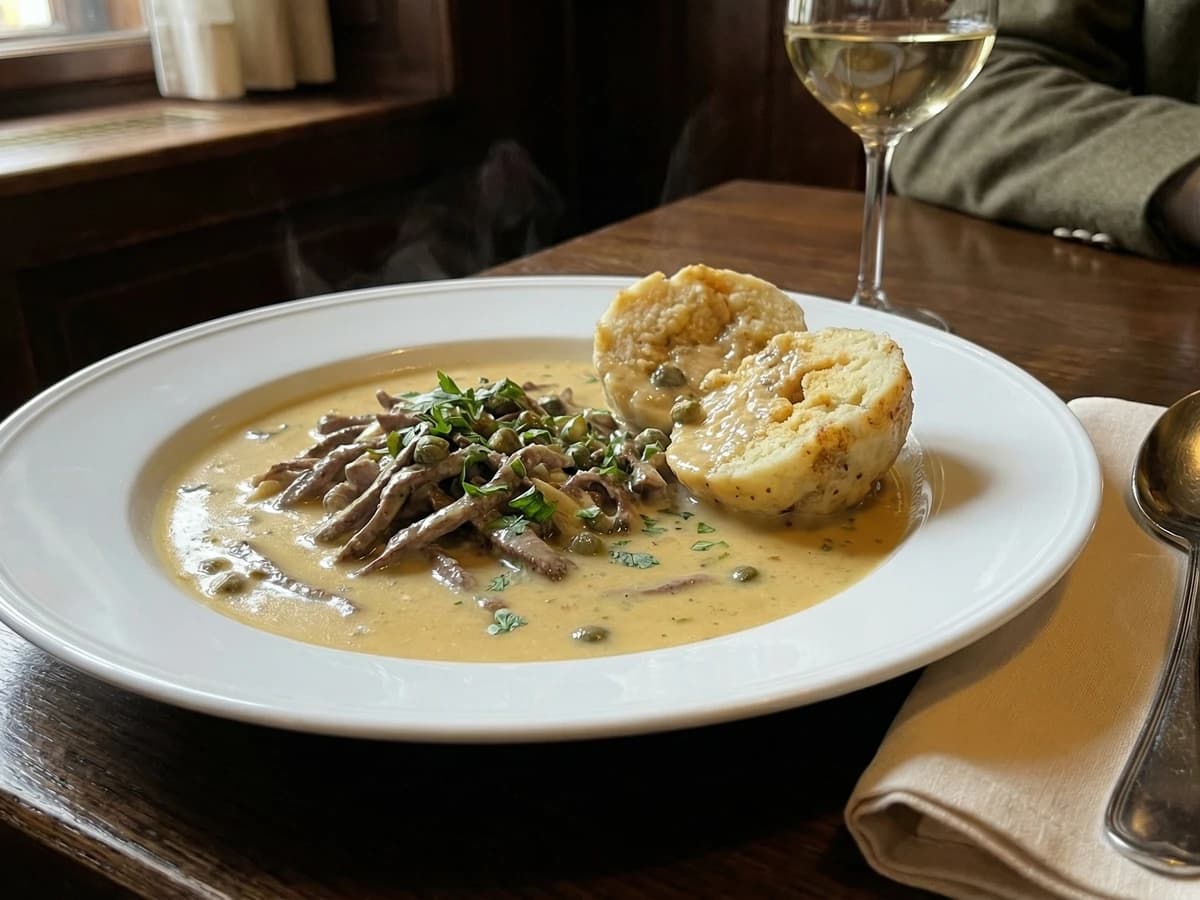
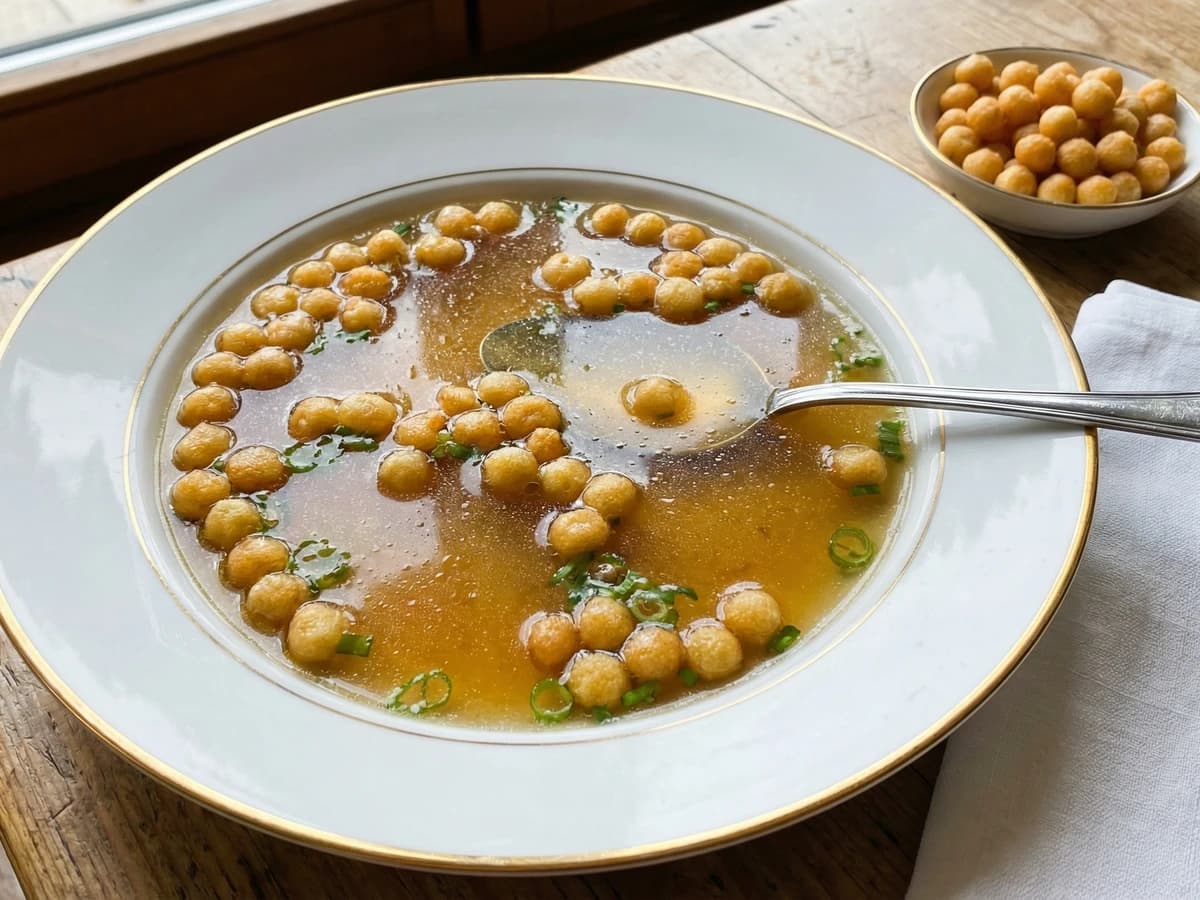
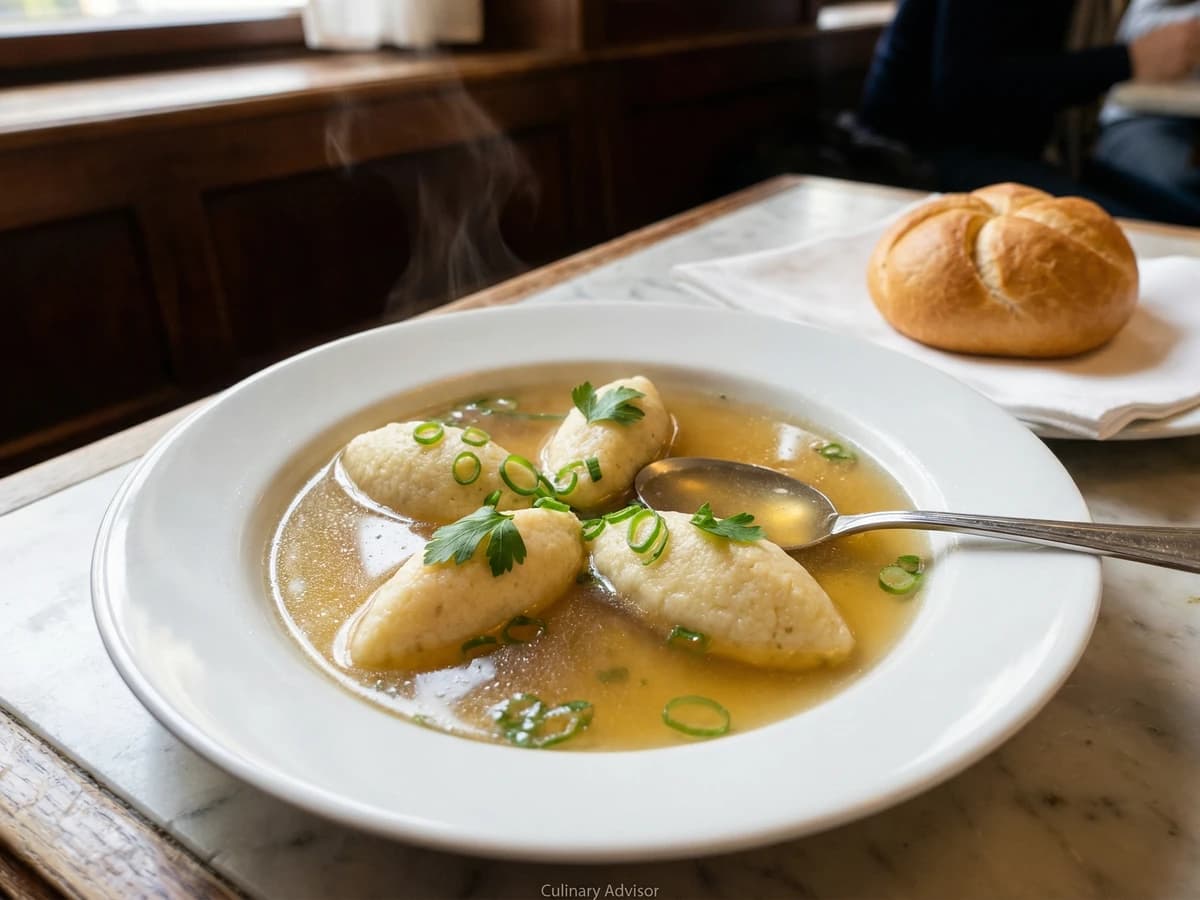
Hand-stretched strudel dough wrapped around yesterday's roast, poached gently in clear golden Rindssuppe and sliced into rounds that turn an honest bowl of broth into a proper meal.
Soups & Stews
Austrian
Weeknight
Make Ahead
50 min
Active Time
30 min cook•1 hr 20 min total
Yield6 servings
Gretel always said Austrian cooking wastes nothing. She meant it as a compliment, not a criticism. The Viennese kitchen is built on the principle that a fine thing, once made, should keep giving. Yesterday's Tafelspitz or Sunday roast doesn't sit sadly in the fridge waiting for someone to reheat it. It gets chopped, seasoned, rolled into a thin sheet of strudel dough, and poached in the very broth it helped create. That's Fleischstrudel, and it's one of the cleverest things in the Viennese soup repertoire.
I grew up watching Gretel and my grandmother Eva turn leftovers into something you'd be proud to serve at a dinner table. In Eva's kitchen in Kent, nothing was wasted, and if you'd been through what their generation had been through, you'd understand why. But this isn't austerity cooking. This is a dish that exists because someone tasted yesterday's roast beef inside a thin, silky wrapper of hand-stretched dough, floating in a bowl of golden Rindssuppe, and thought: this is better than what we started with. They were right.
The technique is the same pulled dough you'd use for Apfelstrudel, stretched until you can read a newspaper through it. If that sounds intimidating, it shouldn't be. The dough is forgiving once it's rested properly, and filling a savoury strudel is simpler than filling a sweet one. No breadcrumbs to toast, no apples to peel. You spread the chopped meat across the dough, roll it tight, wrap it in muslin, and let the broth do the rest. Thirty minutes of gentle simmering, a few minutes of patience while it firms up, then you slice it into neat rounds and lower them into bowls of hot, clear soup. The dough turns translucent and silky. The meat stays tender inside. The broth ties it all together.
Fleischstrudel belongs to the Viennese tradition of Suppeneinlagen, the elaborate soup garnishes that defined Bürgerlich (bourgeois) dining in the 19th and early 20th centuries. A proper Viennese household judged its cook not just by the clarity of her Rindssuppe but by the variety and skill of the garnishes she could produce from it. Frittaten, Leberknödel, Griesnockerl, Fleischstrudel: each one demonstrated a different technique, and the best cooks rotated through them across the week. Fleischstrudel was the thrifty star of this rotation, transforming leftover boiled or roasted beef into something so refined that guests rarely guessed they were eating yesterday's dinner.
The technique, the tradition, and the story behind every dish.
•Large clean cotton cloth or tea towel for stretching dough
•Muslin or thin cotton cloth for wrapping
•Kitchen string
•Rolling pin
•Wide pot for poaching (at least 30cm)
•Sharp knife for slicing
Instructions
1
Make the strudel dough
Mound the flour on a clean work surface and make a well in the center. Drop in the egg, oil, salt, and most of the lukewarm water. Work the wet ingredients into the flour with your fingers, pulling flour in gradually from the edges. Add the remaining water if the dough feels dry. Knead firmly for a good ten minutes until the dough is smooth, soft, and elastic. It should spring back when you press it with your finger and feel like a warm earlobe. Shape it into a ball, brush the surface lightly with oil, and cover with a warm, inverted bowl. Let it rest for at least thirty minutes. The gluten needs this time to relax. If you skip it, the dough will fight you when you try to stretch it and you'll end up with holes.
Use griffiges Mehl if you can find it. Austrian coarse flour has a slightly lower protein content and grainier texture than standard all-purpose, which gives the dough a more tender, silky finish once cooked. If you're using all-purpose flour, add a teaspoon more oil to compensate.
2
Prepare the filling
While the dough rests, melt the butter in a small pan over medium heat. Add the diced onion and cook gently until soft and translucent, about five minutes. You don't want colour here, just sweetness. Let the onion cool for a few minutes, then combine it in a bowl with the finely chopped meat, parsley, beaten egg, a good pinch of salt, pepper, and the nutmeg. Mix thoroughly with your hands. The egg binds the filling so it holds together inside the dough instead of crumbling out when you slice. The mixture should be moist but not wet. If your leftover meat is very lean and dry, add a second egg yolk to keep things supple.
The meat should be chopped fine by hand, not minced in a processor. You want small, distinct pieces with texture, not a paste. A sharp knife and five minutes of patience will get you there.
3
Stretch the dough
Spread a clean cotton cloth or tea towel over your table and dust it generously with flour. Place the rested dough in the center and roll it out with a rolling pin as far as it will go easily. Then slide your hands underneath, palms down, and begin stretching from the center outward, using the backs of your hands. Work your way around the dough gently, letting gravity help. The dough should stretch to roughly 40 by 50 centimeters, thin enough that you can see the pattern of the cloth through it. Trim any thick edges with scissors. If the dough tears in a spot or two, don't panic. A small tear will seal itself when you roll and poach it. A large tear means you didn't let it rest long enough.
Remove your rings and watch before stretching. The dough is thin and unforgiving, and a snagged edge will tear before you can catch it.
4
Fill and roll the strudel
Spread the meat filling evenly across the lower two-thirds of the stretched dough, leaving a three-centimeter border on all sides. Don't pile it too thick. A thin, even layer gives you a better ratio of silky dough to savoury filling in every slice. Fold the side borders inward over the filling, then use the cloth underneath to help you roll the strudel away from you, as tightly and evenly as you can manage. Think of rolling a sleeping bag: firm but not crushing. Press the seam and the ends closed with your fingers.
5
Wrap in muslin
Lay out a piece of clean muslin or a thin cotton cloth, large enough to wrap the strudel with room to spare. Brush the cloth lightly with melted butter or oil. Place the strudel along one edge, seam side down, and roll the cloth around it snugly. Tie the ends securely with kitchen string, like a Christmas cracker. The cloth holds the strudel's shape during poaching and keeps the dough from tearing in the liquid. This is the same technique Austrian cooks use for Serviettenknödel, and it works for the same reason: the wrapping does the structural work so the dough can stay delicate.
If you don't have muslin, a double layer of cling film works in a pinch. Wrap tightly, twist the ends closed, and then wrap the whole thing in a layer of aluminium foil. It's not traditional, but it holds.
6
Poach the strudel
Bring a wide pot of salted water to a gentle simmer. Lower the wrapped strudel in carefully. The water should barely tremble, the same patient simmer you'd use for a Tafelspitz. Rolling boils will batter the dough and turn your strudel into a soggy mess. Poach for twenty-five to thirty minutes, turning it once halfway through if it isn't fully submerged. The strudel is done when it feels firm to the touch through the cloth.
7
Rest and slice
Lift the strudel out of the water and let it rest in its cloth for five minutes. This resting time lets the filling set and the dough firm up, so your slices hold their shape instead of collapsing when the knife goes through. Unwrap the cloth carefully. Using a sharp knife, cut the strudel into rounds about two centimeters thick. The cross-section should show a spiral of translucent dough wrapped around the savoury meat filling. If it looks like a small, elegant pinwheel, you've done it right.
8
Serve in broth
Heat your Rindssuppe until it's properly hot. Place three or four strudel rounds in each warm soup bowl, cut side up so the spiral pattern is visible. Ladle the clear, golden broth over them gently. The slices will warm through in the hot liquid without falling apart. Scatter finely cut chives over the surface. Serve immediately. This is the kind of soup that makes a whole table go quiet for a moment. Mahlzeit!
Chef Tips
•The quality of the broth is everything here. Fleischstrudel is a simple filling inside a simple dough, and it's the Rindssuppe that brings it to life. If you don't have homemade broth, this is not the day to make this dish. Wait until you do. Gretel always said: real soup, not phony soup.
•Tafelspitz leftovers are the traditional and best filling for this strudel. The long-simmered beef has a tenderness and depth that roast beef can match but fresh raw mince cannot. If you're making Tafelspitz earlier in the week, set aside a piece specifically for this.
•You can poach the strudel whole up to a day ahead. Leave it wrapped in the cloth, refrigerate it, and slice cold. The rounds are actually easier to cut when chilled. Reheat them in the hot broth for two minutes before serving.
•Don't overwork the dough when kneading. Ten minutes of firm, rhythmic kneading is right. Twenty minutes of aggressive pounding will make it tough. You want strength and elasticity, not resistance.
Advance Preparation
•The strudel dough can rest for up to two hours under a warm bowl. Longer resting makes it easier to stretch, not harder.
•The filling can be prepared a day ahead and refrigerated. Bring it to room temperature before spreading on the dough.
•The whole poached strudel can be refrigerated in its cloth for up to 24 hours before slicing and reheating in broth. This makes it an ideal make-ahead weeknight dish: do the work on Sunday, eat well on Tuesday.
Frequently Asked Questions
Nutrition Information
1 serving (about 390g)
Calories
325 calories
Total Fat
13 g
Saturated Fat
4 g
Trans Fat
0 g
Unsaturated Fat
8 g
Cholesterol
105 mg
Sodium
650 mg
Total Carbohydrates
28 g
Dietary Fiber
1 g
Sugars
1 g
Protein
22 g
Where cooking meets culture.
Culinary guides, cultural storytelling, and the editorial depth that makes cooking meaningful.