Yucatán's pink rusa, cubed papa, zanahoria, chícharo, and betabel bound in mayonesa con limón and naranja agria. The mandatory cold side that sits beside the cochinita and the relleno negro at every family table from Mérida to Tizimín.
Salads
Mexican
Special Occasion
Holiday
Make Ahead
30 min
Active Time
35 min cook•1 hr 5 min total
Yield8 to 10 servings
This is from Yucatán. Not from any other state, not from any other country. The rusa yucateca is the cold pink salad that lives on the table next to the cochinita pibil at a baptism, next to the lechón al horno at Christmas, next to the relleno negro at a wedding. You do not eat a Yucatecan feast without it. Ask any señora in Mérida and she will tell you the same.
The Russian Salad traveled the world from late-19th-century Moscow and landed in every Spanish-speaking country with its own accent. Yucatán took it, added betabel for the color, dressed it with naranja agria instead of vinegar, and finished it with grated queso de bola, the Dutch Edam that Yucatán has been importing through the port of Sisal since the 19th century. That cheese is not a substitution. It is what the peninsula uses, the same wheel that fills the relleno negro and the queso relleno. Cada estado, su propia cocina.
The technique that separates a real rusa yucateca from a sad pink mush comes down to one rule: the beets cook separately and go in last. If you boil the betabel with the papa, you have made a uniform magenta salad and lost everything that makes the Yucatecan version beautiful. The pink should streak. The cubes should be distinct. You should see the yellow of the potato, the orange of the carrot, the green of the chícharo, and the pink bleeding through it all. That visual tension is the dish.
My mother did not cook Yucatecan food. She was from Jalisco. But I spent six weeks in Mérida and Valladolid one summer and I came home with a notebook full of rusa recipes from courtyard kitchens and birthday parties. The constants were three: separate the beets, use naranja agria, finish with queso de bola. Everything else is the cook's hand. Así se hace y punto.
The Russian Salad (ensalada Olivier) was created in Moscow in the 1860s by Lucien Olivier, a Belgian chef cooking French cuisine in the Hermitage restaurant, and it traveled through the Spanish-speaking world during the late 19th and early 20th centuries as a marker of European cosmopolitan dining. Yucatán adopted and naturalized the dish during the henequen boom, when the Yucatecan elite of Mérida looked to European cuisine for prestige while their cooks adapted every borrowed recipe to peninsular ingredients: naranja agria in place of wine vinegar, queso de bola in place of Gruyère, betabel as a distinct addition rather than the European Olivier's pickled cornichons. The dish became a fixed companion to the celebratory meats of Yucatán's mestizo cuisine, cochinita pibil, lechón al horno, pavo en relleno negro, where its cold sweetness and creamy bind balance the smoky achiote and the heat of habanero.
The technique, the tradition, and the story behind every dish.
mayonesa (Mexican-style, McCormick or Hellmann's mayonesa con limón)
Quantity
1 1/2 cups
crema mexicana
Quantity
1/4 cup
fresh naranja agria juice
Quantity
3 tablespoons
or 2 tablespoons fresh lime juice plus 1 tablespoon fresh orange juice
kosher salt (for the dressing)
Quantity
1 teaspoon
freshly ground black pepper
Quantity
1/2 teaspoon
white onion
Quantity
1/2 small
very finely diced
queso de bola (Edam)
Quantity
1/4 cup, finely grated, plus more for serving
pickled habanero and red onion (cebolla morada en escabeche) (optional)
Quantity
for serving
chile habanero (optional)
Quantity
for serving
sliced thin, on a side plate, for the table
Ingredient
Quantity
yellow waxy potatoes (papa amarilla)peeled and cut into 1/2-inch cubes
2 pounds
carrots (zanahoria)peeled and cut into 1/2-inch cubes
1 pound
medium beets (betabel)scrubbed with tops trimmed
3 (about 1 pound)
fresh shelled green peas (chícharos)or frozen petite peas, thawed
1 1/2 cups
kosher salt (for cooking water)
1 tablespoon, plus more to taste
mayonesa (Mexican-style, McCormick or Hellmann's mayonesa con limón)
1 1/2 cups
crema mexicana
1/4 cup
fresh naranja agria juiceor 2 tablespoons fresh lime juice plus 1 tablespoon fresh orange juice
3 tablespoons
kosher salt (for the dressing)
1 teaspoon
freshly ground black pepper
1/2 teaspoon
white onionvery finely diced
1/2 small
queso de bola (Edam)
1/4 cup, finely grated, plus more for serving
pickled habanero and red onion (cebolla morada en escabeche) (optional)
for serving
chile habanero (optional)sliced thin, on a side plate, for the table
for serving
Equipment Needed
•Two medium saucepans (one for beets, one for potato and carrot)
•Sharp paring knife for uniform cubes
•Large mixing bowl
•Rubber spatula for gentle folding
•Box grater or microplane for the queso de bola
Instructions
1
Cook the beets separately
Place the whole scrubbed beets in a saucepan and cover with cold water by two inches. Add a generous pinch of salt. Bring to a simmer over medium heat and cook for 35 to 45 minutes, until a knife slides into the center with no resistance. Cooking the betabel whole and separate is not optional. If you peel and cube them raw and boil them with the potatoes, every vegetable in the pot turns magenta and you have made a different salad. The pink in a rusa yucateca is earned at the end, not by accident.
Cook the beets with the skin on. The skin slips off under cold water in seconds once they are tender. Peeling raw beets is a waste of time and stains everything you own.
2
Boil the potato and carrot
While the beets cook, place the cubed potato and carrot in a separate large pot. Cover with cold water by two inches and add the tablespoon of salt. Bring to a simmer over medium-high heat and cook for 10 to 12 minutes, until a fork passes through the potato cleanly but the cube still holds its shape. Test one. If it falls apart on the fork, you have gone too far. Drain immediately into a colander and spread the vegetables on a sheet pan to stop the cooking and let the steam escape. Wet potato makes a sad rusa.
3
Blanch the peas
If using fresh chícharos, blanch them in salted boiling water for 2 minutes, then shock in ice water. If using frozen petite peas, a quick rinse under cold water is enough. They are already cooked. Drain well. The peas keep their bright green color and their bite, which is the whole point of including them. Mushy peas in a rusa are a sign the cook stopped paying attention.
4
Peel and cube the beets
Once the beets are tender, drain them and rinse under cold running water. The skins will slip off with a paper towel or your fingers. Wear gloves if you do not want pink fingers for the rest of the afternoon. Cut the peeled beets into the same 1/2-inch cubes as the potato and carrot. Uniform cubes are not vanity. They are how a forkful gets every ingredient in one bite, the way a Mérida cook would serve it.
5
Make the dressing
In a large mixing bowl, whisk together the mayonesa, crema, naranja agria juice, salt, and black pepper until smooth. The naranja agria does the work of vinegar here. It carries that bitter-floral edge that defines Yucatecan cooking, the same juice that wakes up cochinita pibil. If you cannot find naranja agria, the blend of lime and sweet orange gets you close. Bottled white vinegar does not belong in this salad. No me vengas con atajos.
Mayonesa con limón is the Mexican standard for this dish. American mayonnaise will work, but add an extra teaspoon of lime juice to the dressing to compensate for what it is missing.
6
Fold the salad
Add the cooled potato, carrot, peas, and the finely diced white onion to the bowl with the dressing. Fold gently with a rubber spatula until every cube is coated. Now, and only now, add the cubed beets. Fold them in with just a few strokes. You want streaks of pink running through a salad that is still mostly white and yellow and green, not a uniform fuchsia paste. The pink should look like it bled in slowly, the way it does on a Mérida table. Stir the grated queso de bola in last.
7
Chill and serve
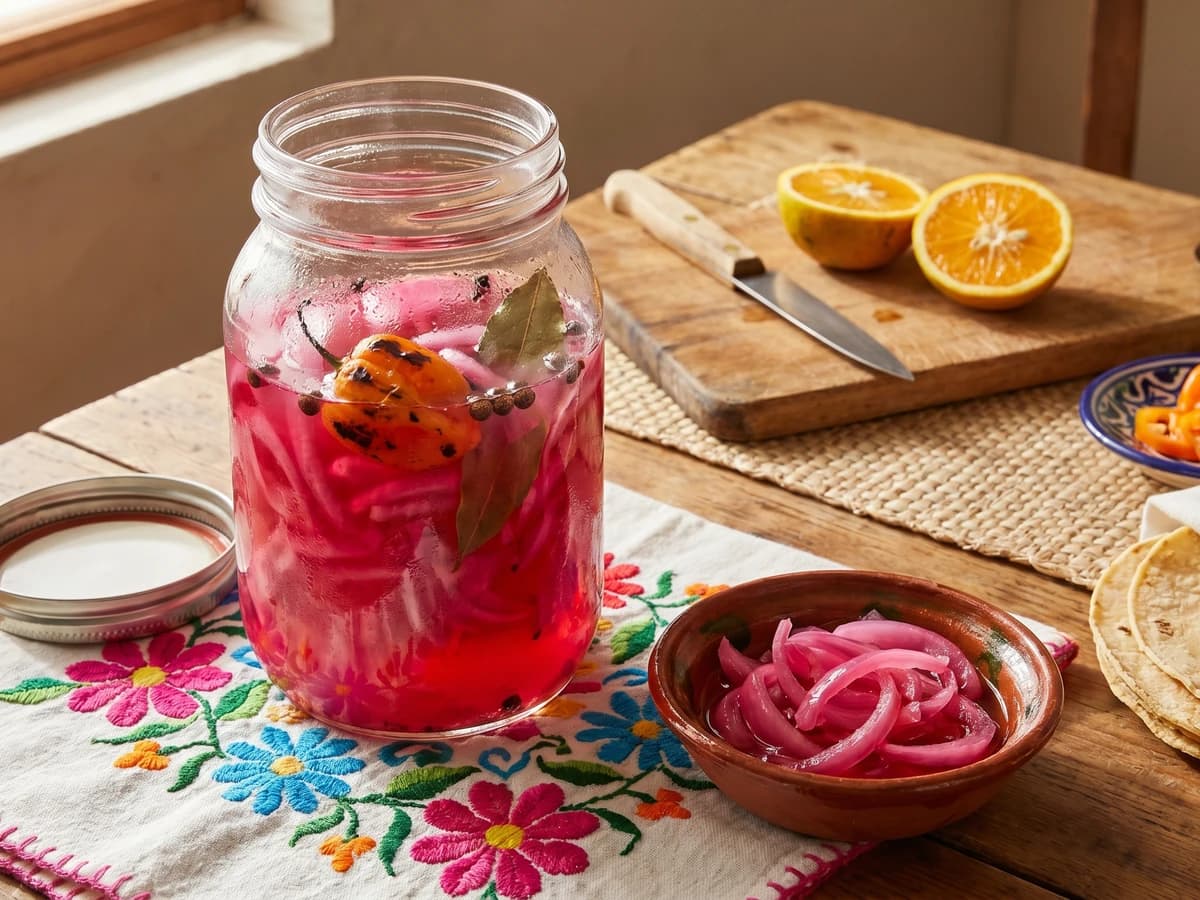
Cover the bowl and refrigerate for at least 2 hours, preferably 4. The salad needs the cold to set up and for the flavors to marry. Serve straight from a Ticul-red clay bowl or a glass jar, with extra grated queso de bola on top and the pickled red onion and habanero on the side. This is the cold side that sits next to cochinita pibil, lechón al horno, or relleno negro at every Yucatecan family meal. Recetas probadas y garantizadas.
Chef Tips
•Cook the betabel separately. This is the rule that separates a Yucatecan rusa from a pink mush. If you ignore this and dump everything in one pot, the salad turns uniform fuchsia and you have made something else.
•Naranja agria does the work of vinegar in Yucatecan cooking. If you cannot find it at a Latin market, the blend of lime and sweet orange is the correct substitute. Bottled vinegar is not. The flavor profile of the peninsula is built on sour orange and you cannot fake it with anything from a supermarket shelf.
•Queso de bola is Dutch Edam, sold in a red wax-coated ball at any Yucatecan market. Look for the brand La Vaca Que Rie's actual Edam wheel, or any imported Dutch Edam at a cheese counter. Do not substitute Monterey Jack or mozzarella. The peninsula has been importing this cheese for over a century and it is part of the cuisine.
•Make this salad the day before you serve it. The flavors deepen overnight and the textures set. A rusa eaten the moment it is made is a rusa that has not yet become itself.
Advance Preparation
•The rusa is better made one day ahead. Cook all the vegetables and dress the salad the night before, cover tightly, and refrigerate. The flavors marry and the pink deepens slightly without taking over.
•The beets can be cooked up to three days ahead and refrigerated whole in their skins. Peel and cube the day you build the salad.
•The dressing can be whisked together two days ahead and held in a jar in the refrigerator. Shake or whisk again before using.
Frequently Asked Questions
Nutrition Information
1 serving (about 285g)
Calories
420 calories
Total Fat
30 g
Saturated Fat
6 g
Trans Fat
0 g
Unsaturated Fat
23 g
Cholesterol
20 mg
Sodium
570 mg
Total Carbohydrates
31 g
Dietary Fiber
6 g
Sugars
7 g
Protein
5 g
Where cooking meets culture.
Culinary guides, cultural storytelling, and the editorial depth that makes cooking meaningful.