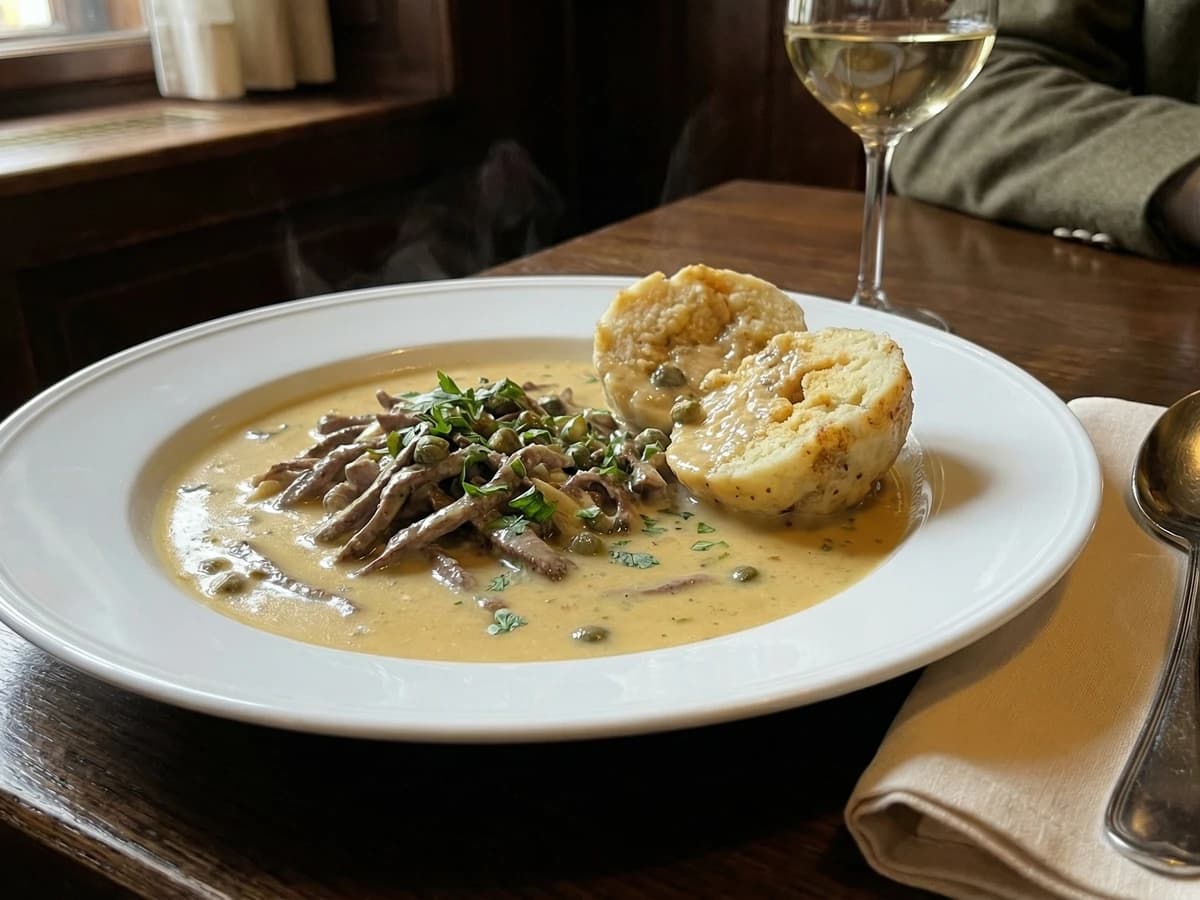
Tender veal simmered in its own broth, then cloaked in a silky white sauce with dill and capers. Viennese Bürgerlich cooking at its most quietly beautiful, the kind of dish that makes a whole table go still.
Soups & Stews
Austrian
Dinner Party
Comfort Food
30 min
Active Time
1 hr 45 min cook•2 hr 15 min total
Yield4 servings
Gretel always said that the dishes nobody photographs are the ones that matter most. Eingemachtes Kalbfleisch is one of those. It's not going to win you any points for color. It arrives at the table pale, creamy, flecked with green dill and little dark capers, looking almost plain. Then you taste it and understand why the Viennese have been making it for two hundred years.
In my grandmother Eva's kitchen in Kent, this was a weeknight supper. Eva would poach the veal slowly with root vegetables until the whole house smelled clean and savory, then build the Einmach, the white roux sauce, from the cooking liquid. She and Gretel had a gentle argument about capers that lasted decades. Eva used small ones, lots of them. Gretel preferred fewer, larger ones. They never resolved it. I use small ones, but I use a lot.
The technique here is a white roux, flour cooked in butter without letting it take any color at all. You cook it just long enough to lose the raw flour taste, then thin it with the veal's own poaching broth, and that's where the flavor comes from. Not from spice, not from browning, not from complexity. From the veal itself, drawn out slowly into a broth that becomes the sauce. This is the kind of Austrian cooking I love best: simple ingredients treated with respect, given time, turned into something that tastes like far more than the sum of its parts.
Serve it with plain boiled potatoes. Nothing else competes for attention and nothing else needs to.
Eingemachtes Kalbfleisch belongs to the tradition of Viennese Bürgerlich cooking, the solid, respectable cuisine of the middle classes that formed the backbone of Austrian home cooking from the 18th century onward. The word 'eingemacht' refers to the Einmach, a roux-based white sauce that predates the French béchamel in Austrian kitchens. Gretel Beer documented this dish as one of the essential preparations every Viennese cook was expected to master, noting that the quality of the sauce depended entirely on the quality of the poaching broth. The dill-and-caper combination reflects the Bohemian influence on Viennese cuisine, carried into the imperial capital through centuries of Habsburg rule over Prague and the Czech lands.
The technique, the tradition, and the story behind every dish.
Place the veal pieces in a large pot and cover with the cold water. Cold water again, just like building a broth. Starting cold draws out the proteins gently and gives you a clean, flavorful poaching liquid instead of something murky. Bring to a simmer over medium heat. As gray foam rises to the surface, skim it away patiently with a spoon. Keep skimming until the foam turns white and the liquid looks clear. This takes about fifteen minutes and it's not a step you can skip.
Don't let the water boil hard. A gentle simmer keeps the veal tender. If you see rolling bubbles, turn the heat down until the surface barely moves.
2
Add the aromatics
Once the broth is skimmed clean, add the onion, carrots, parsnip, celeriac, bay leaf, peppercorns, allspice berries, lemon zest, and salt. The allspice is a quiet signature of Viennese cooking. You won't taste it on its own, but without it, the sauce will feel like something is missing. Reduce the heat to a bare simmer, partially cover the pot, and let the veal cook gently for about one hour and fifteen minutes. The meat is ready when you can pull a piece apart easily with two forks.
3
Strain and separate
Lift the veal pieces out with a slotted spoon and set them aside on a plate. Cover them loosely so they don't dry out. Strain the poaching liquid through a fine-mesh sieve into a clean bowl or jug. You need about 600ml of this broth for the sauce. If you have more, save it. It's good veal stock and you'll find a use for it. Discard the spent vegetables.
4
Build the Einmach
Melt the butter in a clean, heavy-bottomed saucepan over medium-low heat. When it foams, add the flour all at once. Stir constantly with a wooden spoon. You're making a white roux, which means you cook the flour just long enough to lose its raw, pasty taste, about two minutes, but you do not let it take any color at all. The moment it starts to smell biscuity and warm, it's done. If it starts turning golden, your heat is too high.
Use white pepper, not black, throughout this dish. Black pepper leaves dark specks in the pale sauce and the Viennese consider that untidy. White pepper does the same job invisibly.
5
Build the sauce
Start adding the warm veal broth to the roux a ladleful at a time, whisking constantly after each addition. The first few ladles are critical. Go slowly. Whisk until the mixture is perfectly smooth before adding more. If you dump all the broth in at once, you'll be chasing lumps for the rest of the afternoon. Once about half the broth is incorporated and the sauce flows easily, you can add the rest more quickly. Let it simmer gently for ten minutes, stirring often. The sauce should coat the back of a spoon in a clean, even layer. Not thick like paste, not thin like water. Somewhere in between, like heavy cream that's been barely warmed.
6
Finish with sour cream and seasonings
Take the pan off the heat. Stir the sour cream into the sauce until it's fully incorporated and the color shifts from pale ivory to a warm, creamy white. Add the capers, the chopped dill, and the lemon juice. The lemon is essential. It lifts the whole dish out of blandness and gives the sauce a brightness that balances the richness of the cream and the butter. Add just a pinch of sugar. Not enough to taste sweetness, just enough to round off any sharp edges. Season with salt and white pepper. Taste it. If it needs more lemon, add more lemon. Trust yourself.
Add the sour cream off the heat. If the sauce is boiling when the Sauerrahm goes in, it can curdle and you'll have a grainy, broken mess instead of something silky.
7
Return the veal and warm through
Slide the veal pieces back into the sauce. Set the pan over low heat and warm everything through gently for five minutes. Don't let it boil. The veal should be heated through and tender, sitting in a sauce that clings to each piece without drowning it. You'll see the capers nestled against the meat and the dill flecked through the cream. It's not a beautiful dish by modern standards. It's something better than beautiful. It's honest.
8
Serve
Spoon the veal and sauce into warmed shallow bowls. Lay a few fresh dill sprigs across the top. Serve with plain boiled potatoes, nothing fancy, just good floury potatoes cooked in salted water and drained well. The potatoes soak up the sauce and that's exactly what they're there for. Mahlzeit!
Chef Tips
•Ask your butcher for veal shoulder with some connective tissue. The collagen melts during poaching and gives the broth body. Lean, trimmed veal cutlets won't give you the same result. You want pieces that hold together after an hour of simmering, not ones that fall apart into dry threads.
•Fresh dill is the only option here. Dried dill tastes like dusty hay and will ruin the sauce. If you can't find fresh dill, wait until you can. Make something else tonight.
•The sauce should be the consistency of pouring cream, not wallpaper paste. If it's too thick after adding the sour cream, thin it with a splash more broth. You can always add more, but you can't take it back.
•Gretel always said the pinch of sugar was the secret of Viennese white sauces. Not sweetness. Balance. It smooths out the acidity from the sour cream and the lemon without anyone knowing it's there.
Advance Preparation
•The veal can be poached and the broth strained up to a day ahead. Refrigerate the meat and broth separately. The broth may set into a soft jelly overnight, which tells you it's rich in gelatin and will make a beautiful sauce.
•Build the sauce and combine everything just before serving. The dill and sour cream lose their freshness if they sit in a hot sauce for too long.
•Leftover Eingemachtes reheats gently the next day. Add a splash of broth when rewarming, as the sauce thickens in the fridge.
Frequently Asked Questions
Nutrition Information
1 serving (about 450g)
Calories
565 calories
Total Fat
30 g
Saturated Fat
15 g
Trans Fat
0 g
Unsaturated Fat
15 g
Cholesterol
210 mg
Sodium
800 mg
Total Carbohydrates
28 g
Dietary Fiber
5 g
Sugars
7 g
Protein
44 g
Where cooking meets culture.
Culinary guides, cultural storytelling, and the editorial depth that makes cooking meaningful.