
Chef Jeong-sun
Albaechu-mul-kimchi (Baby Cabbage Water Kimchi)
Tender baby napa cabbage in a clear pear-garlic brine, lightly fermented until the broth turns clean and bright, the summer kimchi a beginner can make without a kimjang floor.
A cooking platform built around craft, culture, and the stories behind what we eat.
Created by
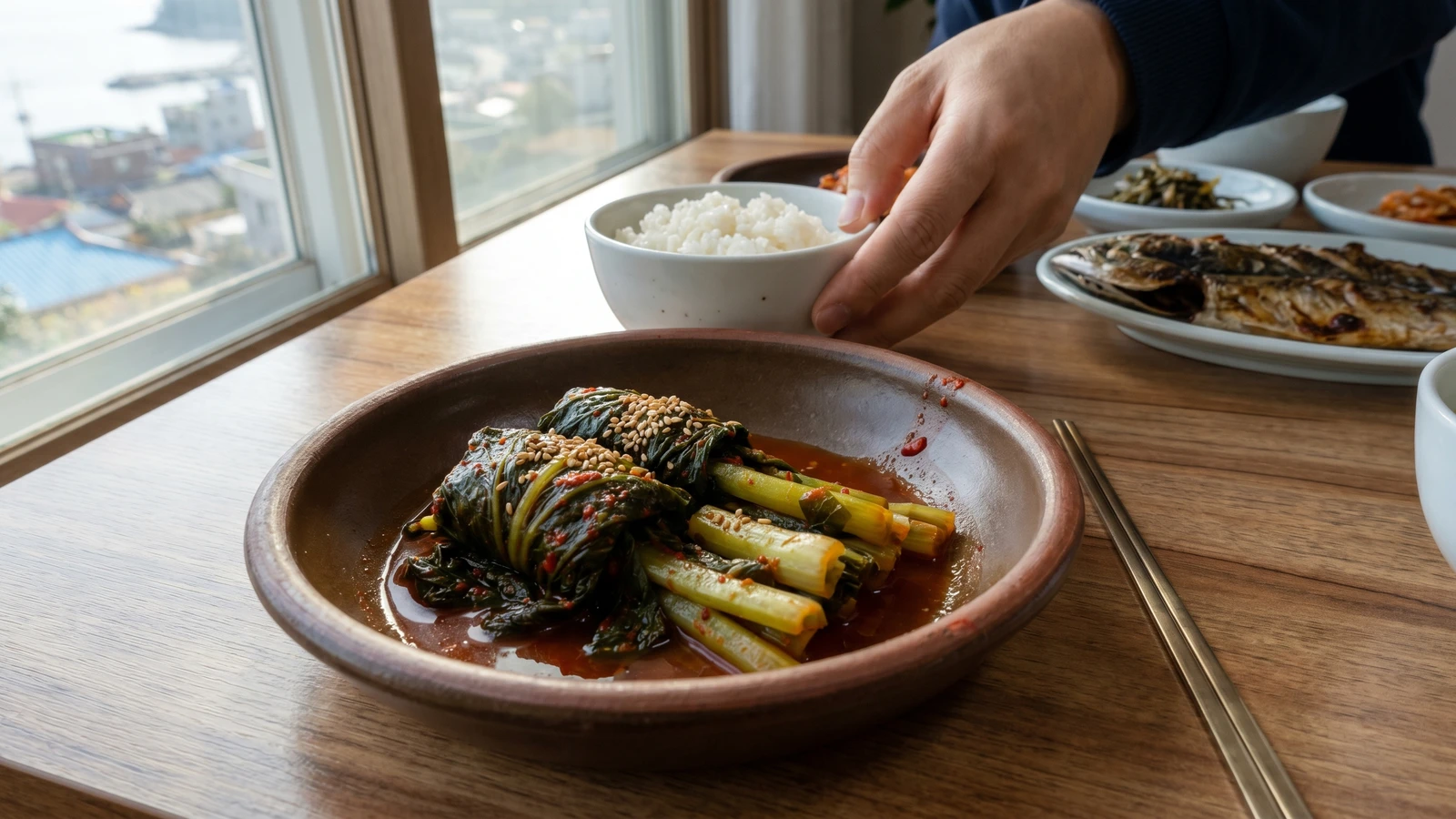
Peppery Dolsan mustard greens from Yeosu, salted until the stems bend, dressed with a restrained seafood-rich paste, and ripened slowly into the kimchi a southern table expects.
Dolsan gat-kimchi belongs to the southern market first. In Yeosu, bundles of gat, mustard greens, sit with their purple-green stems tied tight, leaves broad and alive, roots still carrying the place they came from. Buy it in its season, late autumn into winter, when the stems are full and the leaves have bite without harshness. Cook the month you're standing in.
This kimchi lives or dies in the salting. Gat is not napa cabbage. The leaves wilt fast while the stems stay proud, so you salt the stems more deliberately and handle the leaves like something that can bruise. If you salt carelessly, the finished kimchi turns tough at the stem and tired at the leaf. If you salt correctly, each stalk bends without snapping, and the mustard heat stays clean.
Notebook 41 says this paste must support the gat, not bury it. Use enough gochugaru for color and preservation, enough anchovy fish sauce and salted shrimp for depth, and not so much garlic or sugar that every bite forgets the plant. 손맛 is real. I still measure it, so it can be handed on.
Make this when you have room on the table and no need to rush dinner. Tonight it asks for washing, salting, turning, rinsing, draining, and packing with care. After that, time does the part your hands cannot. Open the jar after two or three days, and it will tell you whether you respected it.
Dolsan gat-kimchi is tied to Dolsan Island in Yeosu, South Jeolla, where the local mustard greens are valued for their pungent scent, tender stems, and the mineral character associated with sea wind and island soil. The opening of Dolsan Bridge in 1984 helped carry Dolsan gat and its kimchi beyond Yeosu, making a regional banchan widely known across Korea. Unlike long-winter baechu kimchi, gat-kimchi is prized for its slow-ripening mustard bite, especially on southern tables with rice, grilled fish, and soups.
Quantity
2kg
roots trimmed, stalks kept whole
Quantity
1/2 cup
for salting the greens
Quantity
8 cups
for brine
Quantity
2 tablespoons
for brine
Quantity
1 cup
for porridge
Quantity
2 tablespoons
Quantity
1 cup
medium grind
Quantity
1/2 cup
Quantity
3 tablespoons
finely chopped
Quantity
2 tablespoons
or 1 tablespoon sugar
Quantity
8 cloves
minced
Quantity
1 tablespoon
minced
Quantity
1/2 medium
grated
Quantity
1/2 medium
grated
Quantity
80g
cut into 2-inch lengths
Quantity
80g
cut into 2-inch lengths
Quantity
1 tablespoon
for serving
| Ingredient | Quantity |
|---|---|
| Dolsan gat (Korean mustard greens)roots trimmed, stalks kept whole | 2kg |
| coarse sea saltfor salting the greens | 1/2 cup |
| waterfor brine | 8 cups |
| coarse sea saltfor brine | 2 tablespoons |
| waterfor porridge | 1 cup |
| sweet rice flour (chapssal-garu) | 2 tablespoons |
| gochugaru (Korean chili flakes)medium grind | 1 cup |
| anchovy fish sauce (myeolchi-aekjeot) | 1/2 cup |
| saeujeot (salted fermented shrimp)finely chopped | 3 tablespoons |
| plum syrup (maesil-cheong)or 1 tablespoon sugar | 2 tablespoons |
| garlicminced | 8 cloves |
| fresh gingerminced | 1 tablespoon |
| Korean pear or Asian peargrated | 1/2 medium |
| oniongrated | 1/2 medium |
| minari (Korean water dropwort) (optional)cut into 2-inch lengths | 80g |
| jjokpa (Korean small scallions) (optional)cut into 2-inch lengths | 80g |
| toasted sesame seeds (optional)for serving | 1 tablespoon |
Trim only the dry root ends and any yellow leaves from the gat, keeping the stalks whole. Rinse in several changes of cold water, lifting the greens out each time so grit stays behind. Do not scrub the leaves. Mustard greens bruise, and bruised leaves ferment muddy instead of sharp.
Dissolve 2 tablespoons coarse sea salt in 8 cups water in a large basin. Dip the gat bundles through the brine, then lay them in the basin with the thick stems gathered toward the center. Sprinkle the 1/2 cup coarse sea salt mostly over the stems, using only a light scatter over the leaves. This is the measure people forget: the stem needs salt, the leaf needs mercy.
Salt the gat for 4 to 5 hours, turning the bundles every hour and moving the top ones to the bottom. After 4 hours, test a stem: it should bend into a soft curve without snapping, while the leaf should be wilted but still green. If the stem breaks, salt 30 to 60 minutes longer. If the leaves look limp and dark, stop at once.
Rinse the salted gat gently in two changes of cold water. Taste a thick stem. It should be seasoned through but not salty enough to make you wince. Drain in a colander for 1 hour, stems upward if you can, so water runs away from the leaves. Wet greens thin the paste and make weak kimchi.
Whisk 1 cup water with 2 tablespoons sweet rice flour in a small pot until smooth. Cook over medium heat, stirring, until glossy and thick enough to coat a spoon, 4 to 5 minutes. Cool completely. This porridge helps the seasoning cling to long leaves and gives the fermentation something steady to eat.
In a large bowl, mix the cooled porridge, gochugaru, fish sauce, chopped saeujeot, plum syrup, garlic, ginger, grated pear, and grated onion. Let it stand 20 minutes so the gochugaru blooms and softens. Taste a little paste on a piece of drained stem. It should be salty, savory, and lightly sweet, stronger than you want the finished kimchi, because the greens will drink it in.
Add the minari and jjokpa to the paste if using. Working with one small bundle of gat at a time, rub paste along the stems first, then lightly through the leaves. Use a firm hand at the bottom and a lighter hand at the top. Do not crush the greens into a red paste pile. Gat should still taste like gat.
Fold each seasoned bundle once or twice to fit your container, keeping the stems and leaves aligned. Pack into a clean kimchi container or glass jar, pressing down to remove air pockets but not smashing the leaves. Leave at least 1 inch of headspace because fermentation will push liquid upward.
Leave the packed kimchi at cool room temperature for 24 hours if your kitchen is around 20°C, or 12 to 18 hours if it is warm. When you see a little brine rise and smell the first clean tang, move it to the refrigerator. Gat-kimchi ripens slowly. It is edible after 3 days, better after 1 to 2 weeks, and deeper after a month.
Use clean tongs every time. Cut only what you will serve, into 2-inch lengths, and return the rest to the container pressed under its brine. Scatter sesame seeds only at the table if you like them. Sesame in the storage jar dulls the clean mustard scent over time.
1 serving (about 180g)
Culinary guides, cultural storytelling, and the editorial depth that makes cooking meaningful.
Discover Culinary ExplorerChef Jeong-sun
Tender baby napa cabbage in a clear pear-garlic brine, lightly fermented until the broth turns clean and bright, the summer kimchi a beginner can make without a kimjang floor.

Chef Jeong-sun
The kimchi from before chili, salted napa cabbage packed with radish, pear, jujube, and pine nuts in a clear brine that turns quietly tart in the jar.

Chef Jeong-sun
A pale summer cucumber kimchi, split and stuffed with radish and chives, then held in a cool pear brine so the cucumber stays clean, crunchy, and plainly itself.

Chef Jeong-sun
Flat spring bomdong cabbage, lightly brined and tucked into a clear pear-radish kimchi broth, made without chili and eaten young while the leaves still taste like spring.