
Chef Klaus
Badische Dinnele
The Baden flatbread that keeps its bread body: sour cream, onion, and Speck on a yeast dough baked hard and hot until the edges blister.
A cooking platform built around craft, culture, and the stories behind what we eat.
Created by
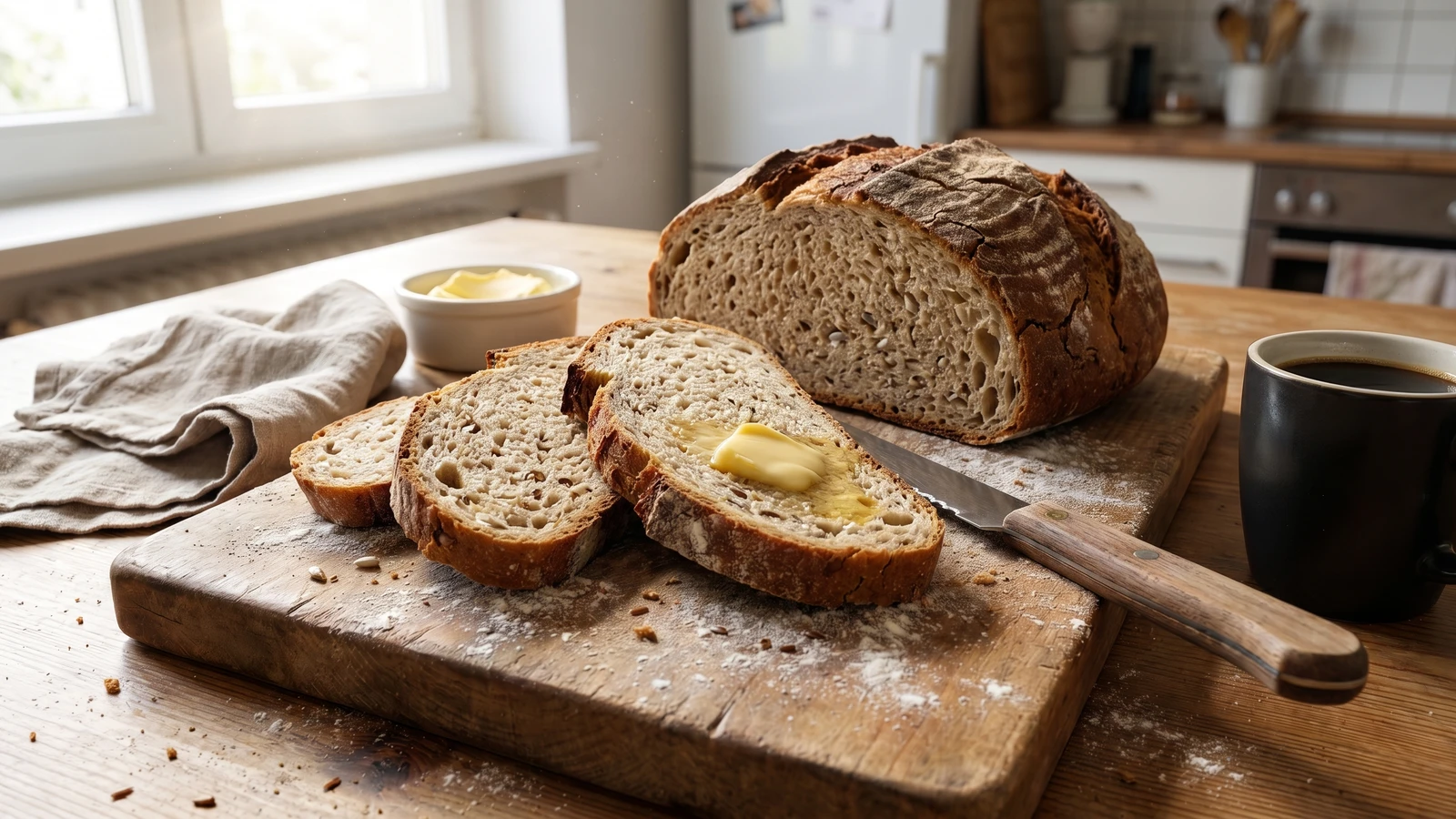
The old spelt loaf belongs back on the weekday table: nutty, soft, sliceable, and mixed short because Dinkel gives you flavour quickly and structure reluctantly.
Dinkelbrot is Swabian and Franconian at heart, though now you'll find it in bakeries from the North Sea to the Alps. In the south, spelt has old roots and a good name; in the north, the rye loaf still stands firmer on the table. Im Norden anders, im Süden anders. This one is a weekday loaf, made ahead, sliced for butter, cheese, cold cuts, or a bowl of soup.
The grain is the point and the trouble. Dinkel, spelt, tastes sweet and nutty, but its gluten is softer and less stubborn than wheat gluten. Knead it like a wheat sandwich loaf and you tear the structure you are trying to build. Mix until the dough comes together and turns smooth, then stop. Nicht aus dem Glas, and not from a packet either. Bread has hands in it.
The step that keeps it moist is the Brühstück, a scald of flour and seeds with boiling water. The starch swells and traps water before the dough is mixed, so the finished loaf stays soft without turning slack. Then watch the proof. Spelt looks ready before it is strong, and if you let it rise too far, it falls in the oven and gives you a sad roofline. Das braucht seine Zeit, but not too much of it.
Spelt was grown widely in southwestern Germany through the Middle Ages, especially across Swabia, Franconia, and Baden, because it tolerated poor soils and cold better than many wheats. Hildegard von Bingen praised Dinkel in the 12th century, which helped give the grain its lasting health-food reputation, though the older reason was practical farming, not romance. Baden and Franconia also made Grünkern from unripe spelt dried over heat, a separate larder product that shows how fully the region used the grain.
Quantity
100g
Quantity
30g
Quantity
20g
Quantity
200ml
Quantity
400g
plus more for dusting
Quantity
7g instant / 21g fresh
Quantity
10g
Quantity
1 tablespoon
Quantity
150ml
Quantity
1 tablespoon
| Ingredient | Quantity |
|---|---|
| whole spelt flour | 100g |
| sunflower seeds | 30g |
| flaxseed or linseed | 20g |
| boiling water | 200ml |
| spelt flour Type 1050plus more for dusting | 400g |
| instant yeast or fresh yeast | 7g instant / 21g fresh |
| fine salt | 10g |
| honey or beet syrup | 1 tablespoon |
| lukewarm water | 150ml |
| neutral oil or melted butter | 1 tablespoon |
Put the whole spelt flour, sunflower seeds, and flaxseed in a bowl and pour over the boiling water. Stir to a thick paste, cover it, and let it cool to room temperature, about 45 minutes. This Brühstück, scald, swells the starch before baking, so the loaf keeps moisture instead of drying out by the second day.
Add the Type 1050 spelt flour, yeast, salt, honey or beet syrup, lukewarm water, oil, and the cooled scald to a bowl. Mix by hand or with a dough hook on low speed for 4 to 5 minutes, only until the dough is smooth, sticky, and pulling together. Stop there. Dinkel gluten tears if you work it too hard, and a torn dough bakes dense.
Cover the bowl and let the dough rise at room temperature for 45 to 60 minutes, until puffed by about half, not doubled. A full double rise is too much for spelt; the dough spends its strength before the oven gets a chance.
Lightly flour the bench, tip out the dough, and fold it gently into a tight log. Set it seam-side down in a greased 23x13cm loaf tin. Keep the pressure firm but brief, because you want surface tension, not a kneaded second dough.
Cover the tin and proof for 35 to 45 minutes, until the dough rises just to the rim and slowly springs back when pressed with a floured finger. If the dent stays deep, it has gone too far. Spelt overproofs quietly, then collapses loudly in the oven.
Heat the oven to 220C. Slash the top once with a sharp knife, put the loaf in, and bake 10 minutes, then lower to 190C and bake 30 to 35 minutes more. The hot start sets the crust, and the lower finish bakes the centre without drying the thin spelt crumb. The loaf is done when it is deep brown and sounds hollow underneath, or reads 96C in the centre.
Lift the bread from the tin and cool it on a rack for at least 1 hour before cutting. Warm spelt crumb is fragile and smears under the knife; cool it fully and the slices hold clean for butter and Abendbrot, the evening bread table.
1 serving (about 70g)
Culinary guides, cultural storytelling, and the editorial depth that makes cooking meaningful.
Discover Culinary ExplorerChef Klaus
The Baden flatbread that keeps its bread body: sour cream, onion, and Speck on a yeast dough baked hard and hot until the edges blister.

Chef Klaus
The farmhouse loaf that made sense of a weekly oven firing: rye for keeping, wheat for lift, sourdough for the crumb, and a dark crust that earns its crack.

Chef Klaus
The Bavarian pretzel lives by its lye bath: a pale dough goes in, a dark glossy Breze comes out, with thin arms, a proud belly, and salt that bites clean.

Chef Klaus
A Bavarian wheat-rye loaf for the Brotzeit board, mild from ripe sourdough, dark-crusted from a fierce first heat, and firm enough to carry cold cuts without sagging.