
Chef Dean
Short Rib Cholent
A magnificent overnight stew where beef short ribs surrender their richness into beans, barley, and potatoes, emerging fork-tender after hours of gentle heat. This is food that feeds both body and tradition.
A cooking platform built around craft, culture, and the stories behind what we eat.

Created by
Pillowy matzo balls suspended in deeply golden chicken broth, the soup that has healed generations and anchored Jewish holiday tables for centuries. This is comfort food at its most elemental.
Every culture has a soup that serves as medicine. For Jewish families across America, this is it. Matzo ball soup arrived with immigrants who carried little but carried this: the knowledge that chicken broth simmered with care could restore the spirit, and that matzo meal mixed with fat and eggs could produce dumplings light enough to float.
The debate between sinkers and floaters has divided families for generations. I stand firmly in the floater camp. A proper matzo ball should yield to your spoon with almost no resistance, dissolving into the broth as you eat. The secrets are simple: schmaltz for richness, seltzer for lift, and a long rest in the refrigerator before shaping. Cold batter holds air. Warm batter produces cannonballs.
The broth matters as much as the matzo balls. You want it golden and clear, tasting unmistakably of chicken with the gentle sweetness of slow-cooked carrots and the fragrance of fresh dill. This is not a quick weeknight soup. It rewards patience. But the components can be made days ahead, which makes it perfect for Hanukkah gatherings when you'd rather light candles than stand at the stove.
I've watched nervous cooks approach matzo balls like they're defusing explosives. Relax. Your grandmother made these without measuring, and so will you once you understand what you're after. The batter should feel like soft clay. The water should barely simmer, never boil. Trust the process. Trust your hands.
Quantity
1 (4-5 pounds)
cut into pieces
Quantity
4 quarts
Quantity
2
quartered
Quantity
4
peeled and cut into chunks
Quantity
4
cut into chunks
Quantity
1
peeled and halved
Quantity
1 bunch
Quantity
1 tablespoon
Quantity
2
Quantity
1 tablespoon
Quantity
4
Quantity
1/4 cup
Quantity
1/4 cup
Quantity
1 cup
Quantity
1 teaspoon
Quantity
1/4 teaspoon
Quantity
2 tablespoons
finely chopped
| Ingredient | Quantity |
|---|---|
| whole chickencut into pieces | 1 (4-5 pounds) |
| cold water | 4 quarts |
| large onionsquartered | 2 |
| large carrotspeeled and cut into chunks | 4 |
| celery stalks with leavescut into chunks | 4 |
| parsnippeeled and halved | 1 |
| fresh dill | 1 bunch |
| whole black peppercorns | 1 tablespoon |
| bay leaves | 2 |
| kosher salt for broth | 1 tablespoon |
| large eggs | 4 |
| schmaltz or vegetable oil | 1/4 cup |
| seltzer water or chicken broth | 1/4 cup |
| matzo meal | 1 cup |
| kosher salt for matzo balls | 1 teaspoon |
| white pepper | 1/4 teaspoon |
| fresh dillfinely chopped | 2 tablespoons |
Place chicken pieces in a large stockpot and cover with cold water. Set over high heat and bring slowly to a boil, watching carefully. As the water heats, gray foam will rise to the surface. Skim this scum away with a large spoon. Keep skimming until the foam turns white and the liquid runs clearer. This takes about 15 minutes and makes the difference between murky soup and golden clarity.
Once skimmed, add the onions, carrots, celery, parsnip, dill bunch, peppercorns, bay leaves, and salt. Reduce heat to maintain the gentlest simmer. You want lazy bubbles rising occasionally, not a rolling boil. Partially cover the pot and let it cook for 1 hour and 30 minutes. The kitchen will smell like safety, like home, like your grandmother's house whether or not she ever made this soup.
Remove chicken pieces and set aside for another use. Strain the broth through a fine-mesh sieve lined with cheesecloth into a clean pot. Discard the spent vegetables and aromatics. You should have about 3 quarts of liquid ranging from pale gold to deep amber. Taste and adjust salt. The broth should taste fully seasoned on its own, rich and chickeny with a whisper of dill.
In a medium bowl, whisk the eggs until uniform. Add the schmaltz and seltzer, whisking to combine. The mixture will look slightly curdled. In a separate bowl, stir together the matzo meal, salt, white pepper, and chopped dill. Pour the wet ingredients into the dry and fold gently with a spatula until just combined. Do not overmix. The batter will be loose and sticky.
Cover the bowl tightly with plastic wrap and refrigerate for at least 1 hour, preferably 2. The batter will firm up considerably, making it easier to shape. More importantly, the cold traps air in the mixture. This is not optional. Room temperature batter produces dense matzo balls that sink and stay sunken.
Fill a wide pot with salted water and bring to a boil, then reduce to a gentle simmer. Wet your hands with cold water. Scoop about 2 tablespoons of batter and roll gently between your palms into a ball slightly smaller than a golf ball. The balls will expand by half as they cook. Do not compact them. Handle them like you're holding something precious, because you are. Place shaped balls on a parchment-lined sheet as you work.
Carefully lower the matzo balls into the simmering water. They will sink at first, then rise within a few minutes as they begin to float. Cover the pot tightly and resist all temptation to peek. Steam cooks the tops while the water cooks the bottoms. Simmer for 30 to 40 minutes. Lifting the lid releases steam and can result in uneven cooking.
After 30 minutes, sacrifice one matzo ball to the cause. Cut it in half. The interior should be uniformly pale and fluffy throughout, with no dense or darker core. If you see a darker center, cover and cook another 10 minutes. When done, remove matzo balls with a slotted spoon and transfer directly into the hot broth.
Ladle hot broth into wide, shallow bowls. Place 2 or 3 matzo balls in each bowl, letting them float proudly. Cut a few carrot coins from your reserved carrots for color if desired. Garnish with fresh dill fronds. Serve immediately while steam rises from the bowls. Watch your guests close their eyes at the first spoonful. This is the whole point.
1 serving (about 450g)
Culinary guides, cultural storytelling, and the editorial depth that makes cooking meaningful.
Discover Culinary ExplorerChef Dean
A magnificent overnight stew where beef short ribs surrender their richness into beans, barley, and potatoes, emerging fork-tender after hours of gentle heat. This is food that feeds both body and tradition.

Chef Juliette
Marseille's great fish stew, saffron-gold and garlic-scented, proves that a hard boil can be the careful choice: it binds olive oil into broth before the whole pot meets bread.

Chef Juliette
Waterzoi asks fresh, bone-in river fish to thicken its own buttery broth, with parsley root and pepper for company. No flour, no stockpot, just a brisk simmer watched closely.
Chef Juliette
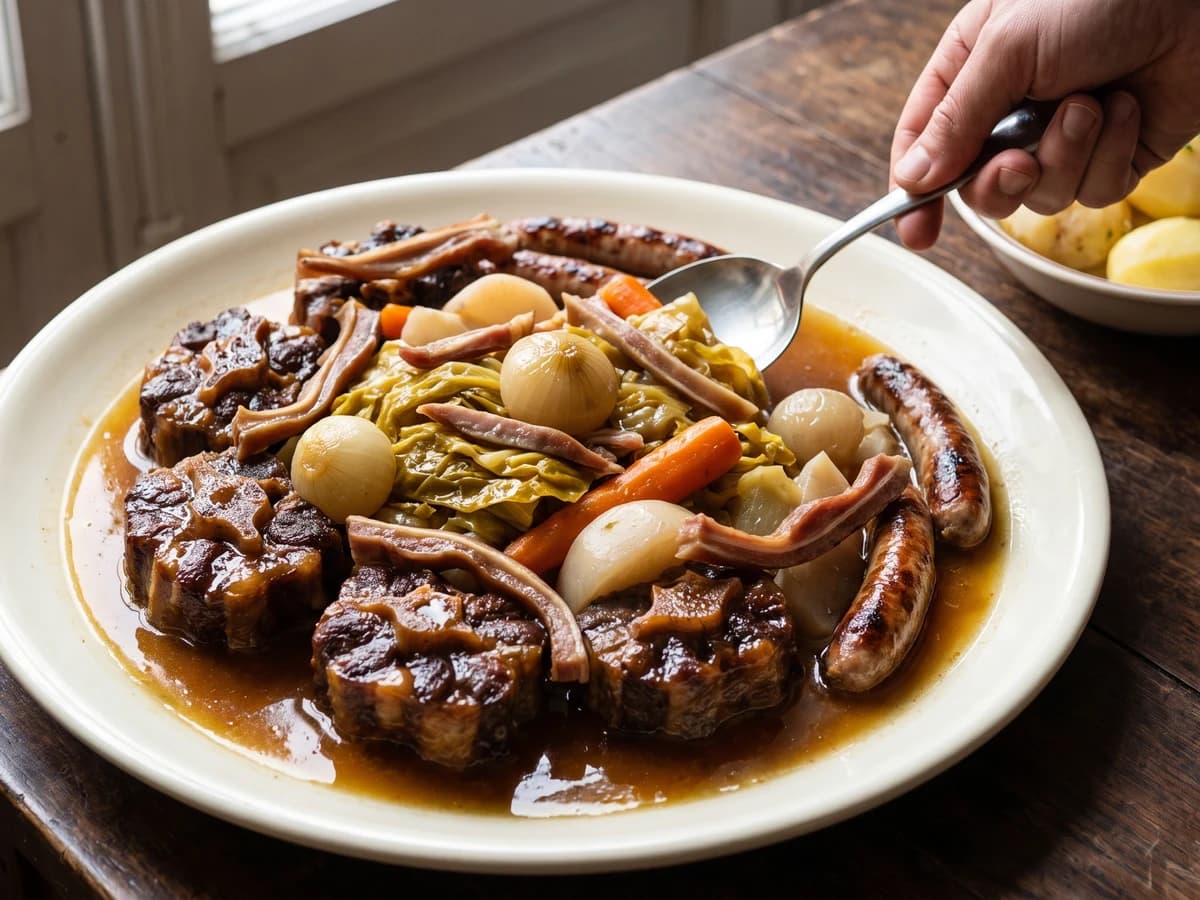
Queue de Bœuf en Hochepot gathers oxtail, pig's trotter and ear, cabbage, roots, and grilled chipolatas around a clear, gelatin-rich broth whose quiet simmer keeps every piece tender and distinct.