
Chef Lupita
Acúmara Tatemada al Comal
Michoacán's Lake Pátzcuaro acúmara, a whole kurucha from the lago tatemada on a comal de leña and served with chile perón atápakua, corn tortillas, and P'urhépecha discipline.
A cooking platform built around craft, culture, and the stories behind what we eat.
Created by
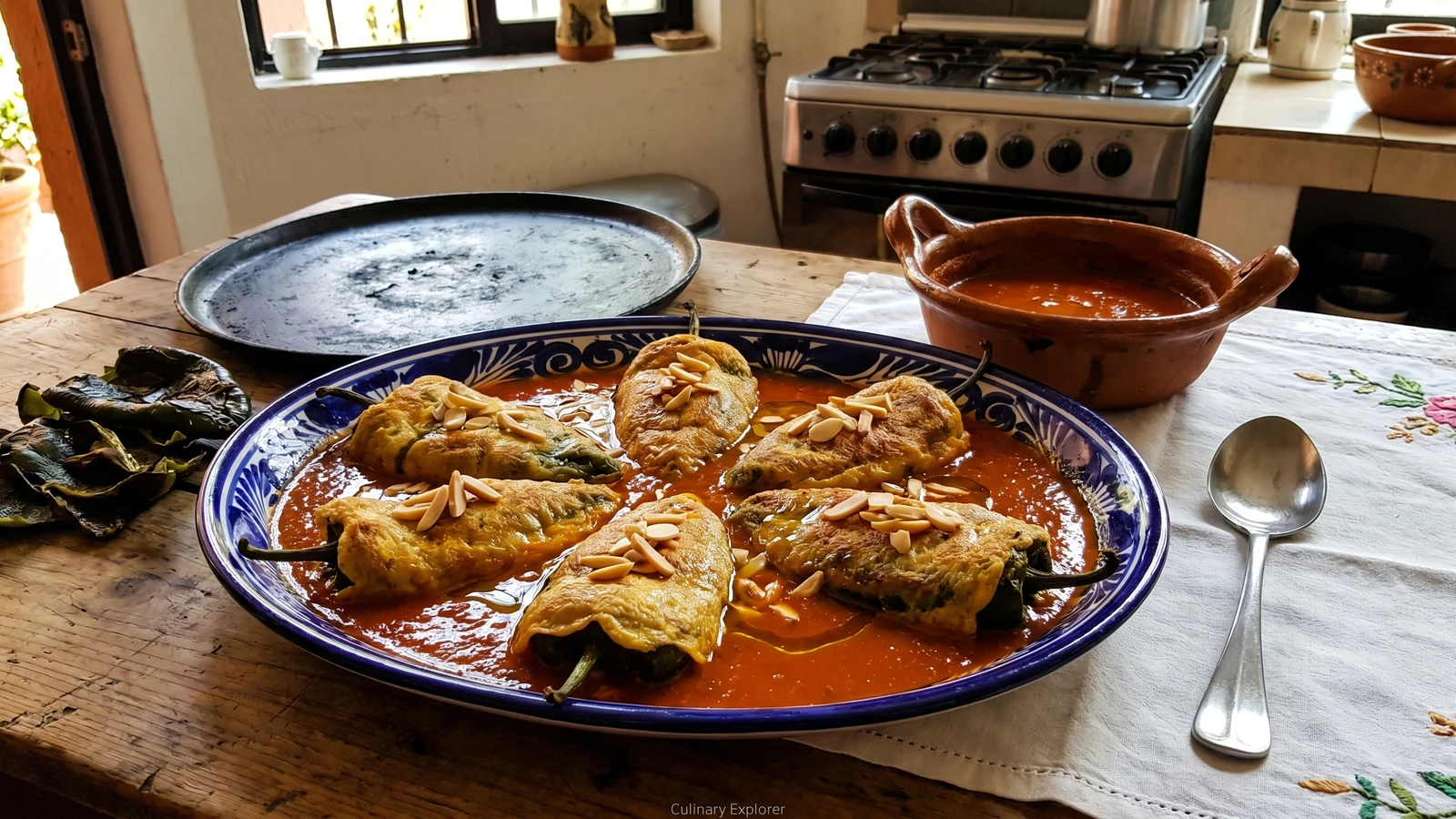
Puebla's Lenten chiles rellenos, poblanos filled with tuna picadillo of potato, carrot, olives, capers, raisins, and almonds, then capeados and settled into a tomato caldillo built for the convent Friday table.
Puebla de los Ángeles, in the central highlands of the state of Puebla, owns this chile relleno de vigilia. The city sits below Popocatépetl and Iztaccíhuatl, wrapped in convent walls, Talavera tile, and markets where the chile poblano is still chosen by hand. At Mercado La Acocota, the señoras will tell you which chiles are para rellenar: broad, straight, dark green, with stems still firm. Pregúntale a las señoras del mercado. They know before the cookbook knows.
This dish belongs to the Lenten table, the Friday refectory, the kitchen that had to feed people well when the Catholic calendar said no meat. The filling is atún with potato and carrot, but the convent hand is in the olives, capers, raisins, almonds, canela, and clove. Those are not decorations. They are the Old World pantry stitched into a Mexican chile by nuns and lay cocineras who understood that abstinence did not mean dull food.
The technique matters. Roast the chile poblano until the skin blisters, then peel it without rinsing away its flavor. Make the tuna picadillo moist, not wet. Capea the chile in beaten egg so it wears a light coat, not a mattress. Then let it rest in caldillo de jitomate until the tomato, chile, and filling understand each other. This is not food from one single Mexico. Cada estado, su propia cocina, and this one speaks Poblano.
Puebla's conventual cooking developed in the 17th and 18th centuries inside Dominican, Augustinian, and Carmelite houses, with Santa Rosa, Santa Clara, and Santa Mónica among the city's best documented kitchens. Chiles rellenos de vigilia come from the abstinence calendar of New Spain, when meatless refectory dishes were engineered with fish, eggs, legumes, vegetables, and imported pantry goods such as olives, capers, almonds, raisins, cinnamon, and clove. The canned tuna version is a 20th-century home-kitchen descendant of older convent fish fillings, adapted when industrial canned atún became reliable in Mexican urban pantries.
Quantity
6 large
broad and straight, stems attached
Quantity
2 medium
peeled and diced into 1/4-inch cubes
Quantity
2 medium
peeled and diced into 1/4-inch cubes
Quantity
1/2 cup
fresh or frozen
Quantity
as needed
Quantity
3 tablespoons
Quantity
1/2 medium
finely chopped
Quantity
2
finely minced
Quantity
2
seeded and finely chopped
Quantity
3 cans (5 ounces each)
drained and flaked
Quantity
1/3 cup
sliced
Quantity
2 tablespoons
rinsed and chopped
Quantity
1/4 cup
Quantity
1/3 cup
toasted and divided
Quantity
1
Quantity
1/2 teaspoon
Quantity
1/2 teaspoon
Quantity
1/8 teaspoon
Quantity
1 small pinch
Quantity
to taste
Quantity
1 1/2 pounds
Quantity
1/4 medium
Quantity
2
unpeeled
Quantity
1 1/2 cups
Quantity
2 tablespoons
Quantity
1
Quantity
1 small sprig or 1/4 teaspoon
Quantity
1-inch piece
Quantity
1
Quantity
1/2 cup
for dredging
Quantity
5
separated
Quantity
1/4 teaspoon
Quantity
2 cups
for frying
Quantity
for serving
Quantity
for serving
| Ingredient | Quantity |
|---|---|
| fresh chile poblanobroad and straight, stems attached | 6 large |
| white potatoespeeled and diced into 1/4-inch cubes | 2 medium |
| carrotspeeled and diced into 1/4-inch cubes | 2 medium |
| green peasfresh or frozen | 1/2 cup |
| kosher salt | as needed |
| olive oil | 3 tablespoons |
| white onionfinely chopped | 1/2 medium |
| garlic clovesfinely minced | 2 |
| Roma tomatoes (jitomate guaje)seeded and finely chopped | 2 |
| tuna packed in olive oildrained and flaked | 3 cans (5 ounces each) |
| manzanilla olivessliced | 1/3 cup |
| capersrinsed and chopped | 2 tablespoons |
| raisins | 1/4 cup |
| slivered almondstoasted and divided | 1/3 cup |
| bay leaf | 1 |
| dried thyme | 1/2 teaspoon |
| dried marjoram | 1/2 teaspoon |
| ground Mexican canela | 1/8 teaspoon |
| ground clove | 1 small pinch |
| freshly ground black pepper | to taste |
| ripe Roma tomatoes (jitomate guaje), for the caldillo | 1 1/2 pounds |
| white onion, for the caldillo | 1/4 medium |
| garlic cloves, for the caldillounpeeled | 2 |
| vegetable broth or water | 1 1/2 cups |
| olive oil, for frying the caldillo | 2 tablespoons |
| bay leaf, for the caldillo | 1 |
| fresh thyme or dried thyme | 1 small sprig or 1/4 teaspoon |
| Mexican canela | 1-inch piece |
| whole clove | 1 |
| all-purpose flourfor dredging | 1/2 cup |
| large eggsseparated | 5 |
| kosher salt, for the eggs | 1/4 teaspoon |
| mild olive oil or safflower oilfor frying | 2 cups |
| arroz blanco (optional) | for serving |
| warm corn tortillas (optional) | for serving |
Heat a dry comal over medium-high heat. Roast the chile poblano directly on the comal, turning with tongs, until the skin blisters and blackens in patches all over. The flesh should soften but not collapse. Put the chiles in a covered bowl for 10 minutes so the skins loosen. Peel with your fingers or a towel. Do not rinse them under water. Water steals flavor, and flavor is why we came to the stove.
Make one lengthwise slit in each peeled chile, starting below the stem and stopping before the tip. Use a small spoon or your fingers to remove the seed cluster and loose veins. Leave the chile whole. If you tear one, do not panic. The egg capeado will help seal small mistakes, but it will not rescue careless hands.
Bring a small pot of salted water to a boil. Add the diced potato and carrot. Cook 6 to 8 minutes, until tender but not falling apart. Add the peas during the final minute. Drain well and spread on a plate so the vegetables stop cooking. A watery filling makes the chile weep in the cazuela. No me vengas con atajos.
Heat 3 tablespoons olive oil in a wide skillet over medium heat. Add the chopped onion and cook until translucent, about 4 minutes. Add the minced garlic and chopped jitomate and cook until the tomato loses its raw smell and the oil begins to show at the edges. Stir in the tuna, potato, carrot, peas, olives, capers, raisins, most of the toasted almonds, bay leaf, thyme, marjoram, canela, clove, black pepper, and salt. Cook 5 to 7 minutes, stirring gently, until the mixture is moist but holds together. Remove the bay leaf and let the filling cool.
On the same comal, roast the 1 1/2 pounds Roma tomatoes, the onion quarter, and the unpeeled garlic cloves. Turn them until the tomatoes are softened and blotched with dark spots, the onion edges brown, and the garlic skins char lightly. Peel the garlic. Blend the roasted tomatoes, onion, garlic, and vegetable broth until smooth.
Heat 2 tablespoons olive oil in a clay cazuela or wide saucepan over medium heat. Strain the blended tomato mixture into the hot oil. It will hiss. Add the bay leaf, thyme, canela, whole clove, and salt. Simmer 15 to 20 minutes, until the caldillo turns glossy and brick red, thin enough to spoon but not watery. Remove the bay leaf, thyme sprig, canela, and clove. The tomato must taste cooked. Raw caldillo is laziness in a bowl.
Spoon the cooled tuna picadillo into each chile poblano. Fill generously, but do not force the chile open like a suitcase. Close the slit with one or two toothpicks if needed. Pat the outside dry with a towel. Moist chiles reject the flour, and then the egg slides off. Cooking is a chain of small decisions.
Put the flour on a shallow plate. Beat the egg whites with 1/4 teaspoon salt until they hold firm peaks. Beat the yolks lightly, then fold them into the whites with a gentle hand. This is capeado, not pancake batter. It should be airy enough to cling to the chile and puff in the oil.
Heat the mild olive oil or safflower oil in a wide skillet over medium heat until a drop of egg sizzles immediately. Dredge one filled chile lightly in flour, shaking off the excess, then coat it in the beaten egg. Fry 2 to 3 minutes per side, turning carefully, until the capeado is golden and set. Work in batches so the oil stays lively. Drain on a rack or paper towels.
Bring the caldillo back to a gentle simmer. Lay the fried chiles into the sauce in one layer and spoon caldillo over the tops. Cook 5 minutes, just long enough for the egg coat to drink a little tomato and for the filling to warm through. Do not boil hard. A violent pot tears delicate food.
Arrange the chiles in a deep Talavera platter with plenty of caldillo around them. Scatter the reserved toasted almonds over the top. Serve with arroz blanco and warm corn tortillas. This is a Poblano Lenten main dish, not a side, not a snack, and not something that needs cheese or crema to explain itself. Recetas probadas y garantizadas.
1 serving (about 620g)
Culinary guides, cultural storytelling, and the editorial depth that makes cooking meaningful.
Discover Culinary ExplorerChef Lupita
Michoacán's Lake Pátzcuaro acúmara, a whole kurucha from the lago tatemada on a comal de leña and served with chile perón atápakua, corn tortillas, and P'urhépecha discipline.

Chef Lupita
Puebla's weekday adobo of pork shoulder braised in a thick guajillo and ancho sauce sharpened with vinegar, cumin, and clove. The deep red of a market spice stall, the dish a poblana cooks without thinking.

Chef Lupita
Loreto's pit-roasted clams, planted hinge-up in beach sand and tatemadas under a fast fire of dried romerillo brush, the resinous Baja desert shrub that gives this dish its smoke.

Chef Lupita
Oaxaca's eighth mole, the silky, almond-and-cinnamon almendrado, served over poached chicken. Mild, sweet, restrained, and a quiet rebuttal to anyone who thinks Mexican food has to be hot to be Mexican.