
Chef Lupita
Acúmara Tatemada al Comal
Michoacán's Lake Pátzcuaro acúmara, a whole kurucha from the lago tatemada on a comal de leña and served with chile perón atápakua, corn tortillas, and P'urhépecha discipline.
A cooking platform built around craft, culture, and the stories behind what we eat.
Created by
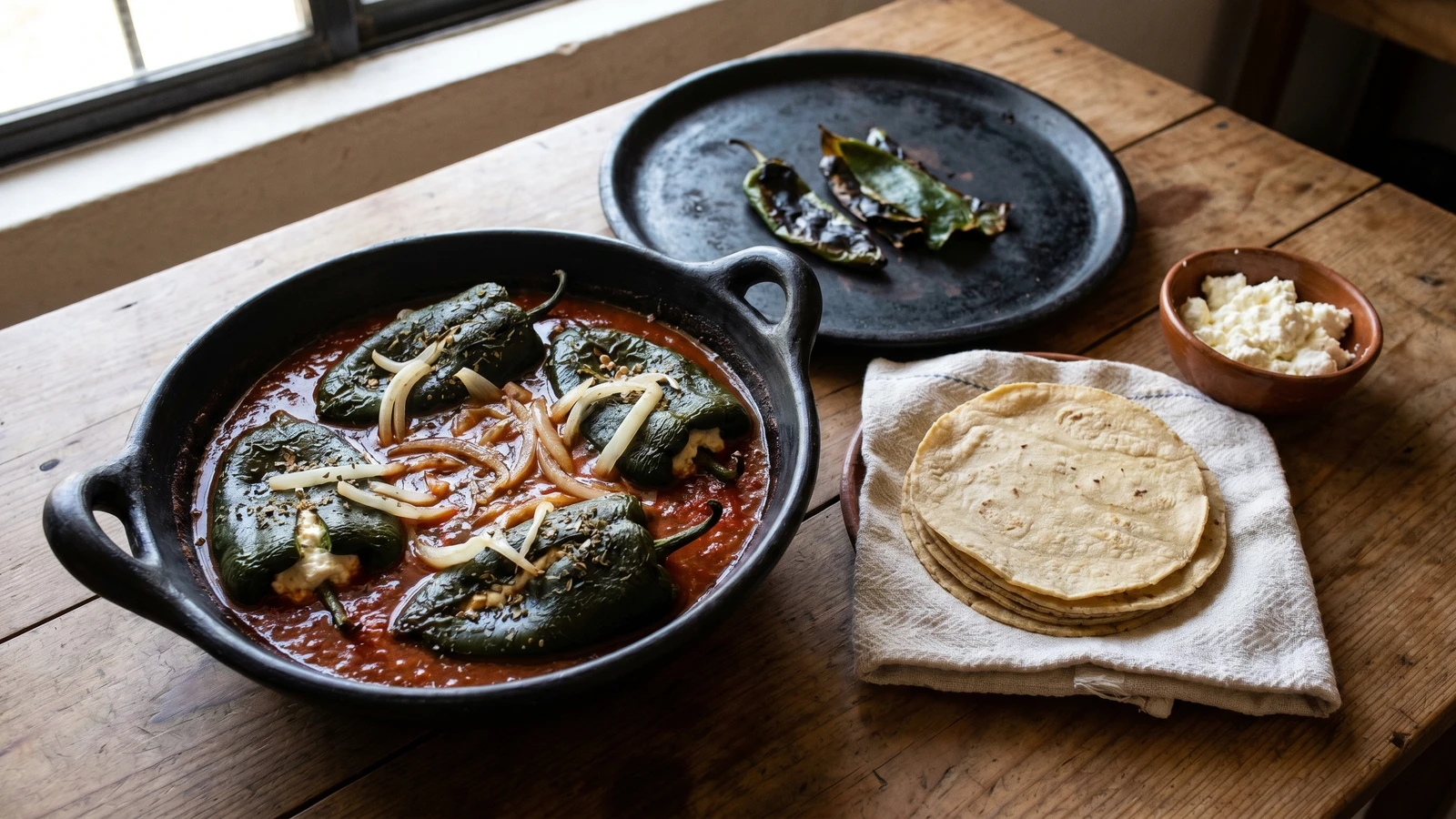
Queréndaro's chile poblano capones, roasted, peeled, and cleared of seeds and venas, filled with requesón, onion, and orégano de monte, then settled into a fried jitomate salsa.
Michoacán, Queréndaro east of Morelia toward the Cuitzeo basin, is where these chiles live. The poblano is roasted on the comal, capado of seeds and venas, filled with requesón, cebolla blanca, and orégano de monte, then bathed in salsa de jitomate. That is the dish. No batter. No yellow cheese. No me vengas con atajos.
This plate comes from the milpa and the monte, not the lago. The lago gives Michoacán kurucha and acúmara, and those dishes have their own table. Here the work is in the chile: char it enough to peel, keep it whole enough to stuff, remove the venas cleanly so the poblano tastes green and deep instead of sharp. The women who perfected this did not need culinary school. They had leña, comal, a good cazuela, and fifty years of feeding people who knew the difference.
I learned the discipline of Michoacán cooking from cocineras tradicionales in Uruapan and Cherán, and from watching the women of Zacán, Janitzio, and Cocucho teach as if the whole state were listening. They are the transmission. Not decoration. Chiles capones are not an atápakua, those P'urhépecha sauces have their own rules, but the same principle applies: control the fire, respect the ingredient, and let the geography show. Saber cocinar es saber vivir.
Chiles capones are associated with Queréndaro, a chile-growing municipality in eastern Michoacán, where capón refers to a chile that has been capado: slit, seeded, and stripped of its venas before stuffing. UNESCO's 2010 inscription of Traditional Mexican Cuisine used a Michoacán paradigm rooted in P'urhépecha communities, a language isolate lineage represented publicly by cocineras tradicionales from places including Zacán, Janitzio, Cocucho, Cherán, and Uruapan. Long before colonial dairy introduced requesón, the Cazonci's state around Lake Pátzcuaro organized tribute through milpa, monte, and lago, which is why Michoacán cooking still reads by geography before it reads by menu category.
Quantity
8 large
firm and dark green, stems attached
Quantity
2 cups
drained for 30 minutes
Quantity
1 large
divided: 1/2 finely chopped, 1/4 roasted, 1/4 thinly sliced
Quantity
1 1/2 teaspoons
crushed between your fingers, divided
Quantity
1 1/2 teaspoons, plus more to taste
Quantity
2 pounds
Quantity
3
unpeeled
Quantity
2 tablespoons
Quantity
1/2 cup
Quantity
for serving
warmed on the comal
| Ingredient | Quantity |
|---|---|
| fresh chile poblanofirm and dark green, stems attached | 8 large |
| requesóndrained for 30 minutes | 2 cups |
| white oniondivided: 1/2 finely chopped, 1/4 roasted, 1/4 thinly sliced | 1 large |
| dried orégano de montecrushed between your fingers, divided | 1 1/2 teaspoons |
| fine sea salt | 1 1/2 teaspoons, plus more to taste |
| ripe jitomate guaje or Roma tomatoes | 2 pounds |
| garlic clovesunpeeled | 3 |
| aceite de maíz or neutral vegetable oil | 2 tablespoons |
| water or light vegetable broth | 1/2 cup |
| hand-pressed corn tortillas (optional)warmed on the comal | for serving |
Heat a comal over medium-high, preferably over leña if you have that kind of kitchen. Roast the chile poblano, turning often, until the skins blister and blacken in patches. You are loosening the skin, not cooking the chile into collapse. The flesh should still hold its shape because these chiles have to carry the filling.
Put the roasted chiles in a covered bowl for 12 minutes. Peel away the loosened skin with your fingers or a towel. Do not rinse them under the faucet. Water washes away the roasted flavor you worked to build on the comal.
Cut one careful slit down the side of each chile, leaving the stem attached. With a small spoon, remove the seeds and venas without tearing the flesh. This is why they are called capones, capados of what gives the chile most of its heat. Not all Mexican food is hot. Sometimes the chile is there for perfume, flesh, and structure.
Finely chop half of the white onion. Mix it with the drained requesón, 1 teaspoon of the orégano de monte, and 3/4 teaspoon of salt. Taste it. It should be bright from the onion and fragrant from the oregano, not salty like botana. The filling is quiet, because the chile and salsa are going to speak.
On the same comal, roast the jitomates, the unpeeled garlic cloves, and one quarter of the onion until the tomato skins are blistered and the garlic softens. Peel the garlic. Blend the roasted jitomates, roasted onion, peeled garlic, 1/2 teaspoon salt, and the water or vegetable broth until smooth. This is a salsa de jitomate, not ketchup with ideas.
Thinly slice the remaining quarter of the onion. Heat the aceite de maíz in a wide cazuela over medium. Fry the sliced onion until it softens and turns translucent at the edges. Pour in the blended salsa. It will sputter. Cook 15 to 18 minutes, stirring often, until the salsa deepens to brick red and a thin orange oil sheen gathers at the edge. Stir in the remaining 1/2 teaspoon orégano de monte and taste for salt.
Spoon the requesón filling into the capados chiles, dividing it evenly. Close each chile gently with your hands. Do not overfill. A chile that bursts open in the cazuela tells everyone you were showing off instead of cooking.
Nestle the filled chiles into the fried jitomate salsa, slit side up. Spoon salsa over the tops without drowning the openings completely. Cover and cook over low heat for 8 to 10 minutes, just until the requesón warms through and the chile relaxes into the sauce. Do not boil hard. Requesón is delicate and a furious pot makes it grainy.
Rest the cazuela off the heat for 5 minutes so the salsa clings to the chiles. Serve family-style with warm corn tortillas from the comal. This dish is milpa and monte: chile, jitomate, maize, oregano. No flour tortillas. Cada estado, su propia cocina.
1 serving (about 290g)
Culinary guides, cultural storytelling, and the editorial depth that makes cooking meaningful.
Discover Culinary ExplorerChef Lupita
Michoacán's Lake Pátzcuaro acúmara, a whole kurucha from the lago tatemada on a comal de leña and served with chile perón atápakua, corn tortillas, and P'urhépecha discipline.

Chef Lupita
Puebla's weekday adobo of pork shoulder braised in a thick guajillo and ancho sauce sharpened with vinegar, cumin, and clove. The deep red of a market spice stall, the dish a poblana cooks without thinking.

Chef Lupita
Loreto's pit-roasted clams, planted hinge-up in beach sand and tatemadas under a fast fire of dried romerillo brush, the resinous Baja desert shrub that gives this dish its smoke.

Chef Lupita
Oaxaca's eighth mole, the silky, almond-and-cinnamon almendrado, served over poached chicken. Mild, sweet, restrained, and a quiet rebuttal to anyone who thinks Mexican food has to be hot to be Mexican.