
Chef Lupita
Arroz a la Oaxaqueña
Oaxaca's red rice, stained with tomato and fried in lard, steamed with carrots, ejotes, black beans, and epazote. The side that anchors a Oaxacan family meal and earns its place beside the main.
A cooking platform built around craft, culture, and the stories behind what we eat.
Created by
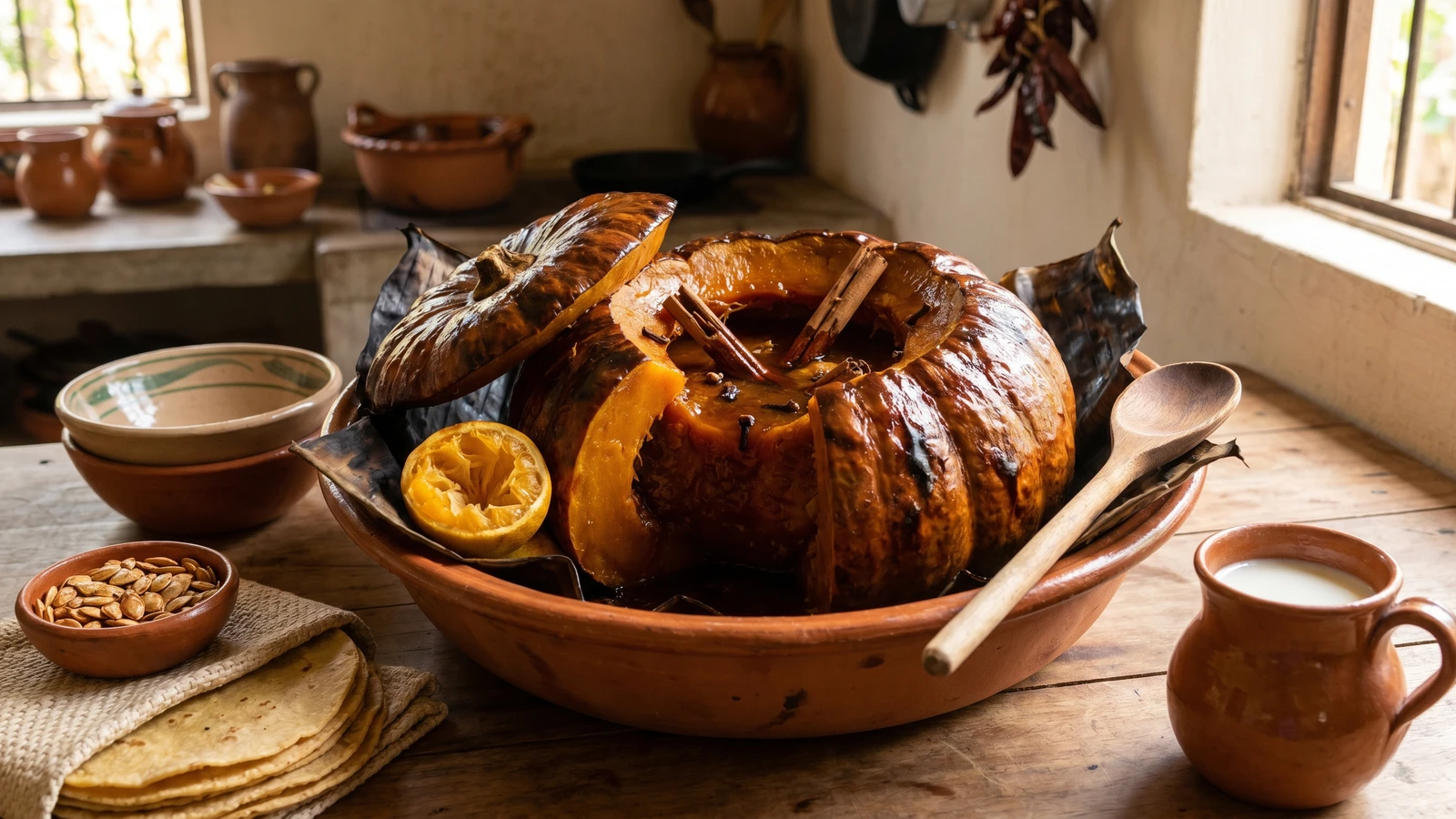
Yucatan's calabaza de Castilla buried in the pib after the cochinita comes out, slow-cooked in piloncillo, canela, and naranja agria until the embers and the banana leaf finish the work the Maya cooks intended.
This is a Yucatecan dish. Specifically from the Maya villages of the peninsula where the pib, the underground earth oven, has been the central cooking method for more than a thousand years. Pibinal is what happens in the pit after the cochinita pibil comes out. The earth is still hot. The stones are still glowing. A calabaza de Castilla goes in whole, wrapped in banana leaf, packed in piloncillo and canela, and it stays there overnight while the family sleeps. By morning, it has melted into itself.
This is not a fall pumpkin dish in the gringo sense. Calabaza de Castilla is a year-round crop in Yucatan, and pibinal is the Maya answer to a question gringo cooks never thought to ask: what do you do with the residual heat of a pit oven? You do not waste it. You make dessert. The same fire that cooked the cochinita cooks the calabaza, and by the time the village wakes up to eat the cochinita for breakfast, the calabaza is ready for the children. Nothing in this kitchen is wasted. Nothing.
My mother never made pibinal. She was from Jalisco, and Jalisco has no pib tradition. The first time I tasted real pibinal was in Pisté, a small village near Chichén Itzá, in the kitchen of a Maya señora named Doña Felipa who let me sit in her yard while her son dug into the pib at dawn. She handed me a piece on a piece of banana leaf with cold raw milk in a clay jarro. I have been chasing that taste for fifteen years. Pregúntale a las señoras del mercado, and they will tell you the pib does things a stove cannot. They are right. But you can come close at home, and coming close is enough to teach you why this dish belongs to the Maya and not to anyone else.
The pib (also called píib or píibil) is a pre-Columbian Maya cooking method documented archaeologically across the Yucatan peninsula for more than two thousand years, predating Spanish contact by centuries. Calabaza de Castilla, despite the name suggesting Spanish origin, refers to the Cucurbita moschata varieties that were domesticated in Mesoamerica around 8,000 years ago and were one of the original 'three sisters' alongside corn and beans in Maya agriculture; the Castilla designation was attached later as a market name. The pairing of pit-roasted squash with piloncillo and canela reflects the post-conquest layering of Old World sugarcane and cinnamon onto an indigenous slow-cooking technique, and pibinal as a named dish appears in 19th-century Yucatecan cookery references as the customary breakfast sweet served alongside cochinita pibil at village celebrations.
Quantity
1 (about 5 to 6 pounds)
the deep-orange field pumpkin with thick ridged skin
Quantity
1 pound
chopped (or substitute dark brown sugar with molasses)
Quantity
2 sticks
broken in half
Quantity
4
Quantity
1
used in some Valladolid kitchens
Quantity
1
halved; if using sweet orange, add the juice of 1 lime
Quantity
2
passed over an open flame until pliable and dark green
Quantity
1 tablespoon
for greasing
Quantity
a pinch
Quantity
1 cup
Quantity
for serving
Quantity
for serving
warmed, the Maya way
| Ingredient | Quantity |
|---|---|
| calabaza de Castillathe deep-orange field pumpkin with thick ridged skin | 1 (about 5 to 6 pounds) |
| piloncillochopped (or substitute dark brown sugar with molasses) | 1 pound |
| Mexican canela (true cinnamon)broken in half | 2 sticks |
| whole cloves | 4 |
| star anise (optional)used in some Valladolid kitchens | 1 |
| naranja agria (Seville sour orange)halved; if using sweet orange, add the juice of 1 lime | 1 |
| banana leavespassed over an open flame until pliable and dark green | 2 |
| manteca de cerdo (pork lard)for greasing | 1 tablespoon |
| sea salt | a pinch |
| water | 1 cup |
| leche bronca (raw whole milk) or thick crema (optional) | for serving |
| hand-pressed corn tortillas (optional)warmed, the Maya way | for serving |
The pib is the Maya underground oven. Stones heated for hours in a pit of hardwood embers, the cochinita pibil lowered in wrapped in banana leaves and buried under earth for half a day. When the pig comes out, the pit still holds enormous heat, and the calabaza goes in to finish overnight in the dying embers. That is pibinal: what the pib makes after the meat is gone. If you have a backyard, hardwood, and patience, build the pib. If you do not, your home oven set very low will mimic the residual heat. It will not be the same. I will not pretend it is. But it will teach you the dish.
Wash the calabaza de Castilla and pat it dry. Cut a circle around the stem like you would for a Maya version of a jack-o-lantern, lifting off a lid about four inches across. Scoop out the seeds and the stringy interior with a spoon. Save the seeds. Toasted with salt, they are pepitas, and they cost nothing. Rub the inside cavity with a thin layer of manteca and a pinch of salt.
In a small clay olla or saucepan, combine the chopped piloncillo, canela, cloves, star anise if using, the cup of water, and the juice squeezed from the naranja agria. Drop the spent orange halves in too. Set over medium heat and stir until the piloncillo dissolves completely. Simmer for ten minutes until it thickens slightly into a dark, fragrant syrup. The cinnamon will smell warm and woody. The orange will cut the sweetness so it does not flatten on the tongue.
Set the prepared calabaza upright in a heavy clay cazuela or Dutch oven lined with one of the banana leaves. Pour the piloncillo syrup into the cavity, spices and orange halves and all. Replace the cut lid. Drape the second banana leaf over the top and tuck it down around the sides. The banana leaf is not decoration. It holds the moisture and gives the calabaza the faint green-grass flavor that pib cooking leaves behind. Without it, you have baked pumpkin. With it, you start to have pibinal.
Heat your oven to 300F. Place the cazuela on the middle rack and roast for three to three and a half hours. Do not open the oven for the first two hours. You are imitating the buried heat of the pib, which once sealed does not get opened until the cook decides. After two hours, check. The skin should be deeply darkened, almost mahogany in places. The flesh through the lid should yield easily to a wooden skewer. If it still has resistance, give it another thirty minutes.
Pull the cazuela from the oven and let the calabaza rest, covered with its banana leaf, for at least twenty minutes. The syrup inside will continue to be absorbed by the flesh as it cools. Skip this rest and you lose the layer of dark, spice-stained sweetness that should soak into the meat of the squash. La cocina no es decoracion, es trabajo, and resting is part of the work.
Lift the calabaza onto a serving platter, banana leaf and all. At the table, scoop the soft, dark-orange flesh out with a spoon, taking some of the syrup pooled in the cavity with each portion. Spoon it into small clay bowls. Pour cold leche bronca or a drizzle of thick crema over the top. The contrast of the warm caramelized squash and the cold dairy is how it has been eaten in Yucatecan villages for generations. Asi se hace y punto.
1 serving (about 280g)
Culinary guides, cultural storytelling, and the editorial depth that makes cooking meaningful.
Discover Culinary ExplorerChef Lupita
Oaxaca's red rice, stained with tomato and fried in lard, steamed with carrots, ejotes, black beans, and epazote. The side that anchors a Oaxacan family meal and earns its place beside the main.

Chef Lupita
Sinaloa's home-cook white rice topped with cold cubes of cream cheese that soften into the warm grain, finished with crema and a sprinkle of chiltepin at the table. The trick that makes a side dish feel like a small luxury.

Chef Lupita
Sonora's white rice, toasted in butter and steamed with sweet corn and tender peas. The clean, quiet partner to a plate of carne asada, not the red rice of central Mexico.

Chef Lupita
Yucatán's white rice with sweet corn kernels, toasted in lard with garlic and onion. The quiet base that holds up against the peninsula's bold achiote-stained stews.