
Chef Juliette
Omelette à l’Écossaise
A creamy omelette aux fines herbes closes around smoked-salmon-wrapped herring milts, gently poached in butter. Have the filling ready, then roll the eggs while they still shine.
A cooking platform built around craft, culture, and the stories behind what we eat.
Created by Chef Juliette
Based on No. 516, Omelet with Kidneys, from Le Guide Culinaire (1907) by Auguste Escoffier
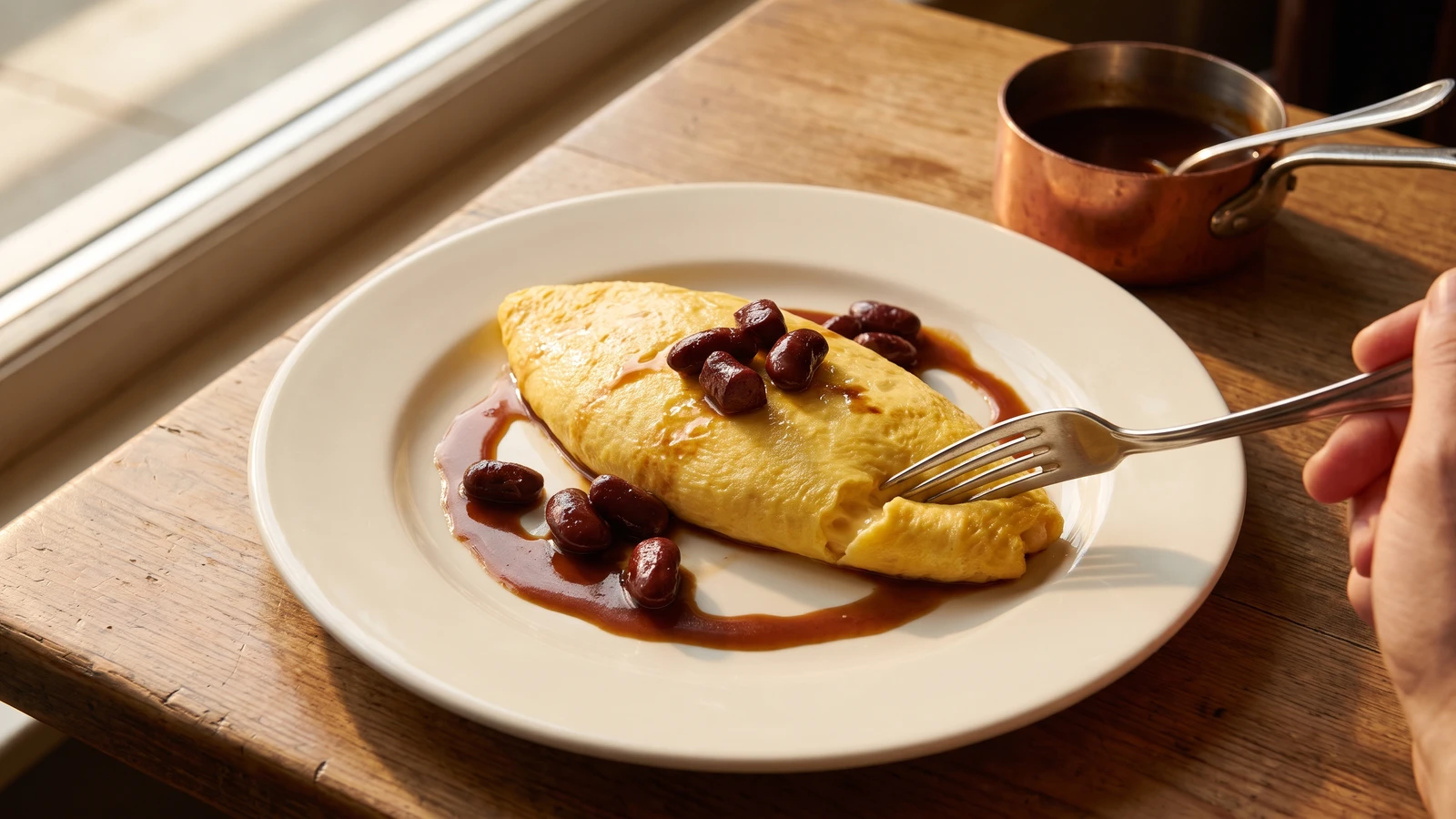
Omelette aux rognons folds tender, butter-sautéed kidney into soft eggs, then opens along the top for a second spoonful and a fine ring of demi-glace, a lesson in timing two quick pans together.
Omelette aux rognons (omelet with kidneys) teaches coordination. The kidney must brown before it tightens, the eggs must fold while still tender, and the demi-glace, the classical reduced brown sauce called half-glaze in the source, must arrive at ribbon consistency. The one true thing to know before touching a pan is that none of these waits for you. Trim, dice, portion, and warm first; once the butter foams, you cook without errands.
The original assumed a saucier on staff, demi-glace drawn from a stockpot never off the fire, and hands to turn out omelettes one by one. At home, good prepared demi-glace, one small saucepan, and one 8-inch skillet are honest equivalents. The source calls for no salamander, so the broiler stays off. Brigade service becomes four individual three-egg omelettes, preserving its modest tablespoon of kidney inside each and a smaller reserve for the slit. The endless stockpot and extra hands are scaffolding. The quick sauté, soft fold, split crown, and thread of sauce are the dish.
Done properly, the omelette is butter-gold and tender, the kidney browned but supple, and the demi-glace dark enough to gleam around the plate. Drying the kidney completely is the step that matters most: moisture defeats the sauté before the eggs ever reach the pan.
Omelette aux rognons belongs to Parisian cuisine bourgeoise and the classical dining-room repertoire, where kidneys were served as a supper garnish as naturally as mushrooms or fines herbes. In that repertoire, a small quantity of separately cooked garnish was folded into the eggs and repeated in a slit on top, both an announcement of the filling and a practical flourish for the table. The dish was never confined to breakfast, and its thread of demi-glace was meant to reinforce the kidney without burying the omelette.
Quantity
2 small sheep's kidneys or a 4-ounce portion (115 g after trimming)
membranes and white cores removed, cut into 1/4-inch (6 mm) dice
Quantity
12
Quantity
1/2 cup (120 ml / 130 g)
Quantity
5 tablespoons (75 ml / 70 g)
divided
Quantity
1 teaspoon (5 ml / 6 g)
divided
Quantity
1/2 teaspoon (2.5 ml / 1 g)
divided
| Ingredient | Quantity |
|---|---|
| sheep's kidneys or calf's kidneymembranes and white cores removed, cut into 1/4-inch (6 mm) dice | 2 small sheep's kidneys or a 4-ounce portion (115 g after trimming) |
| large eggs | 12 |
| prepared demi-glace (half-glaze) | 1/2 cup (120 ml / 130 g) |
| unsalted butterdivided | 5 tablespoons (75 ml / 70 g) |
| fine saltdivided | 1 teaspoon (5 ml / 6 g) |
| freshly ground black pepperdivided | 1/2 teaspoon (2.5 ml / 1 g) |
Trim away every membrane and the firm white core from the kidneys, then cut the flesh into even 1/4-inch (6 mm) dice. Pat the dice thoroughly dry. Divide the eggs among four bowls, three eggs per bowl, and set four plates somewhere warm. Heat the demi-glace gently in a small saucepan. It should be nappante, thick enough to coat a spoon yet fluid enough to fall in a narrow ribbon. If it is stiff, whisk in hot water one teaspoon at a time; if it runs like stock, simmer it briefly until it coats. Hold it over the lowest heat without boiling.
Season the dry kidney dice with 1/4 teaspoon of the salt and 1/8 teaspoon of the pepper. Melt 1 tablespoon of the butter in the omelette pan over medium-high heat. When the foam subsides, add the kidney in one uncrowded layer. Leave it against the pan for 30 seconds, then toss briskly for 60 to 90 seconds, until the edges are browned and the centers have just lost their raw redness. The largest pieces should reach 160°F (71°C). If liquid floods the pan, lift the kidney out at once, boil the liquid away, add a small piece of the measured butter, and return the dice for 15 seconds. Ça se rattrape. Cooking them in that puddle would only make them tough.
Lower the heat and add 2 tablespoons (30 ml) of the warm demi-glace to the kidneys. Toss for about 10 seconds, only until every dice is glossed and the sauce coheres around it. Transfer the mixture to a warm bowl. Cover and reserve one-third for the split crowns of the omelettes; divide the remainder visually into four equal spoonfuls for the fillings.
Work one omelette at a time. Beat the first three eggs with one-fourth of the remaining salt and pepper, stopping as soon as yolks and whites are joined. Wipe the pan, set it over medium-high heat, and add 1 tablespoon of butter. When it foams, pour in the eggs. Shake the pan while stirring in tight circles for 15 to 20 seconds, forming small tender curds beneath a still-fluid surface, then spread them evenly. If the eggs set too quickly, lift the pan off the heat and keep them moving until the heat settles. While the top remains moist, place one portion of the bound kidney across the center. Fold the near third over the filling, tip the pan, and roll the omelette onto a warm plate, seam-side down. A small tear is not a disaster: shape the omelette gently through a clean towel, and its filled slit will finish the presentation.
Use the tip of a sharp knife to divide the omelette lengthwise down the middle, cutting through the upper skin without piercing the base. Ease the opening apart and spoon one-fourth of the reserved kidney dice into the interspace. Draw about 1 1/2 tablespoons (22 ml) of warm demi-glace around the omelette in a fine thread, not over its tender surface. Repeat with the remaining eggs, butter, filling, and plates, serving each omelette as it leaves the pan. À table!
1 serving (about 205g)
Culinary guides, cultural storytelling, and the editorial depth that makes cooking meaningful.
Discover Culinary ExplorerChef Juliette
A creamy omelette aux fines herbes closes around smoked-salmon-wrapped herring milts, gently poached in butter. Have the filling ready, then roll the eggs while they still shine.

Chef Juliette
Four tender herbs, hot butter, and two eggs per pan: this rolled omelette teaches the quick hand and good judgment that keep the outside pale and the center creamy.

Chef Juliette
Four batters, one lesson: let the flour drink deeply before cooking, then spread the batter thinly in butter for crêpes and pannequets that bend without becoming tough.

Chef Juliette
Crêpes au Couvent trap ripe Williams pear dice between two thin pours of sweet batter, then turn in one clean toss and reach the table butter-gold, powdered, and burning hot.