
Chef Juliette
Omelette à l’Écossaise
A creamy omelette aux fines herbes closes around smoked-salmon-wrapped herring milts, gently poached in butter. Have the filling ready, then roll the eggs while they still shine.
A cooking platform built around craft, culture, and the stories behind what we eat.
Created by Chef Juliette
Based on No. 507, Omelet à la Lyonnaise, from Le Guide Culinaire (1907) by Auguste Escoffier
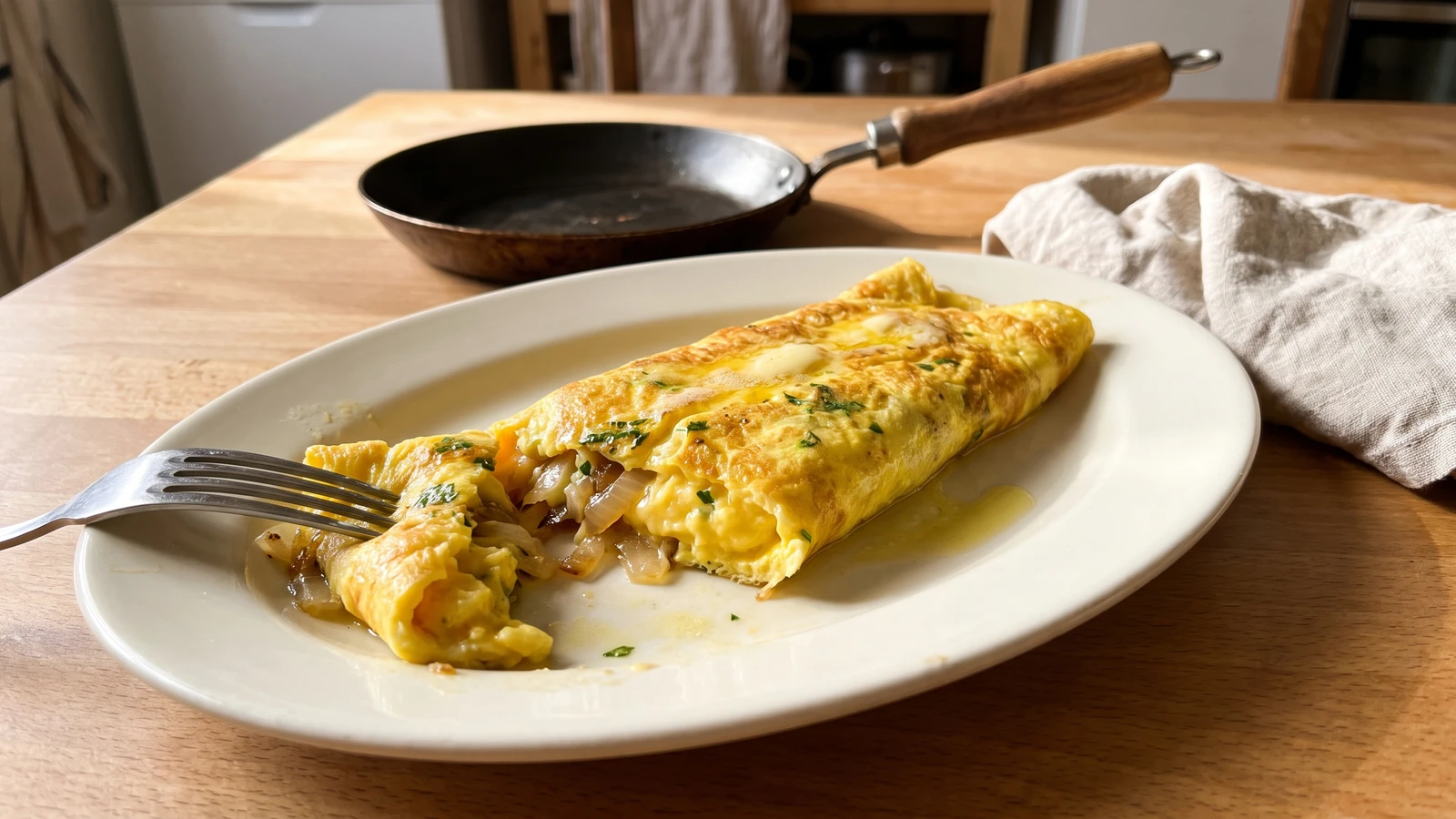
Butter-browned onion, parsley-flecked eggs, and a tender fold: Omelet à la Lyonnaise proves that the simplest pan work can carry Lyon's appetite, provided the onions color and the eggs remain soft.
Omelet à la Lyonnaise (Lyon-style omelet) teaches a useful truth: the filling must finish cooking before the eggs begin. The onion goes into butter first and stays there until tender and lightly browned, because once the eggs enter the pan, the onion's cooking is over. Parsley beaten through the eggs brings freshness without turning the dish into a garden.
The old entry assumed a practiced hand and a seasoned omelet pan kept ready for orders. It needed no saucier, stockpot, or salamander, and none belongs in the home translation; that brigade scaffolding would only bury a spare dish. For four people, make two four-egg omelets in a 25 cm skillet rather than one unwieldy eight-egg slab. The service size changed so the centers stay tender, but the book's onion, butter, parsley, and sequence remain intact. One cook, one stove, one evening.
The eggs should leave the pan softly set, with a pale butter sheen and browned onion tucked through the folds. If the heat races, lift the pan and keep stirring until it calms. The deciding step still comes first: brown the minced onion gently until fully tender and only freckled with gold before the eggs touch it.
Omelet à la Lyonnaise belongs to the classical family of dishes marked à la lyonnaise, preparations identified by onion, a flavor deeply at home in Lyon's bouchons and bourgeois kitchens. In this egg version, the onion is minced and browned lightly in butter while parsley is beaten through the eggs, more restrained than the sliced-onion garnishes served with meats or potatoes. Its passage into the grand repertoire preserved that plain home-pan logic: no cheese, cream, or sauce belongs between the folds.
Quantity
8
Quantity
1/2 medium (about 1/2 cup / 75 g)
finely minced
Quantity
3 tablespoons (45 ml / 42 g)
divided
Quantity
2 tablespoons (30 ml / 8 g)
finely chopped
Quantity
3/4 teaspoon (3.75 ml / 4 g)
divided
| Ingredient | Quantity |
|---|---|
| large eggs | 8 |
| medium yellow onionfinely minced | 1/2 medium (about 1/2 cup / 75 g) |
| unsalted butterdivided | 3 tablespoons (45 ml / 42 g) |
| flat-leaf parsleyfinely chopped | 2 tablespoons (30 ml / 8 g) |
| fine saltdivided | 3/4 teaspoon (3.75 ml / 4 g) |
Divide the eggs between two bowls, four eggs in each. Divide the parsley and 1/2 teaspoon of the salt between them, reserving the remaining salt for the onion. Beat each mixture only until the whites and yolks become one even color. Don't whip in a cap of foam; an omelet needs supple curds, not trapped air.
Melt 1 tablespoon of the butter in a 25 cm (10-inch) omelet pan or skillet over medium-low heat. Add the onion and reserved salt, then cook for 7 to 9 minutes, stirring often, until every piece is tender and lightly freckled with brown. Slightly browned is the instruction, not darkly caramelized. If the edges color while the centers remain raw, lift the pan from the heat and stir for 30 seconds before continuing over a gentler flame. A fine fond, the browned film on the pan floor, may form; leave it because the eggs should take up its flavor. Transfer half the onion to a small bowl and leave the rest in the pan.
Raise the heat to medium and add 1 tablespoon of butter to the onion in the pan. As soon as the butter foams, pour in the first bowl of eggs. Shake the pan while stirring in tight circles with a flexible spatula, drawing the set egg from the edges toward the loose center. Stop after 30 to 45 seconds, when the curds are small and creamy but the surface still flows slowly. If the rim begins to seize while the center is loose, take the pan off the heat and keep stirring. Ça se rattrape. Return it only when the cooking has slowed.
Spread the curds into an even layer and leave them undisturbed for 15 to 30 seconds, just until the underside holds together while the top keeps a moist sheen. Tilt the pan away from you, fold the far third toward the center, then bring the near third over it. Roll the omelet onto a warm plate with the seam underneath. If the skin tears, tuck the torn edge inward with the spatula and turn it seam-side down. The shape returns, the flavor never left, and you never apologize at your own table.
Wipe away any dark specks without scrubbing off the pan's seasoning. Add the final tablespoon of butter, the reserved onion, and the second egg mixture, then cook and fold it in the same way. The first omelet can wait loosely covered on its warm plate for the few minutes this takes, but no longer; residual heat continues setting the center. Cut each omelet in half and serve at once, while the folds are tender and the parsley still smells fresh. À table!
1 serving (about 120g)
Culinary guides, cultural storytelling, and the editorial depth that makes cooking meaningful.
Discover Culinary ExplorerChef Juliette
A creamy omelette aux fines herbes closes around smoked-salmon-wrapped herring milts, gently poached in butter. Have the filling ready, then roll the eggs while they still shine.

Chef Juliette
Four tender herbs, hot butter, and two eggs per pan: this rolled omelette teaches the quick hand and good judgment that keep the outside pale and the center creamy.

Chef Juliette
Four batters, one lesson: let the flour drink deeply before cooking, then spread the batter thinly in butter for crêpes and pannequets that bend without becoming tough.

Chef Juliette
Crêpes au Couvent trap ripe Williams pear dice between two thin pours of sweet batter, then turn in one clean toss and reach the table butter-gold, powdered, and burning hot.