
Chef Juliette
Omelette à l’Écossaise
A creamy omelette aux fines herbes closes around smoked-salmon-wrapped herring milts, gently poached in butter. Have the filling ready, then roll the eggs while they still shine.
A cooking platform built around craft, culture, and the stories behind what we eat.
Created by Chef Juliette
Based on No. 503, Omelet with Vegetable Marrow Flowers, from Le Guide Culinaire (1907) by Auguste Escoffier
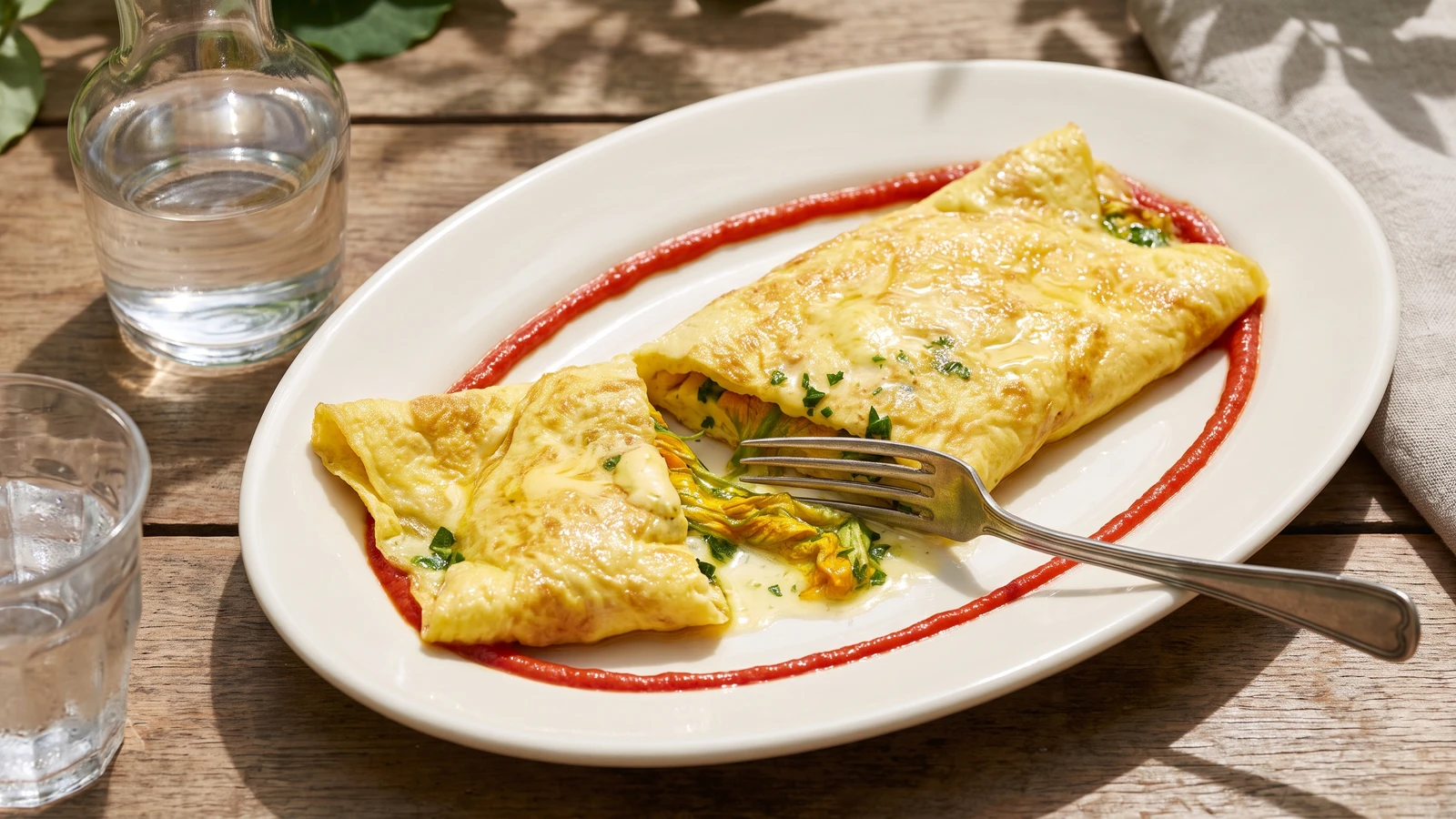
Young squash flowers, cut cisel and stewed gently in butter, turn a tender French omelette into summer supper, with parsley inside and a fine ring of tomato sauce around it.
Omelette aux fleurs de courgette (omelet with vegetable marrow flowers) teaches one true thing: the blossoms must surrender their water before they meet the eggs. Stewed gently, they become tender, faintly sweet ribbons; left raw, they leak into the omelette and turn its soft curd watery.
The source entry assumes a saucier has smooth tomato sauce waiting beside the stove and an omelette cook can move without pause. At home, warm a modest amount of finished sauce first, then make two four-egg omelettes in an ordinary skillet. The classical proportion is kept, with 1½ ounces of flower cups for six eggs becoming 2 ounces for eight. The separate sauce station is brigade scaffolding and can go; the cisel, the buttery stewing, the tender fold, and the thread of tomato sauce are the dish itself. One cook, one stove, one evening.
Cisel, the source's crosswise fine slicing, lets the delicate cups cook evenly without disappearing into paste. Stew that cisel until the pan is dry and the flowers shine with butter. This is the step that decides the omelette, so don't hurry it.
Squash blossoms belong to the summer larder of Mediterranean France, particularly Provence and the country around Nice, where cooks fry, stuff, and fold them into egg dishes while the flowers are newly opened. The classical kitchen carried that garden ingredient into its omelette repertoire, cutting the flower cups cisel and enclosing them in softly set eggs before marking the plate with tomato sauce. Unlike beignets de fleurs de courgette, these blossoms are neither battered nor stuffed, so their delicate green sweetness remains the center of the dish.
Quantity
8
Quantity
About 12 flowers (2 loosely packed cups / 57 g)
stems and stamens or pistils removed
Quantity
4 tablespoons (60 ml / 56 g)
divided; mild olive oil may replace it measure for measure
Quantity
2 teaspoons (10 ml / 3 g)
finely chopped
Quantity
⅓ cup (80 ml / 85 g)
Quantity
¾ teaspoon (3.75 ml / 4.5 g)
divided
Quantity
¼ teaspoon (1.25 ml / 0.6 g)
| Ingredient | Quantity |
|---|---|
| large eggs | 8 |
| young vegetable marrow or courgette flower cupsstems and stamens or pistils removed | About 12 flowers (2 loosely packed cups / 57 g) |
| unsalted butterdivided; mild olive oil may replace it measure for measure | 4 tablespoons (60 ml / 56 g) |
| flat-leaf parsleyfinely chopped | 2 teaspoons (10 ml / 3 g) |
| smooth finished tomato sauce | ⅓ cup (80 ml / 85 g) |
| fine sea saltdivided | ¾ teaspoon (3.75 ml / 4.5 g) |
| freshly ground black pepper | ¼ teaspoon (1.25 ml / 0.6 g) |
Put the finished tomato sauce in the smallest saucepan you have and warm it over low heat until it flows readily from a spoon and carries a gentle gloss. Don't let it boil or reduce; the source asks for a thread around the omelette, not a heavy pool beneath it. Cover and set it off the heat while you cook the flowers.
Open each flower gently and check inside for grit or insects. Rinse only if necessary, then dry thoroughly. Remove the stem and the central stamen or pistil while keeping the tender flower cup intact. Stack the cups loosely and cisel them crosswise into ribbons about ¼ inch (6 mm) wide; don't press them into a tight bundle, or the petals bruise and clump.
Melt 2 tablespoons (30 ml / 28 g) butter in a small sauté pan over medium-low heat. Add the cisel and ¼ teaspoon (1.25 ml / 1.5 g) salt, cover, and cook for 2 minutes so the flowers collapse in their own moisture. Uncover and continue gently for 3 to 5 minutes, stirring, until the liquid has disappeared and the ribbons look glossy rather than wet. Stir in the parsley for the final 30 seconds. If liquid pools in the pan, keep cooking uncovered before proceeding; if the flowers begin to catch, lower the heat and add a teaspoon of water. Ça se rattrape. Transfer them to a plate and let them cool until no longer hot.
Crack 4 eggs into a bowl and add half the stewed flowers, ¼ teaspoon (1.25 ml / 1.5 g) salt, and half the pepper. Beat with a fork just until the whites and yolks lose their separate streaks. Don't whip in a crown of bubbles; an omelette wants a close, tender curd, not a sponge. Keep the remaining flowers ready for the second batch.
Heat a 10-inch (25 cm) nonstick or well-seasoned skillet over medium heat and melt 1 tablespoon (15 ml / 14 g) butter until it foams. Pour in the egg mixture, then stir briskly with a heatproof spatula while shaking the pan until small, moist curds form. Stop stirring while the surface is still softly unset, smooth the eggs into an even layer, and fold the omelette into thirds. It should remain blond outside, with no liquid raw egg inside. If the curds firm too quickly, lift the skillet from the heat and finish folding as the pan cools; if the fold tears, tuck the split underneath when you turn it out. Never apologize at your own table.
Turn the first omelette seam-side down onto a warm oval platter. Repeat with the remaining 4 eggs, stewed flowers, salt, pepper, and 1 tablespoon (15 ml / 14 g) butter. Arrange the second omelette beside the first, then spoon the warm tomato sauce in one fine, continuous thread around them, leaving their butter-gold surfaces uncovered. Cut each omelette in half at the table and serve at once. À table!
1 serving (about 135g)
Culinary guides, cultural storytelling, and the editorial depth that makes cooking meaningful.
Discover Culinary ExplorerChef Juliette
A creamy omelette aux fines herbes closes around smoked-salmon-wrapped herring milts, gently poached in butter. Have the filling ready, then roll the eggs while they still shine.

Chef Juliette
Four tender herbs, hot butter, and two eggs per pan: this rolled omelette teaches the quick hand and good judgment that keep the outside pale and the center creamy.

Chef Juliette
Four batters, one lesson: let the flour drink deeply before cooking, then spread the batter thinly in butter for crêpes and pannequets that bend without becoming tough.

Chef Juliette
Crêpes au Couvent trap ripe Williams pear dice between two thin pours of sweet batter, then turn in one clean toss and reach the table butter-gold, powdered, and burning hot.