
Chef Juliette
Omelette à l’Écossaise
A creamy omelette aux fines herbes closes around smoked-salmon-wrapped herring milts, gently poached in butter. Have the filling ready, then roll the eggs while they still shine.
A cooking platform built around craft, culture, and the stories behind what we eat.
Created by Chef Juliette
Based on No. 432, Poached Eggs with Red Wine, from Le Guide Culinaire (1907) by Auguste Escoffier
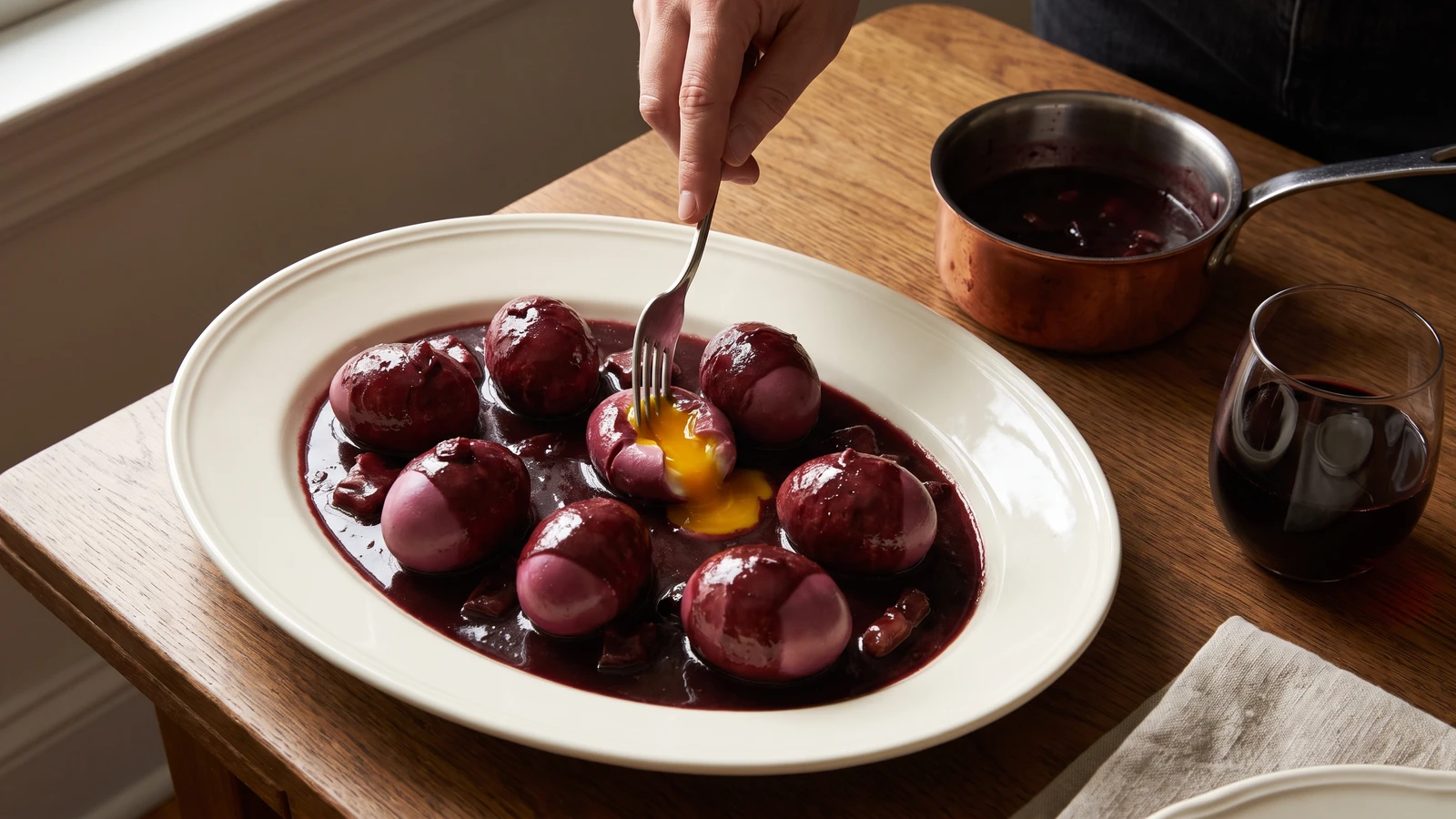
Wine does double duty in Œufs au vin rouge: it poaches the eggs, then becomes Sauce Bordelaise (No. 32), coating butter-fried rusks before one fierce, fast glaze.
Œufs au vin rouge (poached eggs with red wine) teaches one economical truth: the wine is not a bath to throw away. It poaches the eggs, then returns as the foundation for Sauce Bordelaise (No. 32), coating crisp butter-fried rusks and tender yolks. One liquid does two jobs, and the dish tastes composed because of it.
The original entry assumed a saucier on staff, a stock never off the fire, molded oval rusks ready for service, and a salamander for the final flash of heat. At home, you prepare the referenced sauce with the strained poaching wine, shape day-old bread with a knife, and use the broiler. Separate hands and instant service are brigade scaffolding, so they can go. The wine poach, the butter-fried rusk, the Bordelaise, and glacer, the quick top-heat glazing, must stay. One cook, one stove, one evening.
When it lands correctly, each egg sits on a crisp golden raft beneath a wine-dark gloss, and the first cut releases yolk into the sauce. Keep the wine below a boil. That gentle poach is the step that decides whether the whites turn supple or ragged, so give it your full attention before anything meets the pan.
Œufs au vin rouge belongs to the egg course of the French classical table, and its use of Sauce Bordelaise (No. 32) ties it to Bordeaux’s red-wine and marrow sauce tradition rather than to a single provincial breakfast custom. It is often confused with Burgundy’s œufs en meurette, but they are cousins, not aliases: meurette commonly carries lardons, mushrooms, little onions, and croûtons. This codified preparation is sparer, placing each egg on a hollowed butter-fried oval rusk, coating it with Bordelaise, and finishing it under fierce top heat.
Quantity
8
Quantity
1 bottle, 3⅛ cups (750 ml / about 745 g)
preferably a supple dry Bordeaux
Quantity
1½ cups (360 ml / about 370 g) Sauce Bordelaise (No. 32)
prepared according to its own entry with the reserved poaching wine
Quantity
8 slices (about 8 oz / 225 g)
cut ½ inch (1.25 cm) thick
Quantity
6 tablespoons (90 ml / 85 g)
Quantity
½ teaspoon (2.5 ml / 3 g)
divided
| Ingredient | Quantity |
|---|---|
| very fresh large eggs | 8 |
| dry red winepreferably a supple dry Bordeaux | 1 bottle, 3⅛ cups (750 ml / about 745 g) |
| finished Sauce Bordelaise (No. 32)prepared according to its own entry with the reserved poaching wine | 1½ cups (360 ml / about 370 g) Sauce Bordelaise (No. 32) |
| day-old pain de mie or firm white sandwich breadcut ½ inch (1.25 cm) thick | 8 slices (about 8 oz / 225 g) |
| unsalted butter | 6 tablespoons (90 ml / 85 g) |
| fine saltdivided | ½ teaspoon (2.5 ml / 3 g) |
Heat the oven to 300°F (150°C). Trim the bread into eight ovals about 4 inches (10 cm) long, then press a shallow hollow into each center with the back of a spoon without breaking through the base. Dry them on a rack in the oven for 8 to 10 minutes per side, until firm but not colored. Melt one-third of the butter in a skillet over medium heat and fry the rusks in batches, adding fresh butter as needed, until both faces are evenly golden and crisp. Drain them on a rack, hollow side up. The drying gives the bread enough backbone to carry egg and sauce; soft bread simply collapses.
Pour the wine into a narrow 2½-quart (2.4-liter) saucepan and bring it to a bare tremble over medium-low heat, with an occasional small bubble but no rolling boil. Crack each egg into a ramekin, then slip two or three at a time into the wine. Spoon wine gently over any exposed white and poach for 3 to 3½ minutes, until the whites hold together while the yolks remain yielding. Lift each egg with a slotted spoon and place it directly into ice water to stop the cooking. If the whites feather, the wine is too hot. Pull the pan from the heat for thirty seconds, gather the loose white toward the yolk with a spoon, and trim untidy strands after lifting. Ça se rattrape.
Strain the poaching wine through a fine sieve. Measure the amount of wine called for in the separate entry and use this strained liquid when preparing Sauce Bordelaise (No. 32) exactly according to that recipe. Hold 1½ cups (360 ml) warm for serving. The finished sauce should coat the back of a spoon and still flow freely. If it tightens while waiting, stir in hot water one teaspoon at a time; if it remains loose, simmer it gently a little longer.
Set the broiler to high and place its rack 4 to 5 inches (10 to 13 cm) below the element. Bring a wide pan of fresh water to about 175°F (80°C), hot but not simmering. Slip the chilled eggs into it for 45 to 60 seconds, just until warmed through, then lift and blot them carefully on a clean towel. Water left on the whites thins the sauce, so dry them with patience. Arrange the rusks hollow side up on a broiler-safe oval platter, settle one egg onto each, and season lightly with the salt.
Spoon about 3 tablespoons (45 ml) of hot Sauce Bordelaise (No. 32) over each egg, coating the white and allowing a little sauce to pool around the rusk. If the sauce slips away, lift the egg, blot it once more, and recoat it. Place the platter under the broiler for 20 to 40 seconds, just until the sauce catches a taut shine and quivers at the edges. Do not wait for browning; glacer means a polished surface, not a gratin, and another minute would harden the yolks. Bring the platter straight to the table. À table!
1 serving (about 270g)
Culinary guides, cultural storytelling, and the editorial depth that makes cooking meaningful.
Discover Culinary ExplorerChef Juliette
A creamy omelette aux fines herbes closes around smoked-salmon-wrapped herring milts, gently poached in butter. Have the filling ready, then roll the eggs while they still shine.

Chef Juliette
Four tender herbs, hot butter, and two eggs per pan: this rolled omelette teaches the quick hand and good judgment that keep the outside pale and the center creamy.

Chef Juliette
Four batters, one lesson: let the flour drink deeply before cooking, then spread the batter thinly in butter for crêpes and pannequets that bend without becoming tough.

Chef Juliette
Crêpes au Couvent trap ripe Williams pear dice between two thin pours of sweet batter, then turn in one clean toss and reach the table butter-gold, powdered, and burning hot.