
Chef Juliette
Mayonnaise de Volaille
Cold roast chicken, ciseled lettuce, and a shining coat of homemade mayonnaise, arranged with capers, olives, anchovies, eggs, and lettuce hearts, then tossed at the table as the canon intends.
A cooking platform built around craft, culture, and the stories behind what we eat.
Created by Chef Juliette
Based on No. 312, Artichokes à la Grecque, from Le Guide Culinaire (1907) by Auguste Escoffier
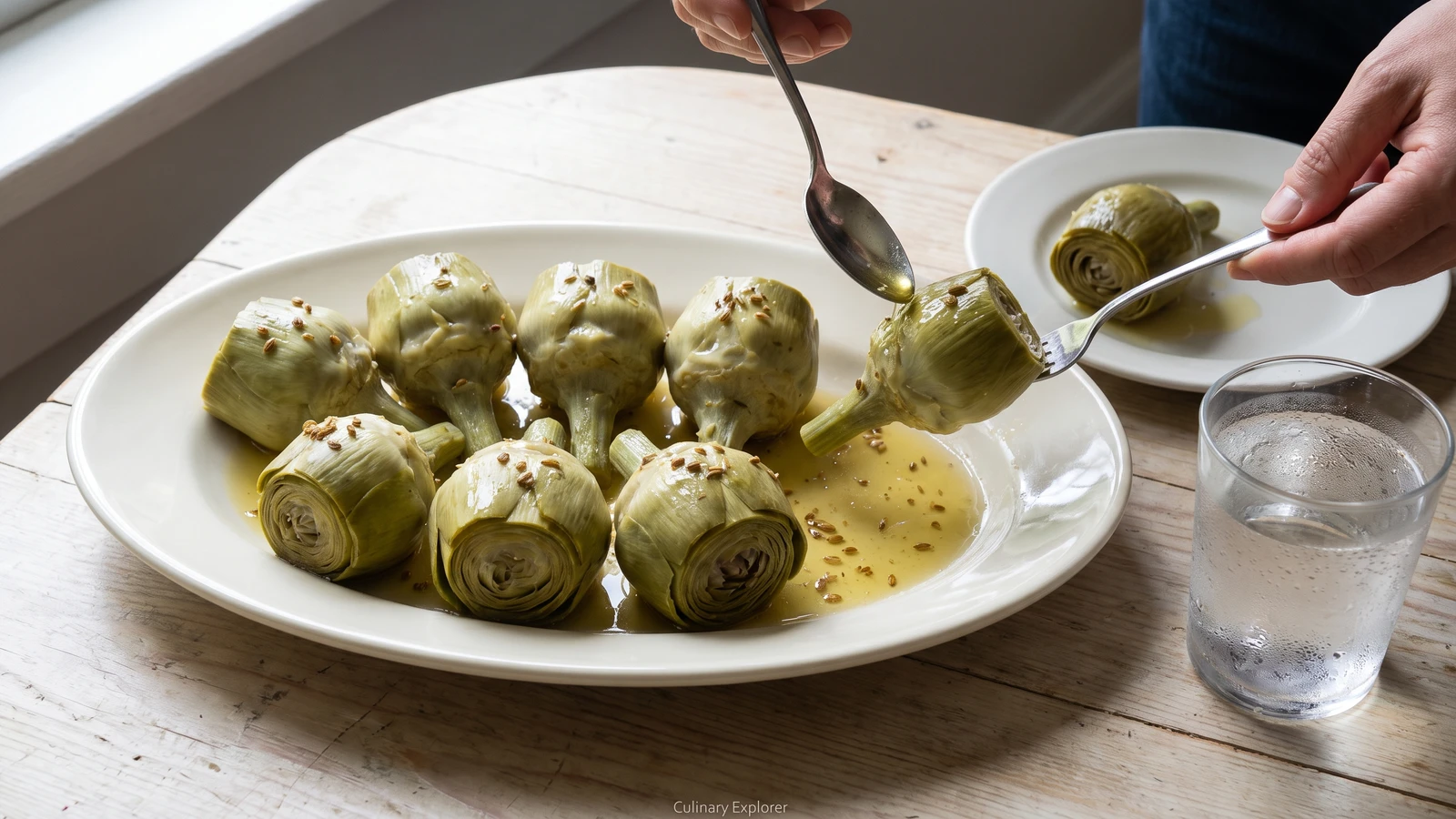
Artichauts à la grecque prove that the cooking liquor can be the salad: tender little artichokes, olive oil, lemon, coriander, and fennel, chilled until every leaf has taken the bright, spiced marinade.
Artichauts à la grecque (small artichokes cooked and chilled in a lemon-spice liquor) teaches one useful truth: sometimes the cooking liquor is the dressing. The artichokes aren't boiled and decorated afterward. They finish in water, olive oil, lemon, coriander, fennel, pepper, thyme, and bay, then cool in that same fragrant mixture. Drain it away and you have drained away the dish.
The source formula assumed twenty little artichokes and the rhythm of a cold-larder station, not a saucier, standing stock, or a salamander. Its brigade assumption was volume and extra hands. For your table, the quantity becomes eight artichokes in one nonreactive saucepan, and the lemon is measured by volume because fruit varies. The four-to-one proportion of water to oil, the flavorings, and the parboil, refresh, and 20-minute simmer remain untouched. Large tubs are scaffolding; a bowl and a fine sieve replace them. One cook, one stove, one evening.
Do not rush the cold rest. The artichokes need at least four hours in their liquor, and overnight is better, before the lemon and spices taste as though they belong inside every leaf. That chilling in the cooking liquor is the step that matters most.
Artichauts à la grecque belong to the Parisian classical hors-d'œuvre repertoire, where small vegetables were organized into named preparations and served cold at the opening of a meal. Despite the name, à la grecque does not identify a Greek national recipe; in French culinary grammar it means vegetables cooked with oil, acid, coriander, and aromatics, then cooled in their liquor. Its make-ahead ease carried the method from formal cold-larder service to bistro and home tables, where mushrooms, leeks, and cauliflower receive the same treatment.
Quantity
8 (about 1½ lb / 680 g)
each 2 to 3 inches (5 to 7.5 cm) wide
Quantity
16 cups (3.8 L / 3.8 kg)
divided between parboiling and refreshing
Quantity
2 tablespoons (30 ml / 31 g)
Quantity
1 cup (240 ml / 240 g)
Quantity
¼ cup (60 ml / 55 g)
Quantity
¼ cup (60 ml / 62 g)
Quantity
¾ teaspoon (3.75 ml / 4 g)
Quantity
1 teaspoon (5 ml / 2 g)
Quantity
½ teaspoon (2.5 ml / 1 g)
Quantity
8 (about 1 g)
Quantity
1 sprig
Quantity
1
| Ingredient | Quantity |
|---|---|
| very small tender globe artichokeseach 2 to 3 inches (5 to 7.5 cm) wide | 8 (about 1½ lb / 680 g) |
| cold waterdivided between parboiling and refreshing | 16 cups (3.8 L / 3.8 kg) |
| fresh lemon juice for the acidulated water | 2 tablespoons (30 ml / 31 g) |
| water for the cooking liquor | 1 cup (240 ml / 240 g) |
| mild extra-virgin olive oil | ¼ cup (60 ml / 55 g) |
| fresh lemon juice for the cooking liquor | ¼ cup (60 ml / 62 g) |
| fine sea salt | ¾ teaspoon (3.75 ml / 4 g) |
| whole coriander seeds | 1 teaspoon (5 ml / 2 g) |
| fennel seeds | ½ teaspoon (2.5 ml / 1 g) |
| whole black peppercorns | 8 (about 1 g) |
| thyme | 1 sprig |
| bay leaf | 1 |
Combine half the cold water with the 2 tablespoons of lemon juice in a 3-quart nonreactive saucepan. Keep it beside the cutting board. Artichoke flesh darkens almost as soon as the knife exposes it, so the acidulated water must be waiting before you begin.
Work on one artichoke at a time. Snap away the darkest, toughest outer leaves until the paler tender leaves appear. Trim the stem to about 1 inch (2.5 cm), pare away its fibrous green skin and tidy the base, then cut about ½ inch (1.25 cm) from the leafy top so the remaining leaves are short and even. Keep the artichoke whole and plunge it immediately into the acidulated water. If a cut surface has already browned, don't discard it. Ça se rattrape: shave away the thinnest possible layer, dip the surface in the lemon water, and carry on.
Set the saucepan over high heat and bring the artichokes and acidulated water to a boil. Lower the heat enough to prevent violent bumping and parboil for 8 to 10 minutes. Drain them, transfer them immediately to a bowl holding the remaining fresh cold water, and leave them until cool. Drain once more in a fine sieve. This refresh stops the first cooking cleanly; the brigade's large tubs are scaffolding, but the cooling itself stays.
Rinse the saucepan, then add the 1 cup water, olive oil, ¼ cup lemon juice, salt, coriander seeds, fennel seeds, peppercorns, thyme, and bay leaf. Bring the mixture to a full boil, stirring once to dissolve the salt. This liquor is not something left behind after cooking. It is the dressing, so taste it now: bright with lemon, plainly seasoned, and fragrant with coriander and fennel.
Lower the refreshed artichokes into the boiling liquor and reduce the heat at once to a gentle simmer. Partially cover the pan and cook for 20 minutes, turning the artichokes carefully every 5 minutes so each side spends time in the shallow liquor. They are ready when a small knife enters the base with little resistance and an inner leaf pulls free without tearing. If they become tender early and the outer leaves begin to loosen, lift them into the serving bowl rather than obeying the clock; let the liquor finish simmering alone, then pour it over them. Ça se rattrape.
Transfer the artichokes and all their cooking liquor to a heatproof bowl. Let them cool uncovered for about 20 minutes, then cover and refrigerate for at least 4 hours, preferably overnight. Turn them once during chilling. This rest is the step that decides the dish: the leaves absorb the seasoned liquor as everything cools, and a merely cooled artichoke will taste dressed only on its surface.
Remove the thyme sprig and bay leaf. Arrange the artichokes on a chilled oval dish, stir the separated liquor back together, and spoon several tablespoons over and around them, carrying a few coriander and fennel seeds onto the plate. Serve very cold as a composed salad or hors-d'œuvre, with the remaining liquor kept around the artichokes for storage. À table!
1 serving (about 140g)
Culinary guides, cultural storytelling, and the editorial depth that makes cooking meaningful.
Discover Culinary ExplorerChef Juliette
Cold roast chicken, ciseled lettuce, and a shining coat of homemade mayonnaise, arranged with capers, olives, anchovies, eggs, and lettuce hearts, then tossed at the table as the canon intends.

Chef Juliette
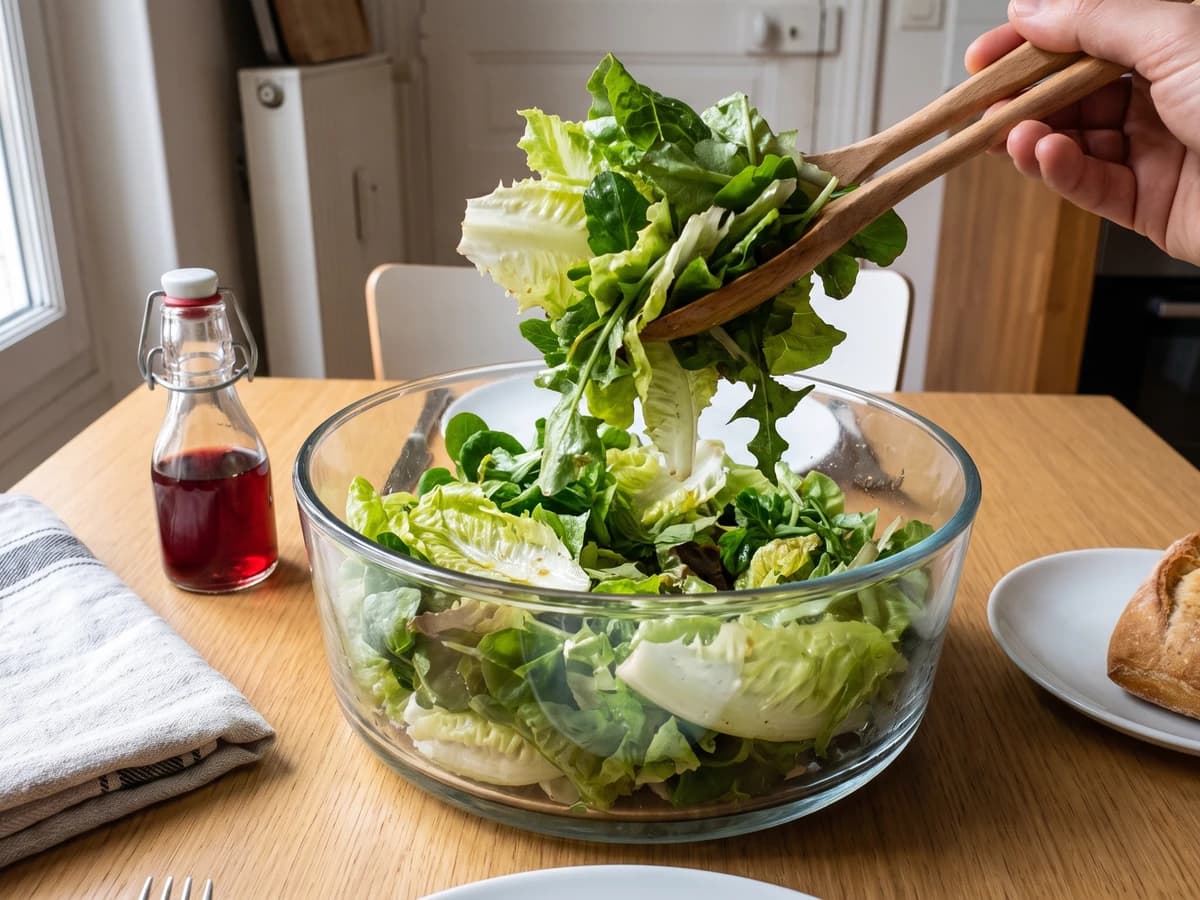
Cold roast or poached chicken with fine ribbons of lettuce, dressed at the final moment with oil and vinegar: a composed salad whose freshness depends entirely on timing.
Chef Juliette
Five leaves, one living rule: laitue, romaine, chicorée, mâche, or pissenlit must be washed, dried, and dressed only as they go to the table, while every leaf still carries its light vinaigrette.
Chef Juliette
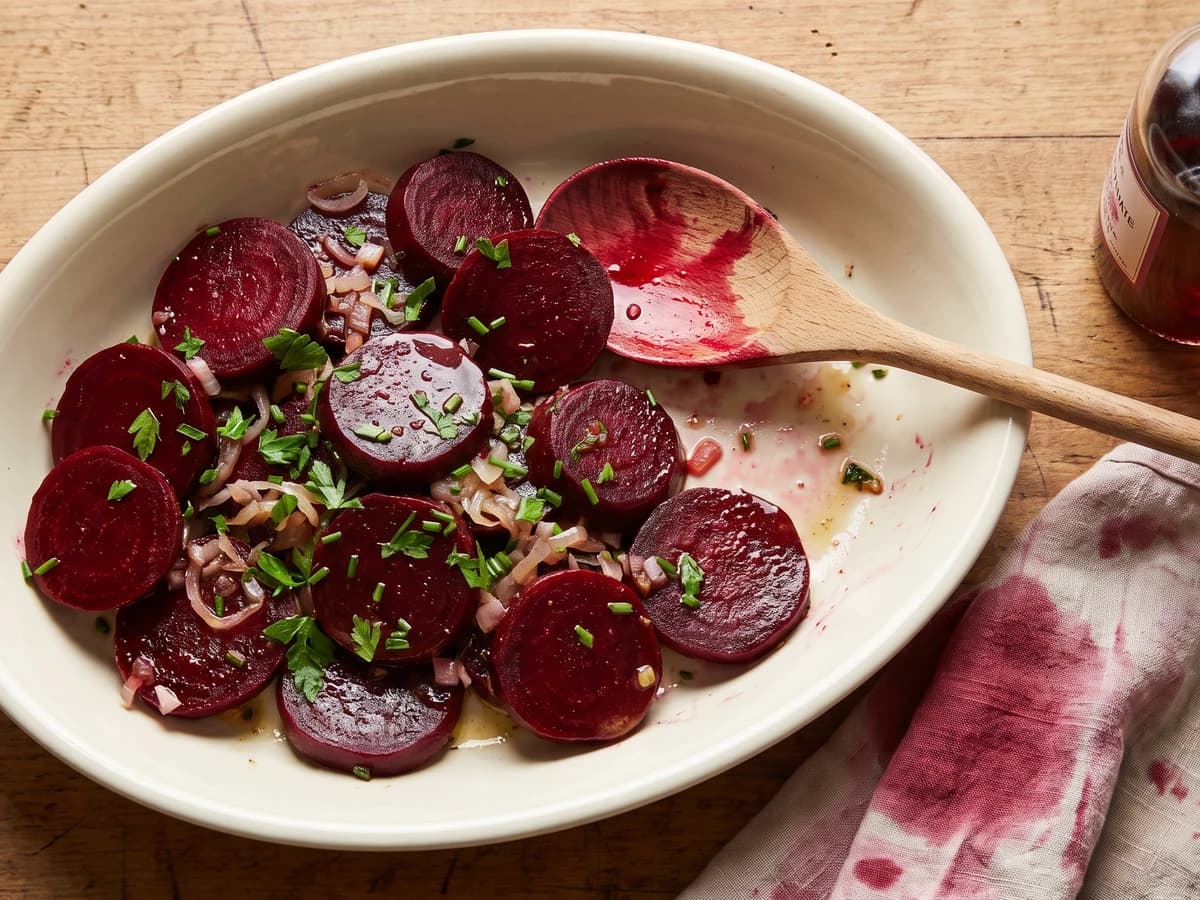
Salade de Betteraves proves that baking, not boiling, is the whole argument: concentrated garnet sweetness, tender baked onion, sharp mustard, and herbs cut into a weeknight salad worth making ahead.