
Chef Juliette
Various Almond Preparations
Five almond preparations, one discipline: remove the skins cleanly, dry every kernel through, then cut, toast, or cloak it in pale caramel without letting its fragrant oils escape.
A cooking platform built around craft, culture, and the stories behind what we eat.
Created by Chef Juliette
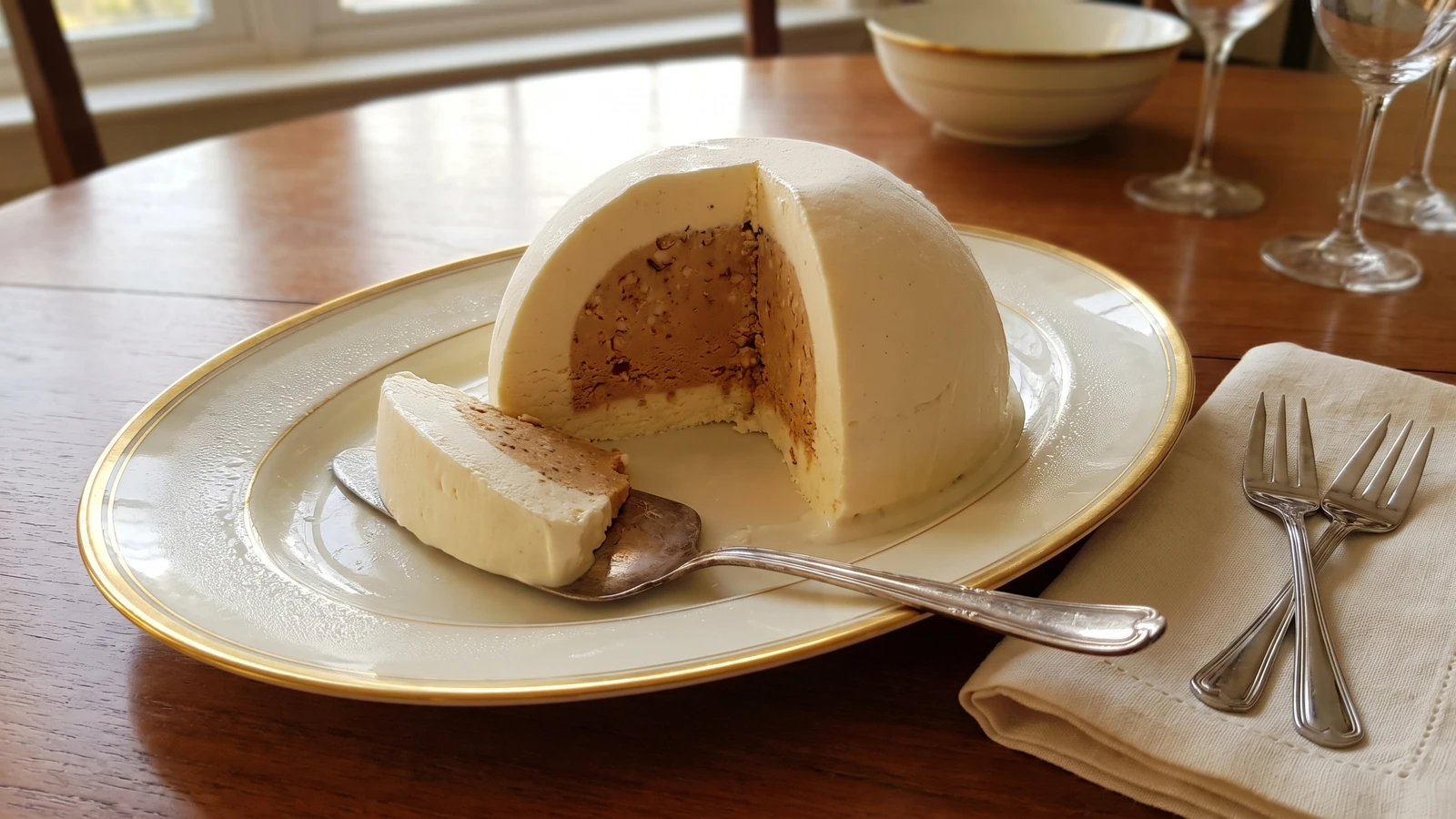
Based on No. 2890, Bombe Odette, from Le Guide Culinaire (1907) by Auguste Escoffier
A vanilla ice cream dome hiding a deep-Pralin pâte à bombe: the moulding lesson that turns two frozen textures into one clean slice, with caramel dark enough to speak through the cold.
Bombe Odette (a vanilla ice cream shell with a praline yolk-and-cream centre) teaches one true thing before you touch the pan: cold mutes flavour. The Pralin, nuts enclosed in caramel and ground fine, must begin with caramel taken to a decisive deep amber. Pale caramel tastes only of sugar once frozen, however handsome it looked in the saucepan.
The original gives a brigade its orders in a sentence: clothe the mould with vanilla ice cream, then fill it with pralined bombe preparation. It assumed a pastry cook, ice cream already made, a freezing cabinet always ready, and a mould rocked over broken ice as patiently as an aspic. Your honest equivalent is good full-fat vanilla ice cream, a 1.25 litre metal mould or deep bowl, and an ordinary freezer. The broken-ice operation is brigade scaffolding and can go; the even vanilla shell and freshly made pâte à bombe, yolks expanded with hot sugar syrup and lightened with cream, are the dish and must stay. One cook, one stove, one evening.
Take the caramel to deep amber before the nuts enter, then work quickly. If it smells scorched, don't bargain with it; begin again. That colour is the one step that decides whether Bombe Odette tastes richly pralined or merely sweet.
Bombe glacée, a moulded frozen dessert, belongs to the Parisian grand-kitchen repertoire, where rounded metal moulds held contrasting ice creams, parfaits, and rich bombe preparations. Bombe Odette is a named formula within that family: vanilla ice cream outside and pralined bombe preparation within, rather than a regional household sweet. Its reference to Another Method of Preparing Aspics de Filets de Soles (No. 916) does not put fish anywhere near dessert; it borrows the shared classical action of clothing a mould with a thin, even lining before adding the centre.
Quantity
3 cups (710 ml / 640 g) (No. 916)
softened until spreadable
Quantity
1/4 cup (60 ml / 35 g)
Quantity
1/4 cup (60 ml / 35 g)
toasted and skinned
Quantity
1/3 cup (80 ml / 67 g)
Quantity
4
Quantity
1/2 cup (120 ml / 100 g)
Quantity
2 tablespoons (30 ml / 30 g)
Quantity
1 cup (240 ml / 240 g)
| Ingredient | Quantity |
|---|---|
| full-fat vanilla ice cream, for clothing the mould by Another Method of Preparing Aspics de Filets de Solessoftened until spreadable | 3 cups (710 ml / 640 g) (No. 916) |
| blanched almonds | 1/4 cup (60 ml / 35 g) |
| hazelnutstoasted and skinned | 1/4 cup (60 ml / 35 g) |
| granulated sugar, for the Pralin | 1/3 cup (80 ml / 67 g) |
| large egg yolks | 4 |
| granulated sugar, for the pâte à bombe | 1/2 cup (120 ml / 100 g) |
| water | 2 tablespoons (30 ml / 30 g) |
| cold heavy cream | 1 cup (240 ml / 240 g) |
Set a 1.25 litre metal bombe mould or deep stainless-steel bowl in the freezer for 30 minutes. Move the vanilla ice cream to the refrigerator until it yields to a spoon but retains its body, usually 15 to 20 minutes. It should spread like cold butter, not pour. Reserve about 3/4 cup for sealing the base later.
Warm the almonds and hazelnuts briefly in a dry pan, then keep them nearby. Put the Pralin sugar in a small, pale-lined saucepan over medium heat. Let it melt around the edges, drawing the liquid sugar gently through the dry patches with a heatproof spatula only as needed. When every crystal has melted and the caramel reaches a deep amber, a shade beyond copper, add the warm nuts and turn them quickly to coat. If the sugar crystallizes before taking colour, add 1 tablespoon of water and dissolve it again over low heat; ça se rattrape. If the caramel turns black or smells acrid, it cannot be rescued. Begin again before adding the nuts.
Immediately scrape the caramel-coated nuts onto baking parchment or a silicone mat and spread them into one layer. Leave them until completely cold and hard, about 20 minutes. Break the slab into small pieces and process until it becomes a very fine sandy powder, stopping before the released nut oil turns it into a loose paste. Scrape down the processor several times; coarse shards will feel unpleasant in the frozen centre.
Clothe the chilled mould according to the principle in Another Method of Preparing Aspics de Filets de Soles (No. 916), using the freezer in place of broken ice. Press one-third of the softened vanilla ice cream over the bottom and sides, rotate the mould, and smooth it into an even layer. Freeze for 10 minutes, then repeat until the shell is about 1.5 cm thick with no metal showing. If the ice cream turns glossy and slides toward the bottom, stop and chill both mould and ice cream for 5 minutes. Ça se rattrape: scrape the heavy patch level, then fill any bare spots once everything is firm.
Put the yolks in a mixer bowl and beat at medium speed until pale and slightly thickened. Meanwhile, boil the pâte à bombe sugar and water without stirring until the syrup reaches 118°C. With the mixer running on low, pour the syrup in a narrow stream down the inside of the bowl, avoiding the whisk. Raise the speed and beat until the mixture triples in volume, falls from the whisk in a thick ribbon, and the bowl no longer feels warm, about 7 minutes. If syrup hardens against the bowl, leave those threads where they are rather than scraping them into the mixture. If the base remains warm, whisk it over a bowl of ice until cool; warm pâte à bombe collapses the cream.
Whip the cold cream to soft peaks, stopping while the tips still bend. Fold the ground Pralin into the cool pâte à bombe, then fold in one-third of the cream to loosen it. Add the remaining cream in two portions with broad turns of the spatula, reaching to the bottom of the bowl. The finished pralined bombe preparation should be light but distinctly nutty, with enough body to mound softly. If it loosens because the base was still warm, set the bowl over ice and fold gently for a minute. Do not beat it harder, which only drives out the air.
Scrape the pralined bombe preparation into the vanilla-lined mould, pressing it gently into the curve so no hollow pockets remain. Stop about 1 cm below the rim and freeze for 30 minutes. Spread the reserved vanilla ice cream over the centre to seal the base completely, level it with the rim, and press parchment directly against the surface. Wrap the mould and freeze for at least 6 hours, preferably until the following day.
Chill the serving platter. Remove the parchment, dip the mould only to its rim in warm water for 4 to 6 seconds, dry it, and invert it onto the platter. If the bombe doesn't release, wrap the mould briefly in a warm damp towel and try again; don't keep dipping until the vanilla shell melts. Return a sweating or softened bombe to the freezer for 10 minutes. Cut it with a long knife dipped in hot water and wiped dry between slices, revealing the pale vanilla shell and deeper praline centre. À table!
1 serving (about 150g)
Culinary guides, cultural storytelling, and the editorial depth that makes cooking meaningful.
Discover Culinary ExplorerChef Juliette
Five almond preparations, one discipline: remove the skins cleanly, dry every kernel through, then cut, toast, or cloak it in pale caramel without letting its fragrant oils escape.

Chef Juliette
A pastry pantry lesson in one tray: filberts warmed only until their red skins release, rubbed clean, cooled, and chopped into a fragrant mise-en-place for cakes, creams, pralines, and petits fours.

Chef Juliette
The smallest pâtisserie discipline decides whether a cake leaves its mould intact: clarified butter in every corner, followed by the lightest veil of dry flour or fécule.
Chef Juliette
Four whites, one spotless bowl, and a patient change of speed: whisk gently until loosened, then briskly to glossy stiffness, with powdered sugar waiting if the foam begins to granulate.