
Chef Juliette
Various Almond Preparations
Five almond preparations, one discipline: remove the skins cleanly, dry every kernel through, then cut, toast, or cloak it in pale caramel without letting its fragrant oils escape.
A cooking platform built around craft, culture, and the stories behind what we eat.
Created by Chef Juliette
Based on No. 2867, Bombe Joséphine, from Le Guide Culinaire (1907) by Auguste Escoffier
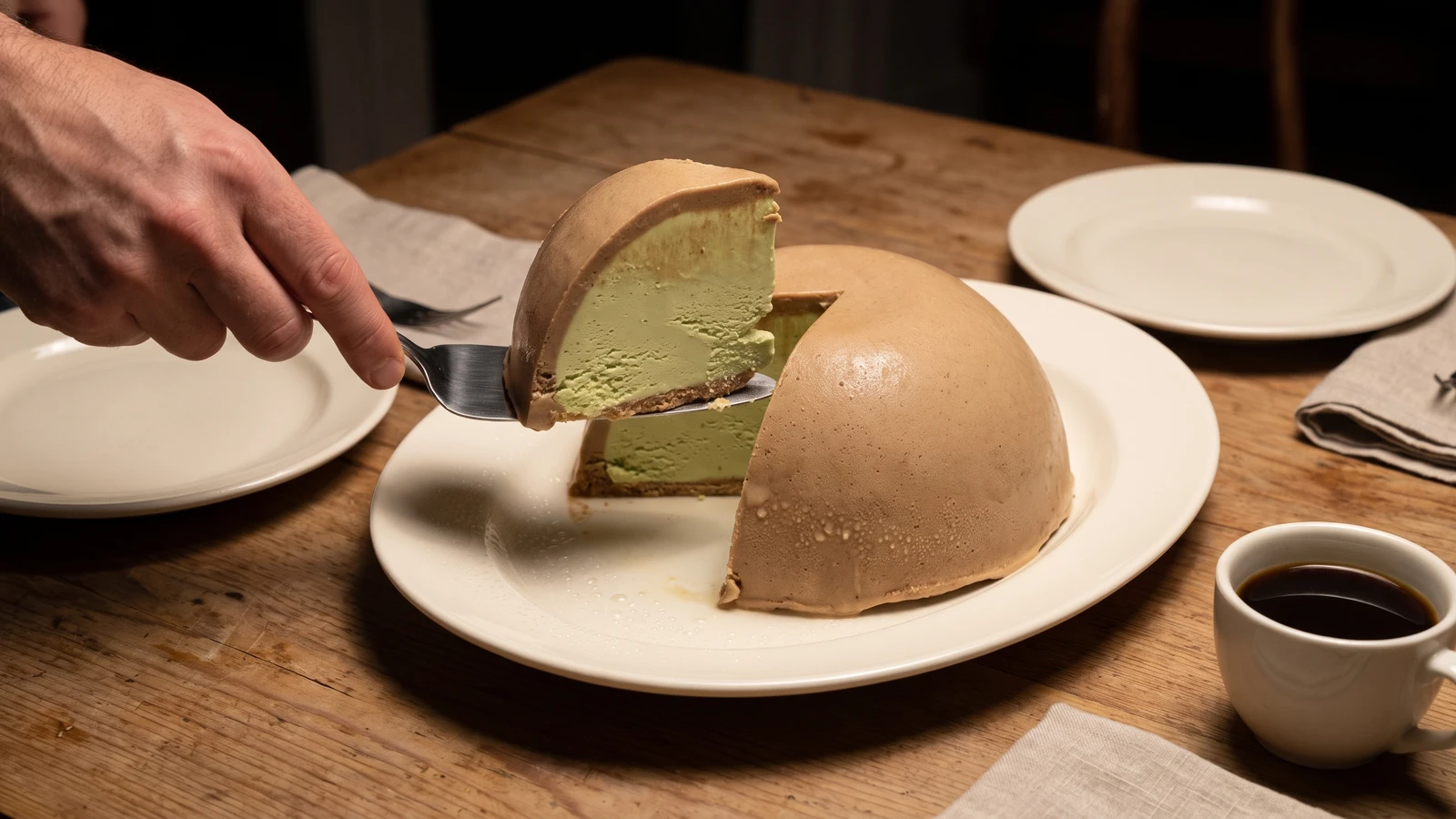
Coffee ice forms a bittersweet shell around pale-green pistachio pâte à bombe, a frozen lesson in contrast whose success depends on skinning the nuts and clothing the mould evenly.
Bombe Joséphine (coffee ice enclosing a pistachio pâte à bombe, a hot-syrup yolk emulsion) teaches that cold is structure, not merely temperature. The shell must be firm before the filling arrives, the pâte à bombe must be cool before the cream is folded through, and every pistachio must lose its skin before it is pounded. Leave those papery skins on and a fresh green centre turns tired brown, with a faint bitterness no amount of sugar can flatter.
The original instruction assumed a pastry section with coffee ice and pistachio Bombe-preparation already waiting, deep metal moulds packed in freezing ice, and enough hands to manage both mixtures at once. The honest home equivalent is a 1.5-litre metal bowl, an ordinary freezer, and a dense prepared coffee ice cream for the outer layer. Making that coffee base again would be brigade scaffolding; making the pistachio pâte à bombe is the dish, so that stays. The quantities now fill one modest bombe for eight, managed by one cook with an electric mixer and a sugar thermometer.
Turned out, it should be a smooth coffee-brown dome that cuts cleanly to reveal a pale-green centre, dense at first touch and then melting into cream, roasted coffee, and pistachio. Begin with the step that decides both its colour and its flavour: blanch and skin every pistachio before you grind it.
The bombe glacée belongs to the classical pastry repertoire of Paris, where rounded metal moulds gave these layered frozen desserts the name and profile of an artillery shell. From pastry workrooms they traveled to formal dining tables because the whole dessert could be assembled before service, then revealed intact with considerable ceremony and very little last-minute work. Joséphine is one of the repertoire's dedicatory titles, but the enduring identity lies in its precise pairing of coffee ice outside and pistachio Bombe-preparation within, not in a proven biographical story.
Quantity
3 cups (710 ml / about 650 g)
kept very cold
Quantity
1¼ cups (300 ml / 150 g)
Quantity
⅔ cup (160 ml / 135 g)
divided
Quantity
3 tablespoons (45 ml / 45 g)
Quantity
5 (about 90 g)
Quantity
1¼ cups (300 ml / 300 g)
divided
Quantity
⅛ teaspoon (0.6 ml / 0.7 g)
Quantity
1 technique reference (No. 916)
consulted only for clothing the mould; no savoury ingredient is used
| Ingredient | Quantity |
|---|---|
| dense coffee ice (glace au café)kept very cold | 3 cups (710 ml / about 650 g) |
| raw unsalted shelled pistachios | 1¼ cups (300 ml / 150 g) |
| granulated sugardivided | ⅔ cup (160 ml / 135 g) |
| water | 3 tablespoons (45 ml / 45 g) |
| pasteurized large egg yolks | 5 (about 90 g) |
| cold heavy creamdivided | 1¼ cups (300 ml / 300 g) |
| fine salt | ⅛ teaspoon (0.6 ml / 0.7 g) |
| Another Method of Preparing Aspics de Filets de Solesconsulted only for clothing the mould; no savoury ingredient is used | 1 technique reference (No. 916) |
Put a 1.5-litre metal bombe mould or stainless-steel bowl in the freezer. Drop the pistachios into boiling water for 60 seconds, drain them, and cool them under cold water. Rub away every loosened skin between clean towels or your fingertips. If stubborn skins remain, blanch those nuts for another 30 seconds. Ça se rattrape. Spread the skinned pistachios on a tray and dry them in a 120°C (250°F) oven for 12 to 15 minutes without letting them colour, then cool completely.
Soften the coffee ice in the refrigerator for 10 to 15 minutes, just until a spatula can bend it without finding liquid around the edges. Reserve ¾ cup (180 ml / about 165 g) for closing the bombe. The book borrows the term clothing the mould from Another Method of Preparing Aspics de Filets de Soles (No. 916): for this frozen application, press the remaining coffee ice firmly over the bottom and sides of the frozen mould in an even layer 1 to 1.5 cm thick. Smooth the hollow, inspect it for bare metal, and freeze for 45 to 60 minutes. If a thin patch appears once firm, press on more coffee ice and freeze it for another 15 minutes.
Set aside 2 tablespoons (30 ml / 25 g) of the measured sugar. Pound or process the cooled pistachios with that sugar and the salt, first to a fine meal and then to a damp paste, scraping the bowl frequently. Add 2 tablespoons (30 ml / 30 g) of the measured cream and continue until the paste is smooth and vividly green. If the machine warms the nuts and oil begins to separate, stop and chill the mixture for 10 minutes before continuing; forcing a hot paste only makes it greasier.
Whip the remaining 1⅛ cups (270 ml / 270 g) cold cream to soft peaks. It should mound gently and fold without leaving lumps, not stand stiffly around the whisk. Hold it in the refrigerator while you make the pâte à bombe.
Put the remaining ½ cup plus 1 tablespoon (130 ml / 110 g) sugar and the water in a small heavy saucepan. Heat gently until the sugar dissolves, then boil without stirring. When the syrup reaches about 110°C (230°F), begin beating the yolks at medium-high speed until thick and pale. At 118°C (244°F), pour the syrup into the moving yolks in a thin stream aimed between the whisk and the bowl. Keep beating until the mixture forms a heavy ribbon and the bowl feels barely warm, about 7 to 10 minutes. If the syrup crystallizes in the pan before pouring, add 1 tablespoon (15 ml / 15 g) water and dissolve it again over gentle heat. Ça se rattrape. If a little syrup hardens against the mixing bowl, leave it there rather than scraping the shard into the smooth pâte à bombe.
Stir one-third of the cooled pâte à bombe into the pistachio paste to loosen it, then fold that mixture through the remaining pâte à bombe. Fold in the whipped cream in three additions, turning the bowl and cutting through the centre until no white streaks remain. Spoon the pistachio Bombe-preparation into the frozen coffee shell, stopping about 1.5 cm below the rim, and smooth it without crushing out the air. Freeze for 30 minutes, until the surface has begun to firm.
Soften the reserved coffee ice just enough to spread, then seal it across the pistachio filling in a level layer flush with the rim. Cover the surface directly with baking parchment, wrap the mould well, and freeze for at least 6 hours, preferably overnight. The centre must be firm all the way through before unmoulding; impatience here gives a handsome shell and a collapsing middle.
Chill the serving platter. Remove the wrapping and press a cloth dipped in lukewarm water against the mould for 5 to 8 seconds, then invert it onto the platter. If the bombe resists, repeat for another few seconds rather than heating it aggressively. If an edge softens, return the unmoulded bombe to the freezer for 10 minutes. Cut it with a long knife dipped in hot water and wiped dry before every slice. Serve without ornament while the coffee shell is firm and the pistachio centre has just begun to soften. À table!
1 serving (about 170g)
Culinary guides, cultural storytelling, and the editorial depth that makes cooking meaningful.
Discover Culinary ExplorerChef Juliette
Five almond preparations, one discipline: remove the skins cleanly, dry every kernel through, then cut, toast, or cloak it in pale caramel without letting its fragrant oils escape.

Chef Juliette
A pastry pantry lesson in one tray: filberts warmed only until their red skins release, rubbed clean, cooled, and chopped into a fragrant mise-en-place for cakes, creams, pralines, and petits fours.

Chef Juliette
The smallest pâtisserie discipline decides whether a cake leaves its mould intact: clarified butter in every corner, followed by the lightest veil of dry flour or fécule.
Chef Juliette
Four whites, one spotless bowl, and a patient change of speed: whisk gently until loosened, then briskly to glossy stiffness, with powdered sugar waiting if the foam begins to granulate.