
Chef Juliette
Mayonnaise de Volaille
Cold roast chicken, ciseled lettuce, and a shining coat of homemade mayonnaise, arranged with capers, olives, anchovies, eggs, and lettuce hearts, then tossed at the table as the canon intends.
A cooking platform built around craft, culture, and the stories behind what we eat.

Created by Chef Juliette
Based on No. 2728, Melon à l’Orientale, from Le Guide Culinaire (1907) by Auguste Escoffier
Melon à l’Orientale turns one perfectly ripe melon into its own chilled serving bowl, layering fragrant pulp and wild strawberries with sugar and kirsch before a crisp gaufrette meets every spoonful.
Melon à l’Orientale (kirsch-macerated melon with wild strawberries) teaches macération, the cold steeping of fruit with sugar and alcohol, in its clearest form. The one true thing to know is that ripeness carries the entire dish: the melon must smell generous but remain firm enough to survive hollowing, filling, sealing, and service.
The classical entry asks for none of the brigade’s usual saucier, stockpot, or salamander. Its assumptions are quieter: wild strawberries close at hand, a silver spoon, a very cold larder, and a napkin-draped serving dish. A stainless-steel spoon, the refrigerator, and a clean folded napkin do the same work. For one small melon serving four, the unspecified copious sugar becomes 60 g, while one-sixth imperial pint of kirsch is written as 95 ml so the measure cannot be mistaken. The equipment is scaffolding. The intact shell, alternating fruit layers, kirsch, butter seal, and two-hour rest are the dish.
One cook, one stove, one evening, and for once the stove gets the night off. Cut the stalk lid on an inward angle and scoop with patience, because keeping the melon shell intact is the step that decides whether this arrives as intended.
Melon à l’Orientale belongs to the formal French dessert and fruit-service table, not to a particular province. Orientale here is one of the classical repertoire’s loose fantasy names rather than a claim of Middle Eastern origin; the method itself is French service, with fruit macerated in sugar and kirsch, returned to its shell, and sent to the table with gaufrettes. The intact melon moved naturally from elaborate dining rooms to summer dinner tables because its vessel, perfume, and presentation are all built into the fruit.
Quantity
1, about 3 lb (1.35 kg)
Quantity
1½ cups (360 ml / 225 g)
gently hulled
Quantity
½ cup (120 ml / 60 g)
divided
Quantity
⅙ imperial pint (6 tablespoons plus 1 teaspoon / 95 ml / 90 g)
Quantity
1 teaspoon (5 ml / 5 g)
softened
Quantity
8
special wafers, for serving
| Ingredient | Quantity |
|---|---|
| just-ripe small round melon, such as Charentais or cantaloupe | 1, about 3 lb (1.35 kg) |
| wild strawberriesgently hulled | 1½ cups (360 ml / 225 g) |
| icing sugardivided | ½ cup (120 ml / 60 g) |
| kirsch | ⅙ imperial pint (6 tablespoons plus 1 teaspoon / 95 ml / 90 g) |
| unsalted buttersoftened | 1 teaspoon (5 ml / 5 g) |
| gaufrettesspecial wafers, for serving | 8 |
Choose a melon that smells deeply fragrant at the stalk end but still feels firm beneath your thumb. It must be ripe enough to perfume the kirsch and sound enough to remain its own serving bowl. Wash the rind, dry it completely, and set the melon upright to find its most stable position.
With a sharp paring knife, make a neat circular incision about 3 inches (7.5 cm) across around the stalk. Angle the blade slightly inward as you cut so the resulting lid cannot fall through the opening. Lift it carefully, keep it intact, and scrape away any seeds or fibres clinging underneath. Scoop the seeds and wet central fibres from the melon without enlarging the opening.
Withdraw the pulp with a sturdy stainless-steel grapefruit spoon or dessert spoon, working in sections and leaving a thin, even wall of flesh against the rind. Cut the pulp into roughly ½-inch (1.25 cm) dice. Do not scrape blindly at the bottom, where the rind is easiest to pierce. If a pinhole appears, plug it from inside with a rice-grain dab of the softened butter, chill the patch for 10 minutes, and set the melon in a snug bowl before filling. Ça se rattrape.
Sprinkle about 2 tablespoons (30 ml / 15 g) of the icing sugar copiously over the hollowed interior. Refill the melon with alternating layers of diced pulp and wild strawberries, dusting each layer lightly with some of the remaining sugar. Handle the berries with your fingertips and never press down; the layers keep the tiny fruit whole while the sugar begins the macération.
Pour the kirsch slowly down the inner wall, turning the melon between additions so the liquor reaches every layer. If the fruit stands above the cut line, remove a spoonful rather than forcing the lid onto it. Replace the stalk lid in its original position, wipe the seam completely dry, and pipe or press a thin continuous thread of softened butter around the joint. The butter is an edible cold seal, not a sauce. If it slips from a damp rind, wipe the seam again, chill the melon for 10 minutes, and reseal it.
Keep the melon upright in the refrigerator for exactly 2 hours. This rest is the dish: the sugar draws out the fruit juices while the kirsch carries the perfume through every layer. Set the sealed melon on a clean folded napkin in a shallow serving dish. At the table, cut through the firm butter thread, lift the stalk lid, and spoon the fruit with its collected liquor into four cold bowls. Serve two crisp gaufrettes beside each portion. À table!
1 serving (about 280g)
Culinary guides, cultural storytelling, and the editorial depth that makes cooking meaningful.
Discover Culinary ExplorerChef Juliette
Cold roast chicken, ciseled lettuce, and a shining coat of homemade mayonnaise, arranged with capers, olives, anchovies, eggs, and lettuce hearts, then tossed at the table as the canon intends.

Chef Juliette
Cold roast or poached chicken with fine ribbons of lettuce, dressed at the final moment with oil and vinegar: a composed salad whose freshness depends entirely on timing.
Chef Juliette
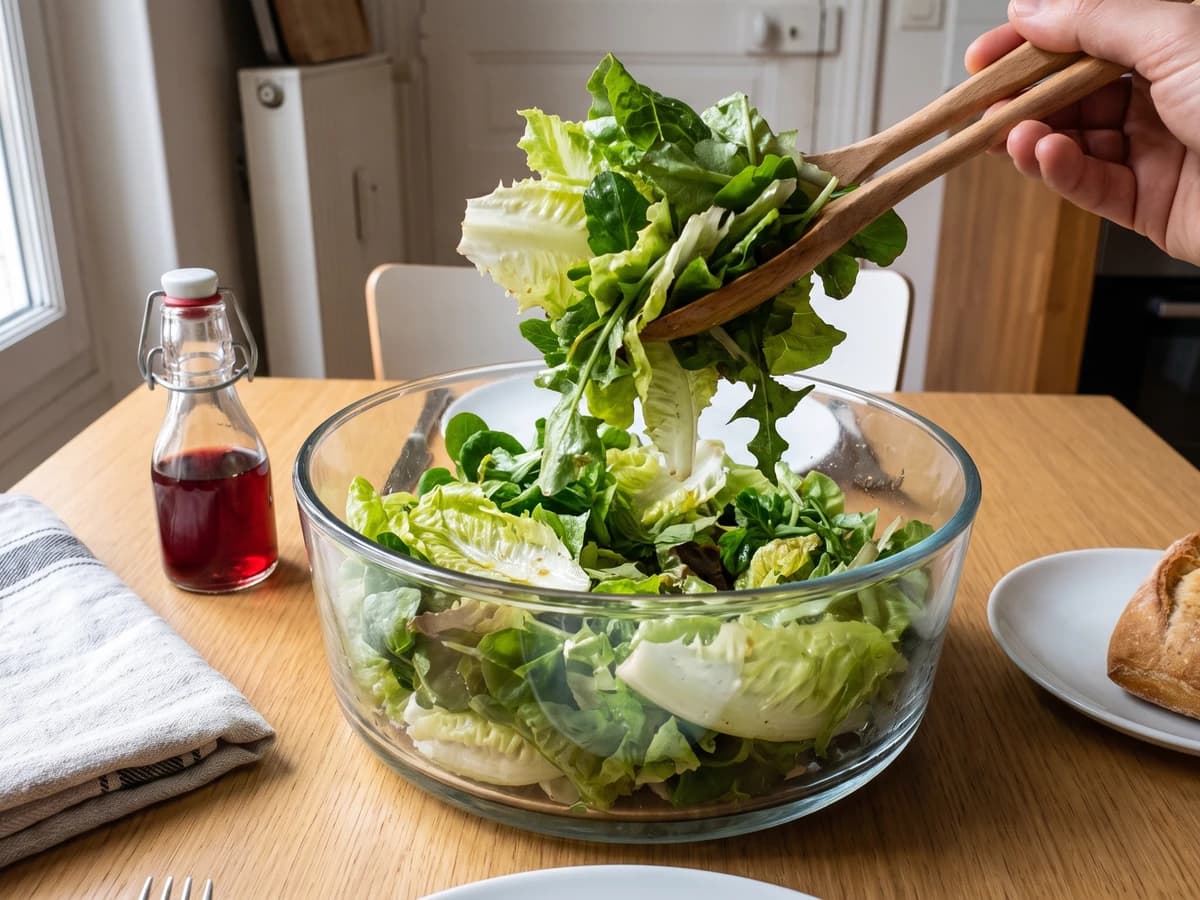
Five leaves, one living rule: laitue, romaine, chicorée, mâche, or pissenlit must be washed, dried, and dressed only as they go to the table, while every leaf still carries its light vinaigrette.
Chef Juliette
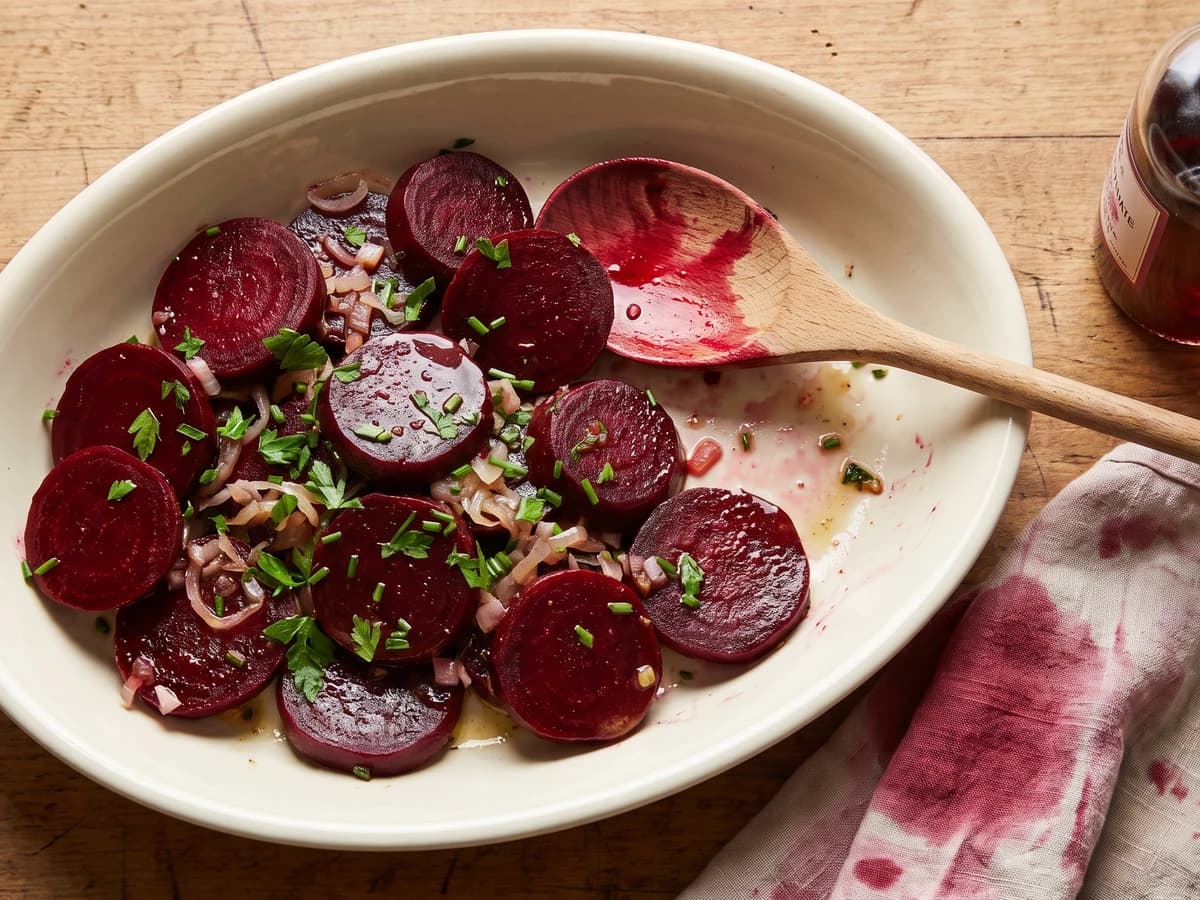
Salade de Betteraves proves that baking, not boiling, is the whole argument: concentrated garnet sweetness, tender baked onion, sharp mustard, and herbs cut into a weeknight salad worth making ahead.