
Chef Juliette
Mayonnaise de Volaille
Cold roast chicken, ciseled lettuce, and a shining coat of homemade mayonnaise, arranged with capers, olives, anchovies, eggs, and lettuce hearts, then tossed at the table as the canon intends.
A cooking platform built around craft, culture, and the stories behind what we eat.

Created by Chef Juliette
Based on No. 2702, Pêches au Chateau-Laffite, from Le Guide Culinaire (1907) by Auguste Escoffier
Pêches au Château-Laffite proves that reduction is not mere boiling: tender peach halves, wine-dark claret syrup, and raspberry-scented currant jelly, all served cold so the fruit stays lucid and the sauce gleams.
Pêches au Château-Laffite (peach halves poached in claret) teaches the discipline of reduction. Boiling away volume is easy; stopping with the wine concentrated, the sweetness balanced, and the syrup still supple is the cook's work. The one true thing to know before touching the pan is this: the reduced syrup must be quite cold before it meets the peaches. Warm syrup keeps cooking their tender flesh, while cold syrup clings in a garnet gloss.
The source assumed a cellar ready to spend Château-Laffite by the bottle, a saucier free to reduce the poaching wine, and a silver timbale for service. For four people, the professional quantity becomes four peaches, eight generous halves, in one snug nonreactive pan. One bottle remains because that is what covers the fruit without dilution. A sound dry Médoc claret supplies the intended tannin and dark fruit, while a chilled glass compote bowl replaces the silver. The separate saucier and formal vessel are brigade scaffolding, so they can go. The ten ounces of sugar per bottle, cooling the fruit in its poaching liquor, reducing that liquor by three-quarters, and finishing it with raspberry-flavoured red-currant jelly are the dish, so they stay.
The finished peaches should hold their shape beneath a translucent wine-dark syrup, tender enough for a spoon but never collapsing into compote. Measure the poaching liquid before reducing it, stop when precisely one-quarter remains, and cool that syrup completely before spooning it over the fruit. That is the step that decides Pêches au Château-Laffite.
Pêches au Château-Laffite belongs to the named-wine desserts of formal Parisian dining rooms, while the claret in its title points south-west to Pauillac in the Médoc, one of Bordeaux's great wine communes. It is not a Bordelais household fruit salad; its home was a well-stocked classical pantry where fresh fruit, preserved jelly, cellar wine, and silver serving pieces met at dessert. Once separated from the silver timbale, the method travels readily to the home table because scalding, poaching, and reduction have always belonged to an attentive domestic cook.
Quantity
4 medium (about 1½ pounds / 700 g total)
Quantity
1 bottle (3⅛ cups / 750 ml / about 745 g)
Quantity
1 cup plus 7 tablespoons (345 ml / 285 g; 10 ounces by weight)
Quantity
2 tablespoons (30 ml / 40 g)
or combine 1½ tablespoons red-currant jelly (22 ml / 30 g) with 1 teaspoon seedless raspberry preserve (5 ml / 7 g)
| Ingredient | Quantity |
|---|---|
| ripe but firm peaches | 4 medium (about 1½ pounds / 700 g total) |
| Château-Laffite wine or sound dry Médoc claret | 1 bottle (3⅛ cups / 750 ml / about 745 g) |
| granulated sugar | 1 cup plus 7 tablespoons (345 ml / 285 g; 10 ounces by weight) |
| raspberry-flavoured red-currant jellyor combine 1½ tablespoons red-currant jelly (22 ml / 30 g) with 1 teaspoon seedless raspberry preserve (5 ml / 7 g) | 2 tablespoons (30 ml / 40 g) |
Bring a saucepan of water to a full boil and prepare a bowl of very cold water. Cut a shallow cross through the skin at the base of each peach, lower the peaches into the boiling water, and scald them for 20 to 40 seconds. Transfer them immediately to the cold water. Peel from the crossed end, then cut each peach in half along its seam and remove the stone. If the skin clings, return that peach to the boiling water for another 15 seconds rather than tearing at the flesh. Ça se rattrape.
Pour the claret into a snug 2-quart nonreactive saucepan and add all the sugar. Warm it over medium heat, stirring gently, until the sugar dissolves and the wine looks clear rather than grainy. Bring it only to a bare simmer. The quantity of sugar will look bold. It is exactly the source ratio of ten ounces for one bottle, and the finished dish depends on it.
Lower the peach halves into the sweetened wine. Keep the liquid at the faintest tremble for 4 to 8 minutes, turning the halves once if needed, until a fine skewer enters with slight resistance. Lay a cartouche (a round of baking parchment) directly on the surface if the fruit bobs above the wine; this keeps it bathed without disturbing the wine-to-sugar ratio. Do not boil hard. If the edges begin to fray, remove the pan from the heat at once and set its base in cold water while leaving the peaches in their syrup. Their shape can still be saved.
Leave the peaches in their poaching syrup until both reach room temperature, about 45 minutes, then refrigerate them in the syrup for at least 1 hour. Cooling in the wine is not idle waiting: the fruit finishes tenderizing gently and takes on its garnet color. Once cold, lift the halves carefully with a slotted spoon and arrange them in a chilled glass compote bowl, loosely covered while you finish the syrup.
Strain the poaching liquid into a heatproof measuring jug and note its exact volume. Divide that figure by four; this is your finishing mark. Pour the liquid into a wide saucepan and boil it briskly but steadily until only one-quarter of the measured amount remains, checking in the jug as you approach the mark. The bubbles will become slower and glossier, but trust the measured volume rather than the apparent thickness because hot syrup always looks thinner than cold. If you overshoot without scorching it, add boiling water a tablespoon at a time until the syrup returns to the correct volume. Ça se rattrape.
Take the reduced wine off the heat and whisk in the raspberry-flavoured red-currant jelly until completely dissolved. If using the home equivalent, blend the red-currant jelly with the seedless raspberry preserve first, then whisk that mixture into the wine. Pass the syrup through the sieve again if any flecks remain. Once cold, it should be nappant (lightly coating), not firm like a jarred jelly.
Cool the syrup to room temperature, then refrigerate it for at least 1½ hours, until quite cold. If it sets too firmly to flow, whisk in chilled water one teaspoon at a time until it falls from the spoon in a slow ribbon. Spoon the cold garnet syrup over the cold peaches, coating each half and allowing a little to pool in the bowl. Serve directly from the compote. À table!
1 serving (about 320g)
Culinary guides, cultural storytelling, and the editorial depth that makes cooking meaningful.
Discover Culinary ExplorerChef Juliette
Cold roast chicken, ciseled lettuce, and a shining coat of homemade mayonnaise, arranged with capers, olives, anchovies, eggs, and lettuce hearts, then tossed at the table as the canon intends.

Chef Juliette
Cold roast or poached chicken with fine ribbons of lettuce, dressed at the final moment with oil and vinegar: a composed salad whose freshness depends entirely on timing.
Chef Juliette
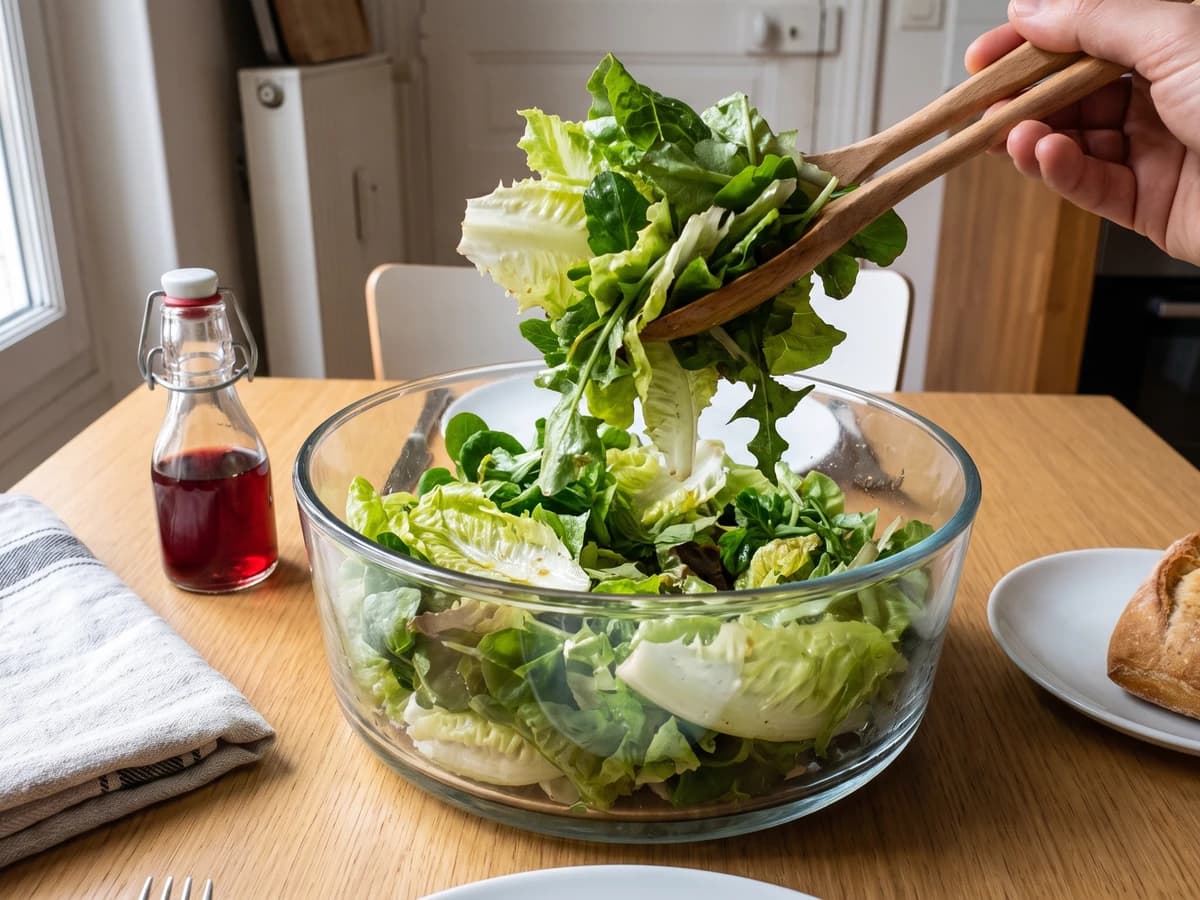
Five leaves, one living rule: laitue, romaine, chicorée, mâche, or pissenlit must be washed, dried, and dressed only as they go to the table, while every leaf still carries its light vinaigrette.
Chef Juliette
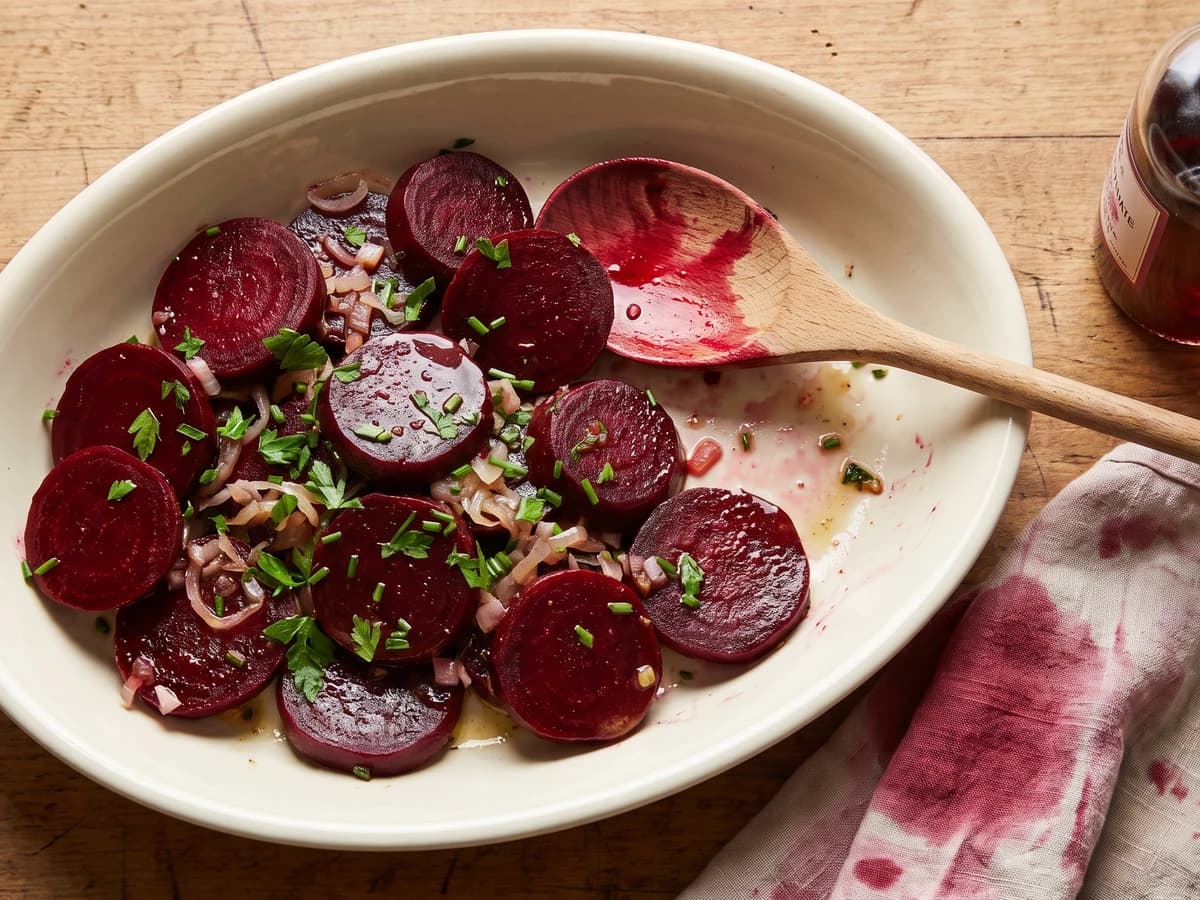
Salade de Betteraves proves that baking, not boiling, is the whole argument: concentrated garnet sweetness, tender baked onion, sharp mustard, and herbs cut into a weeknight salad worth making ahead.